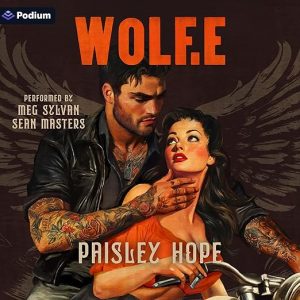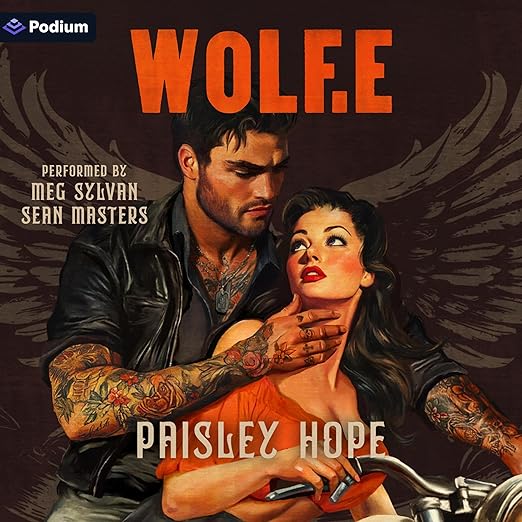
I finished Wolf.e on a weeknight that had gone longer than I'd planned, which turned out to be appropriate conditions - this is a book that prefers the hours when your defenses are slightly lower and you're willing to let something loud and propulsive take over. Paisley Hope's debut entry in The Soldiers of Bedlam series doesn't ask for your credence in its moral universe; it asks you to accept Gabriel Wolfe on its own terms and then makes a sustained case for why you should.
Gabriel Wolfe is the club president of the Hounds of Hell MC, a fallen dark angel with a backstory built from trauma and a psychology calibrated toward violence and control. The synopsis is unusually honest about this: he uses women, he craves chaos as a stabilizer, and the formula of his life is simple and brutal. What disrupts that formula is the arrival of Brinley - a woman reviewer Rose describes as a good girl returning to her hometown after the worst stretch of her life, who reconnects with a childhood friend tied to the club. The setup is conventional for the subgenre, and Hope deploys it with confidence rather than apology.
The Verdict, Briefly
The duet narration format, with Sean Masters handling the primary performance, is a choice that earns its keep here. Dark MC romance lives and dies on the credibility of the male protagonist's voice, and Masters gives Wolfe a physical weight - low, deliberate, with a controlled menace that sells the character's psychological profile. Reviewer Kaitlyn L noted the mouth on Wolfe specifically, flagging the dirty talk as a notable feature, and the narration supports that register without tipping into self-parody.
What distinguishes Hope's approach from more mechanical genre entries is the attention she pays to the club's internal dynamics. Reviewer Vee Bee made a point that stuck with me: the book works to show that motorcycle clubs aren't simply criminal enterprises but function as community structures that provide genuine services and belonging to their members. This is a familiar argument in MC romance, but Hope earns it through the found family element rather than just asserting it. Wolfe's care for the people who wear his cut is the most humanizing thing about him, and it's established before Brinley arrives rather than invented as a redemption shortcut.
Why Listen to Wolf.e
If you're coming to this from the MC dark romance genre specifically, the audiobook delivers the full genre experience in eleven-plus hours: a morally grey antihero with a violent past, a female protagonist with real backbone (reviewer Margaret Gibson appreciated that the FMC becomes genuinely strong by the end), forced proximity, intense spice, and the particular texture of found family that the best entries in this subgenre get right. The pacing is fast - reviewer Vee Bee read it in two days in print, and the audio equivalent moves at a similar clip.
For listeners outside the genre's established readership, the content is deliberately intense. There are descriptions involving blood that reviewer Gibson flagged as a bit much, and the moral universe of the club requires genuine suspension of judgment about legality and violence. Hope doesn't soften these elements, which is the right creative choice for this audience but an honest thing to name for anyone approaching without prior genre familiarity.
Points to Consider
The book's greatest strength is also its most visible seam: it operates almost entirely within genre conventions, and listeners who find those conventions tired won't find much here to change their minds. The fallen angel backstory adds a supernatural tinge that sits somewhat loosely against the otherwise grounded MC setting - it's more atmospheric than developed, a flavoring rather than a structural element. Whether that bothers you depends almost entirely on how invested you are in internal consistency versus emotional momentum.
The spice level is high and consistent throughout, which is either a feature or a limitation depending on your preference. Reviewer Margaret Gibson found it occasionally excessive; reviewer Kaitlyn L rated it four out of five flames. Plan accordingly.
The Right Listener for Wolf.e
Established fans of motorcycle club dark romance who want a debut that handles the subgenre's conventions with genuine craft will find this satisfying. The duet narration works, the antihero is credible, and the found family element has genuine warmth. Listeners who haven't read MC romance before and are curious about the subgenre should know what they're entering: this is not a gentle introduction, and Hope assumes you're already comfortable with the moral territory. Readers looking for redemption arcs that feel earned rather than tropey will want to calibrate expectations; the emotional journey is real but the conventions are fully present throughout.
Is Wolf.e the first book in The Soldiers of Bedlam series, and does it resolve its central story?
Yes, Wolf.e is listed as book one in The Soldiers of Bedlam series. Based on reviewer accounts, the central romantic arc between Gabriel Wolfe and Brinley resolves within this volume, though as the series opener it likely establishes threads for subsequent books.
What does the 'fallen dark angel' element mean for the story - is this a paranormal romance or primarily an MC romance?
Based on the synopsis and reviews, the fallen angel backstory appears to be primarily atmospheric - a way of framing Wolfe's darkness and his origin story rather than a literal supernatural plot mechanism. Reviewers describe it as MC romance with dark romance elements rather than paranormal fantasy.
How does Sean Masters handle the duet narration format - does he voice both perspectives or just Gabriel Wolfe?
The synopsis notes duet-style narration, which in the MC romance genre typically means a primary narrator handles both perspectives with distinct voices for each character. Masters' performance is praised for giving Wolfe physical credibility, which suggests he's effective in the dominant narrative voice.
Is the violence in Wolf.e primarily in the background of the MC setting, or is it graphic and central to the plot?
Reviewer Margaret Gibson flagged some content involving blood as a bit much, suggesting violence appears in a somewhat graphic form at points. It's not simply background texture - it's part of the world Hope builds and part of what defines Wolfe's character and environment. Listeners sensitive to graphic content should go in prepared.