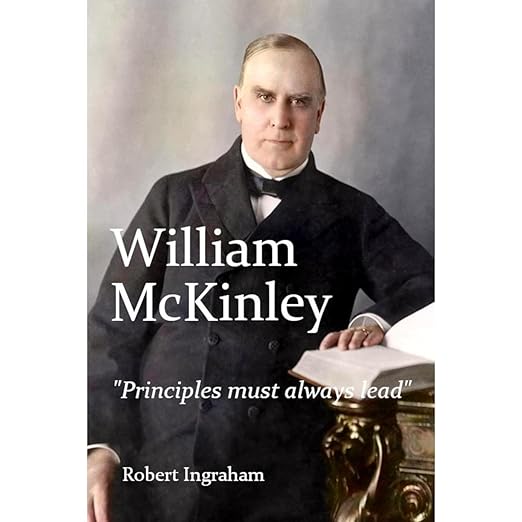
William McKinley tends to occupy a peculiar blind spot in American political memory, and Robert Ingraaham's audiobook on the twenty-fifth president is a sustained effort to correct that. The audiobook runs ten hours and seven minutes and is delivered via Virtual Voice narration, which is worth naming upfront since the synthetic quality will be a relevant factor for many listeners. McKinley appears in most survey histories as the avatar of high protective tariffs and the reluctant catalyst of the Spanish-American War, then exits the narrative when his assassin's bullet in 1901 hands the presidency to Theodore Roosevelt. This audiobook argues that reading is not only incomplete but actively distorted, and it makes that case with considerable conviction across its full length.
Ingraaham's central revisionist claim is worth stating plainly because it genuinely surprises: the McKinley he presents is anti-imperialist, anti-Wall Street, a champion of trade unions and working-class Americans, and one of the last defenders of Black voting and citizenship rights in the era following Reconstruction. This portrait stands in sharp contrast to the robber baron-adjacent figure that most college history courses present, and Ingraaham is explicit about why that distortion happened and has persisted. McKinley's assassination was, in his reading, a catastrophic turning point that removed from power the most formidable opponent of the forces of oligarchy and empire then operating in American politics. That is a substantial interpretive claim, and the audiobook works across its full length to substantiate it through specific policies, decisions, and the stated principles McKinley expressed throughout his career.
The structure moves through McKinley's career as a congressman, a governor of Ohio, and finally as president, examining not only what he did but why. That question, posed directly and returned to repeatedly, is the book's organizing principle. The examination of character as the animating force of policy is the work's most distinctive intellectual contribution. At a time when policy history tends to treat legislation as the primary object of study, Ingraaham insists that the principles of the American Revolution, as McKinley understood and applied them, shaped every major decision he made as a public servant. Whether or not you find that argument fully convincing, it is rigorously pursued and consistently applied across the ten hours of the audiobook.
Why It Works in Audio
One reviewer with a major in American History described the book as indispensable for understanding a period typically framed only through the lens of Robber Baron excess. That framing is instructive: Ingraaham is not writing for casual history readers but for people with some prior knowledge of the Gilded Age who want a counter-narrative that takes McKinley's actual record seriously. The McKinley presidency as the apex of the American System of Economics, the protectionist-industrialist framework associated with Henry Clay and Abraham Lincoln, is treated with enough historical depth that readers without some familiarity with that tradition may need supplementary reading to follow the argument in its full complexity.
The parallel to Lincoln is made explicitly and returned to several times as an interpretive lens rather than a hagiographic equation. Like Lincoln, Ingraaham argues, McKinley's legacy has been distorted through selective remembering: praising the tariff work while excising the commitments to labor and racial equality that he considers equally central to understanding the man. That parallel gives the book a coherent intellectual structure that carries the argument forward across what is a dense and sometimes demanding amount of political analysis, requiring active engagement rather than passive listening.
Before You Commit to William McKinley
Listeners should be aware that this is an argumentative work with a clear thesis rather than a neutral survey history. Ingraaham's sympathies are evident throughout, and his reading of McKinley's assassination as a politically motivated removal of a dangerous adversary to oligarchic power is presented with conviction rather than the tentativeness typical of mainstream academic history. Readers accustomed to carefully hedged historical scholarship may find the confidence of the interpretive framing at odds with the evidential base. The available listener count is small, which means the 5.0 rating reflects genuine enthusiasm from a self-selecting audience rather than broad critical consensus.
The Virtual Voice narration, while functional, lacks the tonal range that a skilled human narrator would bring to passages of political drama or moral argument. Listeners who want the emotional texture of great historical narration will find the synthetic delivery somewhat flat across ten hours of dense historical and political analysis. The text itself is strong enough that this limitation does not undermine the content, but it is worth noting for anyone who prioritizes narration quality as a significant factor in their listening experience and decision to purchase.
Who Will Get the Most From It
This audiobook will most reward readers already interested in Gilded Age American politics, the American System of Economics, or the historical treatment of labor rights and racial equality in the post-Reconstruction era. Listeners who enjoyed serious political biographies of Lincoln, Grant, or Cleveland will find this a useful companion work. Those approaching it as a casual introduction to the period may struggle with the density of argument and the assumed familiarity with the political frameworks Ingraaham deploys throughout. The book is a contribution to a specific historical debate, and its value is highest for those who know enough about that debate to engage with Ingraaham's revisionist argument on its own terms, push back where they see reason to, and appreciate the weight of what he is actually claiming about McKinley's historical importance.
Common Questions
Is the William McKinley audiobook suitable for listeners with only a general knowledge of American history?
It helps to have some familiarity with Gilded Age politics and the American System of Economics. Ingraaham writes argumentatively and assumes readers can follow references to Henry Clay, Lincoln, and Reconstruction without extensive background explanation.
How does this audiobook handle the Virtual Voice narration across ten hours of dense historical content?
The synthetic narration is clear and serviceable for factual and analytical content but lacks the vocal range to dramatize moments of political significance. It is workable rather than ideal for a book making strong moral and political arguments over a long runtime.
Is the William McKinley audiobook neutral in its political framing, or does it advocate a particular view?
It is openly argumentative. Ingraaham presents McKinley as a misunderstood champion of labor, racial equality, and anti-imperialism, and his assassination as a catastrophic political turning point. This is a revisionist rehabilitation, not a balanced survey history.