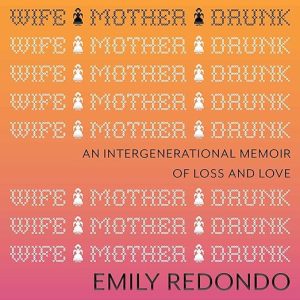
Wife Mother Drunk is one of the rare addiction memoirs that refuses to flatten its subject into a recovery arc, and the choice to have Emily Redondo narrate her own audiobook transforms an already unflinching account into something that operates differently than any produced narration could achieve. Her voice carries the weight of lived experience in a way that no outside narrator could simulate, and that directness is both the memoir's central strength and the thing that makes it hardest to hear.
A Nonlinear Memoir Traced Back Through Generations
Emily Redondo spent twenty institutional stays confronting her alcoholism before arriving at anything resembling stability, and Wife Mother Drunk does not condense that into a tidy journey. The book's structure honors the actual shape of addiction recovery: nonlinear, repeatedly interrupted by relapse, marked by progress that gets undone and then slowly rebuilt. Readers who come expecting a clean before-and-after narrative will not find one, and that refusal is one of the memoir's most honest choices.
What separates this account from many addiction memoirs is its generational scope. Redondo doesn't treat her alcoholism as a personal failure that emerged from nowhere; she traces it backward through her family line to pioneer-era ancestors who carried their own unprocessed traumas forward into their children, who carried them forward further. That genealogical investigation gives the memoir an unusual structural depth. Redondo is doing something closer to forensic family history than conventional confession.
A Breast Pump in Rehab, Neurological Damage After
The scene of Redondo entering rehab with a breast pump, her five-week-old at home, encapsulates the memoir's central tension: a woman whose love for her children is genuine and overwhelming, whose disease nevertheless kept pulling her away from them and toward destruction. She was arrested for a DUI with a four-year-old in the backseat. She stole alcohol from liquor stores. She drank from morning until night while maintaining the visual surface of suburban motherhood. Redondo holds all of this without letting any piece of it excuse the rest.
The memoir's engagement with the long-term neurological damage caused by chronic alcohol use adds a dimension that most recovery narratives omit. Redondo confronts not just the social and emotional consequences of her addiction but its physical imprint on her brain and body, an imprint that recovery doesn't fully erase. That honesty distinguishes this from accounts that end with sobriety as full restoration.
Redondo's Own Voice Carries the Real Cost
Self-narrated memoirs succeed or fail on the author's vocal honesty, and Redondo's performance here is exceptional. She reads without performing distance from her own material; you hear the cost of recounting these episodes, and that cost is information. When she describes her worst moments, her voice carries the specific weight of someone who has had to account for those moments in real consequences rather than just on the page. The twelve hours and forty-one minutes feel intimate in a way that actor-narrated memoirs rarely achieve.
The intergenerational structure also works particularly well in audio form. Redondo voices different periods of her family's history with enough tonal variation to keep them distinct while maintaining the connective tissue of her own perspective as the one assembling the story. The past and present feel genuinely braided rather than alternating, which is a harder effect to achieve in audio than on the page.
The memoir's final sections, dealing with ongoing recovery and the neurological realities of long-term alcohol damage, are among the most valuable for listeners who have personal or professional experience with addiction. Redondo writes about the awkward, unglamorous nature of a recovery that doesn't culminate in full restoration, and she writes about it without self-pity, which is a difficult tone to sustain and a remarkable thing to hear sustained.
Redondo's Voice Shifts From Patience to Earned Authority
This memoir contains detailed accounts of active alcoholism, including scenes that involve children and significant danger. Listeners who are in early recovery or who have experienced childhood parental addiction should prepare for content that may be activating. The material is handled with care, but it is not softened.
The generational historical sections require some patience from listeners oriented toward personal narrative. Redondo spends meaningful time in her ancestors' lives, building the case for inherited trauma, and those sections move differently than the immediate memoir material. They're worth the investment, but listeners should know the memoir's rhythm shifts between registers.
The ending is honest rather than triumphant. Recovery is ongoing, consequences are permanent, and Redondo communicates both of those facts clearly. Readers seeking a conventional redemption conclusion will find something more complex and, arguably, more true.
One of the most striking elements of the listening experience is how Redondo's voice changes across the timeline of her story. In the early sections covering her pioneer ancestry and her own childhood, she reads with a kind of archaeological patience, piecing together evidence. When the narrative moves into the hardest years of her active addiction, the arrest with her four-year-old in the car, the twenty treatment institutions, the long-term neurological damage she sustained, her voice carries something that performance alone cannot replicate: the sound of someone who has earned the right to tell this particular story. That authenticity is the central asset of this audiobook, and it makes the recovery sections genuinely affecting rather than formulaic.
For Families Who Need the Mechanism Explained
This audiobook reaches anyone whose family has been touched by alcoholism or intergenerational trauma, which is to say a very large audience. It's particularly valuable for listeners who have struggled to explain addiction's hold to people who haven't experienced it, because Redondo renders the mechanism of the disease with unusual clarity. Family members of people in recovery, people in recovery themselves, and clinicians who work in addiction medicine will all find material here that speaks directly to their experience.
Readers who want addiction memoirs that engage with the science of trauma transmission and neurological damage, rather than focusing solely on personal narrative, will find Redondo's approach uncommonly rigorous. The self-narrated format makes this one of the more powerful audio listening experiences in the genre. Come prepared to sit with discomfort, and come knowing it will be worth it.
A Few Questions About Wife Mother Drunk
Is Wife Mother Drunk audiobook narrated by the author?
Yes. Emily Redondo narrates her own memoir, and the self-narration is central to the audiobook's power. Her voice carries the lived cost of the story in ways that a performed narration could not reproduce.
Is this audiobook appropriate for people in recovery?
The memoir contains detailed accounts of active addiction that some listeners in early recovery may find activating. Individual listeners should assess their own readiness for the material before starting.
How long is the Wife Mother Drunk audiobook?
The runtime is twelve hours and forty-one minutes, making it a substantial commitment that rewards listeners who stay with its full arc rather than sampling.