Key Details
- Performance: Virtual Voice AI delivers the analytical prose adequately; the cold clinical register suits a book that deliberately refuses comfort, though a thoughtful human narrator would have added nuance.
- What it covers: Neurological conditioning in toxic attachment, intermittent reinforcement, the failure of cognitive clarity to override trained responses
- Feel: Cold and analytically precise, deliberately anti-comfort
- Our call: A genuinely unusual relationship audiobook that explains the neuroscience of staying in harmful relationships with clinical rigor, most useful for readers seeking diagnosis over recovery guidance.
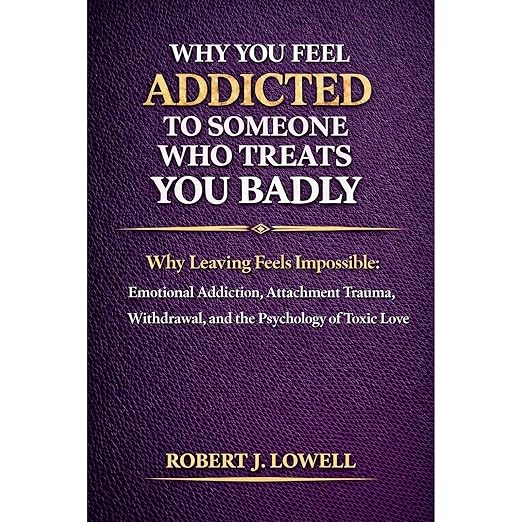
Robert J. Lowell's book makes a claim in its opening pages that most relationship self-help refuses to state plainly: staying in a harmful relationship is not a character failure. The mechanism keeping people in those relationships is neurological rather than moral. The nervous system, conditioned through intermittent affection and emotional unpredictability, develops something that functions not like love but like chemical dependence. Why You Feel Addicted to Someone Who Treats You Badly is a two-hour-and-forty-eight-minute audiobook, narrated via Virtual Voice AI narration, that examines this mechanism with clinical precision rather than therapeutic reassurance.
Understanding the Trap Doesn't Make It Stop
The book's stated purpose is unusual and worth taking seriously: it does not attempt to comfort the reader. It does not offer a recovery workbook. It does not provide red-flag checklists. What it offers instead is a dissection of the internal mechanics through which emotional dependency forms, sustains itself, and resists the rational will to end. That framing, explicitly anti-comfort and anti-motivational, is either the book's greatest strength or its most significant limitation, depending on what the listener is looking for.
Lowell covers specific psychological and behavioral conditioning mechanisms: intermittent reinforcement and its role in creating craving rather than attachment; the way emotional unpredictability imprints more deeply than stability in human learning systems; the parallel between attachment trauma and addiction pathways in the brain's reward circuitry; the withdrawal-like symptoms that follow separation from even genuinely harmful partners; and the counterintuitive finding that increased understanding of the dynamic, more cognitive clarity, often strengthens rather than weakens the bond in its early stages.
That last point is the most provocative and the most useful. Lowell argues that comprehension is not sufficient for liberation because the system doing the trapping is not a cognitive system. It is a conditioned nervous system responding to learned survival patterns. Understanding the trap intellectually changes nothing about the biological pull toward the person who represents the pattern. That insight explains a phenomenon that therapists describe regularly and that most relationship books conspicuously avoid: why clients who fully understand what is happening to them continue to return.
Virtual Voice Suits This Clinical, Cold Register
At under three hours, this is a compact and dense listen. The Virtual Voice narration delivers the content clearly, and for a book whose primary strength is its analytical precision rather than its emotional resonance, the absence of a narrator's interpretive personality is less damaging than it would be in a memoir or narrative nonfiction title. Lowell's prose has its own particular energy, direct and almost cold in its clinical register, and the AI narration does not resist that quality or impose warmth that would undercut the book's deliberate refusal to comfort.
The psychological research framework, referencing behavioral conditioning, attachment theory, and neuroscience of reward systems, provides intellectual scaffolding for experiences that many listeners will have found impossible to explain. The shame that accompanies returning to a harmful relationship, the panic at permanent separation, the experience of craving rather than missing, these are named and explained with a precision that is itself a form of relief even within a book that refuses to offer comfort in the conventional sense. Being seen clearly is different from being reassured.
The chapter structure moves from mechanism to mechanism systematically. Memory distortion and its role in sustaining the bond, the way longing sabotages detachment, the particular failure mode of hope as a cognitive trap within these dynamics, each receives its own focused treatment. The accumulative effect is a complete picture of a system rather than a collection of observations about its parts.
Diagnostic by Design, Without a Recovery Plan
The book's deliberate refusal to offer recovery guidance is its most consistent formal choice and its most likely source of reader dissatisfaction. Lowell is explicit: this is not a recovery workbook. The final proposition, that seeing the system clearly causes it to lose power, is a form of therapeutic promise, but it is stated as a consequence rather than demonstrated through practical steps. Listeners in acute distress who need a concrete framework for what to do next will find this book diagnostic rather than prescriptive. That distinction matters enormously depending on where the listener is in their experience.
The runtime of under three hours means the book moves through complex psychological territory without the depth that a longer treatment might provide. The references to behavioral conditioning and neuroscience are persuasive as introductions to the relevant research areas but are not comprehensive. Listeners who find the framework compelling may want to pursue the underlying literature, particularly on intermittent reinforcement and trauma bonding, as follow-on reading.
Analytical Clarity Instead of a Recovery Roadmap
This audiobook serves listeners who have experienced the specific confusion of knowing a relationship is harmful and returning anyway, and who want a precise analytical account of why that happens rather than a motivational framework for stopping it. It is also useful for therapists, coaches, and others who work with clients in this situation and want a clear lay-science explanation they can point to or build from.
Those looking for a recovery roadmap, step-by-step guidance for detachment, or emotional support framing will find this book deliberately unhelpful in those terms. Its strength is diagnostic clarity. Its limitation is the same quality: a refusal to extend beyond naming the system into offering an exit map. Whether that refusal is a principled choice or a gap depends on what the listener most needs from the audiobook experience.
Common Questions
Is this audiobook useful as an active recovery tool, or is it more of an analytical explanation of the dynamic?
Lowell explicitly states this is not a recovery workbook. It is a diagnostic text focused on explaining the mechanisms of emotional dependency rather than prescribing steps for leaving it.
Does this audiobook address why people return to harmful relationships even after they have left?
Yes, and specifically. The chapter on why cognitive clarity and understanding often strengthen rather than weaken the bond in early stages is one of the book's most substantive insights.
At under three hours, does this audiobook cover the relevant psychology in enough depth to be genuinely useful?
The coverage is introductory rather than comprehensive. The framework is persuasive and clearly explained, but readers who want depth on the underlying behavioral conditioning and neuroscience will need to follow up with the primary research literature.
Is this audiobook appropriate for someone currently in a harmful relationship, or is it better suited for retrospective understanding?
It works for both situations but functions differently in each. For someone currently in the dynamic, it provides the kind of analytical clarity the author suggests can diminish the system's power. For retrospective understanding, it offers precise language for experiences that often resist articulation.