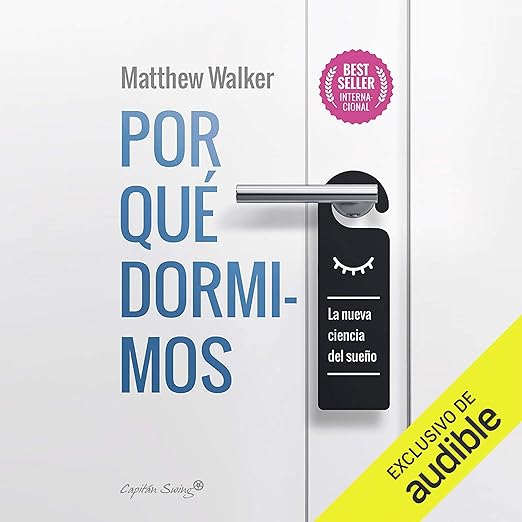
Spend a credit here and you get an audiobook entirely in Spanish, from the synopsis down to every review beneath it, a detail worth confirming before checkout rather than after. The synopsis credits Matthew Walker as a leading sleep neuroscientist and promises a deep dive into why sleep matters and what happens when we do not get enough of it, and the narrator here is Gerardo Quiroz, with a product note confirming that the audio itself is in Spanish and that a companion PDF ships alongside the purchase in your library. This is categorized under both health-wellness and science-engineering, a dual classification that fits a book straddling hard neuroscience and everyday wellness advice.
First, the Big Picture
Sleep science is the entire subject here, and the Spanish synopsis lays out familiar territory for a book built around a single central argument: sleep as one of the most important and least understood parts of daily life, and the case that a full night of it can sharpen memory, stabilize emotion, support the immune system, and regulate metabolism and appetite. The listing describes dreaming as a kind of virtual reality space where the brain works through past and present knowledge together, and frames the book as a tour through years of clinical research and practice translated into practical guidance on learning, mood, energy, and hormone regulation. The synopsis also promises coverage of long-term outcomes: reducing the effects of aging and increasing longevity, alongside prevention angles tied to specific conditions the listing names directly. That is a lot of ground to cover in just over thirteen hours, and all five written accounts left under this listing, entirely in Spanish, suggest the material lands regardless of the language it arrives in, with every one of the five ratings coming in at four stars or higher. The synopsis frames Walker as offering a revolutionary look at sleep's effect on nearly every aspect of physical and mental well-being, which is an ambitious claim for any single audiobook to carry, though the reviews here do not push back on it at all. The listing also notes that Walker frames sleep as something that recalibrates emotion, reaffirms the immune system, and refines metabolism, three separate systems bundled into a single nightly process, which is the kind of scope that makes a book like this feel comprehensive rather than narrowly focused on one health outcome. The synopsis frames dreaming specifically as a kind of nightly rehearsal space, blending what the brain already knows with whatever it has taken in that day, a framing that pushes the book beyond simple sleep hygiene tips into something closer to cognitive science for a general audience.
Why Listen to Why We Sleep
Mauricio Chacon's review calls the book "un grato descubrimiento," a welcome discovery, describing being pulled in from start to finish by information found immediately applicable to daily life, and recommending it broadly to other listeners. Juan A.'s review goes further, urging readers to get to know the subject better rather than treating sleep as an afterthought, and Juliana duran's short review simply calls the book excellent without elaborating further, a common pattern among the five write-ups here, most of which run only a sentence or two. What matters for this specific edition is the audience it serves: Spanish-speaking listeners who want Walker's research delivered directly in Spanish rather than through a second-language read of a dense science book packed with citations. A companion PDF is also noted as included with purchase, which matters for a book this heavy on study citations and figures, even in audio form, since following along with charts and references is easier with a document open beside the narration than trying to hold data points in memory. Length working against the material is not a complaint that shows up anywhere in the five write-ups, which is worth something for a thirteen-hour science title that could easily have felt padded in a less focused telling. Sandra Camacho Camacho and Maria C Arce Borrero both left their reviews within roughly six months of each other in 2025, alongside Mauricio Chacon's review from earlier that same year, so at least the timing of the written feedback clusters together even if the rating count itself does not match it.
A Few Reservations
Two of the five reviews here describe something closer to a package arriving than an audiobook downloading. Sandra Camacho Camacho's review is titled "Excelente tiempo de entrega," excellent delivery time, and Maria C Arce Borrero writes that it "llego rapido y en buen estado," arrived quickly and in good condition, adding that the book was purchased as a gift for a spouse. Both read like feedback meant for a printed book or a shipped item, not a digital audio file, and it is worth flagging rather than smoothing over: something about how this listing aggregates reviews appears to be pulling in commentary meant for a different format of the same title. The rating counter itself does not add up: it logs a single vote, while five different people took the time to write full reviews underneath that same lone number. A 4.7 average has no mathematical path back to one whole-star rating, whatever rounding rule you try, so the figure printed on the page should be treated as provisional rather than a reliable summary of how this edition actually landed with a wider audience. The price is also listed at zero dollars on this listing, which is worth double-checking at checkout since a book this substantial rarely stays free for long on any platform, and the discrepancy between a single logged rating and a zero listed price could easily be a separate data quirk on the same listing. Nothing in the five reviews addresses runtime pacing either, whether the science sections drag or the practical advice sections move too quickly, so that judgment is left entirely to individual listeners.
Should You Listen to Why We Sleep?
Spanish-speaking listeners are the intended audience first, and English speakers hoping to practice the language while absorbing nonfiction should know they are getting Walker's full argument, not a simplified version aimed at learners. English narration is simply not on offer here; nothing in the metadata suggests an English audio track exists on this particular listing, so English speakers should search for the original edition instead rather than assume this one will switch languages partway through. For its intended audience, the combination of accessible science, a companion PDF, and five consistently positive reviews makes it a reasonable pick for anyone already invested in sleep health content in Spanish and looking for a research-backed starting point rather than a lighter self-help treatment of the subject.
- Performance: Gerardo Quiroz reads the Spanish-language edition; no review comments on the performance specifically.
- What it covers: sleep science, memory and mood, long-term health
- Feel: informative and urgent, delivered entirely in Spanish
- Our call: a solid pick for Spanish-speaking listeners wanting Walker's research directly, not for English speakers expecting an English track.
Before You Listen
Who narrates the Why We Sleep audiobook in this edition?
Gerardo Quiroz narrates this Spanish-language edition. The five reviews attached to this listing focus entirely on the book's content and never circle back to discuss the reading itself, so Quiroz's credited voice carries the thirteen-hour, twenty-seven-minute runtime without any confirmed listener feedback on pacing or delivery.
Does the Why We Sleep audiobook include a companion PDF?
Yes, the listing notes that a companion PDF becomes available in your library alongside the audio once purchased. That matters for a book this dense with citations and research findings, since following study references is easier with a printed companion than through audio narration alone.