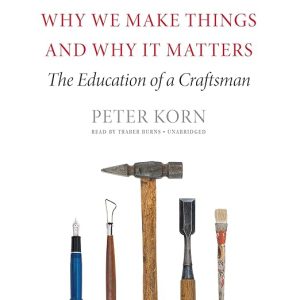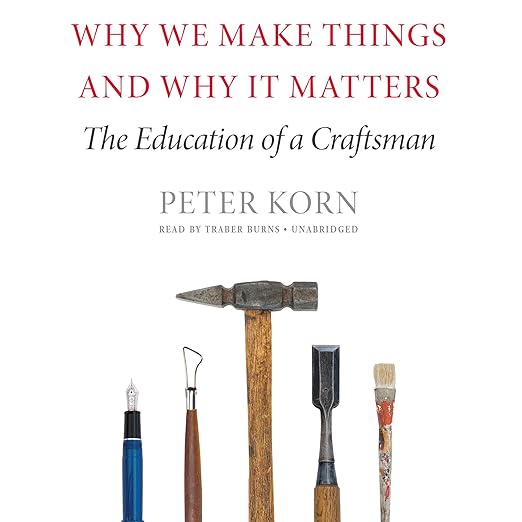
I have a friend who builds furniture, not as a hobby but as a vocation she chose deliberately after a decade in an office, and the conversation she always wants to have is not about joinery techniques or wood species but about what it means to spend a life making things with your hands when almost everything around her says that is a marginal choice. Peter Korn's Why We Make Things and Why It Matters is the book I kept wanting to hand her, and it is also, I realized while listening to it, a book I was reading for myself.
Korn is the founder of the Center for Furniture Craftsmanship in Maine, an internationally respected nonprofit institution, and before that he was a novice carpenter on Nantucket, then a designer and maker of fine furniture, then a teacher and administrator at Colorado's Anderson Ranch Arts Center. The arc of his life is the architecture of the book. But Why We Make Things is not really a career memoir. It is an inquiry into what Korn calls the why of craft: why making things with our hands generates meaning that other activities do not, what that says about human nature, and how the products of creative work inform the society they enter.
Nantucket Years, Where an Ivy Grad Found Carpentry
Korn is honest early on that the question he is asking is unlikely to yield a single, tidy response. The act of making, whether furniture or a poem or a meal, involves too many variables, too many different kinds of satisfaction and frustration, for any unified theory to cover them. What he offers instead is something more useful: a series of close observations from four decades of hands-on practice, organized around the places and relationships that shaped his understanding of what making actually is and what it does to the person who does it consistently.
The Nantucket years, where a young Ivy-educated Korn finds himself drawn to carpentry without knowing why, are the book's most vivid opening section. He writes about learning to work with his hands with the attention of someone who found in the craft something he had not been looking for and did not initially have language to describe. This is personal writing at its most honest, and reviewer Jackie Burton captures it well: brutally honest and painful at times, yet heartwarming and funny, neither a promotional piece for the craftsman's life nor a polemic against the society that undervalues it. The Nantucket section earns the philosophical ambition that follows it.
Bogged Down in Semantics by the Middle Section
The book's middle section is where it becomes most intellectually ambitious and, for some readers, most demanding. Korn draws on philosophy of mind, aesthetic theory, and the sociology of work to build a framework for understanding why making objects is such a fundamentally human act. He is not a philosopher by training, and one reviewer noted that the later sections get bogged down in semantics and a proliferation of near-synonymous terms. That is a fair observation; there are passages where the prose reaches for academic vocabulary in a way that slows the book's momentum and creates the slight sensation of watching a craftsman reach for the wrong tool.
Reviewer Shripad Lale described the initial two-thirds of the book as the stronger half precisely because it is rooted in personal experience, and that framing is useful. The early and middle sections, where Korn's argument grows from what he has actually lived, carry more force than the later passages where the theory becomes more self-standing. For listeners who are most interested in the philosophical argument, the imbalance may feel like a limitation. For those who are most interested in the memoir dimension, it will feel appropriate, and the book overall reads as a generous attempt to think seriously about questions that most people who make things never have the occasion to fully articulate.
Burns Narrates Without Turning Into Ambient Sound
At five hours and thirty-seven minutes, Why We Make Things is one of those audiobooks where the runtime matches the book's register: long enough to be substantive, short enough that the contemplative pace does not become fatigue. Traber Burns narrates with a warmth that is genuine rather than performed, and his delivery suits the introspective quality of Korn's writing without becoming so smooth that it starts to feel like ambient sound. The book is best listened to in two or three sessions rather than one; this is material that rewards a pause between sections to let the ideas accumulate.
The physical making Korn writes about is inherently tactile and visual, and there are moments in the audio where you feel the absence of the photographs or illustrations that might accompany a print edition. But this is a minor limitation; the book is primarily a work of thought and language rather than demonstration, and the prose carries the ideas without needing visual support. Listen if you are a craftsperson, artist, or maker of any kind who has wondered why the work feels meaningful in a way that is hard to explain. Skip if you are looking for practical instruction or a how-to approach to furniture making; Korn is explicitly not writing that book, and he says so clearly in the opening pages.
Listen if You Wonder Why the Work Matters
At five hours and thirty-seven minutes, Why We Make Things is one of those audiobooks where the runtime matches the book's register: long enough to be substantive, short enough that the contemplative pace does not become fatigue. Traber Burns narrates with a warmth that is genuine rather than performed, and his delivery suits the introspective quality of Korn's writing without becoming so smooth that it starts to feel like ambient sound. The book is best listened to in two or three sessions rather than one; this is material that rewards a pause between sections.
The physical making Korn writes about is inherently tactile and visual, and there are moments in the audio where you feel the absence of photographs that might accompany a print edition. But this is a minor limitation; the book is primarily a work of thought and language rather than demonstration, and the prose carries the ideas without needing visual support. Listen if you are a craftsperson, artist, or maker of any kind who has wondered why the work feels meaningful in a way that is hard to explain to people who do not share it. Skip if you are looking for practical instruction or a how-to approach to furniture making; Korn is explicitly not writing that book, and he says so clearly in the opening pages.