Quick Take
- Narration: Caitlin Davies delivers a clear, accessible read appropriate for the Who Was? series format, keeping younger listeners engaged without condescending to them.
- Themes: Artistic mastery, Renaissance Italy, the relationship between genius and perseverance
- Mood: Informative and warm, with enough personality to feel like more than a textbook
- Verdict: A brisk, well-organized introduction to Michelangelo for young listeners, though adults looking for depth will want something longer.
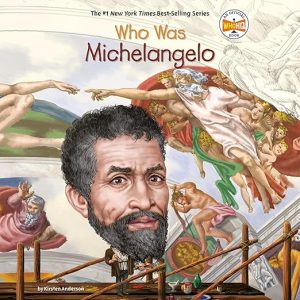
My niece, who is eight and already determined to become an illustrator, asked me for a book about Michelangelo after seeing a photograph of the Sistine Chapel ceiling in a magazine. I handed her this one. She listened to the fifty-nine-minute audiobook in a single sitting on a Saturday afternoon, then immediately went to find images on the family’s tablet so she could see what Davies had been describing. That is a pretty good outcome for a children’s biography.
The Who Was? series has carved out a reliable niche in middle-grade nonfiction, and Who Was Michelangelo? follows the template with confidence. Kirsten Anderson covers the full arc of Michelangelo’s life, from his apprenticeship in Florence through his complex relationships with the Medici family and several popes, and all the way to his continued productivity into his late eighties. For a book under an hour, the coverage is genuinely impressive.
The Apprentice Who Refused to Stay Small
One of the smarter choices in Anderson’s treatment is her focus on Michelangelo’s early years. The story of a young man with extraordinary talent navigating the patronage system of Renaissance Florence is inherently compelling, and it grounds the later achievements in something relatable. The connection between his training, his stubbornness, and his eventual mastery is not spelled out in a moralistic way; it is just shown through the sequence of events, which is the right approach for younger readers.
Davies’ narration keeps pace with the material. She is not doing character voices here, but her reading has a warmth that suits the biographical format, and she handles the Italian names and places without the awkwardness that sometimes creeps into English narrators attempting Renaissance vocabulary.
Beyond the Sistine Ceiling
What the synopsis rightly emphasizes is that this book covers more than the two or three works most people associate with Michelangelo. The statue of David gets its time, but so does his poetry and his work as an architect. For young listeners who might only know Michelangelo as the ceiling painter from a pop culture reference, this is a useful corrective. One reviewer noted that the book is perfect for encouraging a young artist, with the point being that Michelangelo was also a little boy who loved drawing. That is not a throwaway observation; it is actually what the book does well, making the distance between a passionate young person and a recognized master feel traversable rather than mythic.
The Practical Limits of Fifty-Nine Minutes
A runtime of under an hour is a feature for its intended audience and a limitation for anyone hoping for real biographical depth. Anderson necessarily compresses decades of complex patronage relationships, artistic rivalry, and theological context into accessible summaries. The book mentions the Medici family and the popes without really exploring those relationships in the way a longer treatment would. That is not a criticism so much as a reminder of what this series is designed to do: introduce, inspire, and leave young listeners wanting more.
The series format also means the book follows a familiar structure, moving chronologically through Michelangelo’s life with the same rhythm as other Who Was? entries. Listeners already familiar with the series will feel at home immediately. Those hoping for something unconventional in its approach will not find it here, but that is not really the point.
Who Should Listen, Who Should Skip
This is a natural fit for listeners between roughly six and twelve, particularly those with an interest in art, history, or biography. It is short enough to work as a car ride listen or a Saturday afternoon activity, and it covers enough ground to genuinely inform a young listener about Michelangelo’s life. Adults or older students looking for a serious treatment of the artist’s life, relationships, or theological context will want to look elsewhere, but as an entry point for younger audiences it does what it sets out to do with efficiency and warmth.
Frequently Asked Questions
How does this book handle Michelangelo’s complex relationship with the Catholic Church and the popes he worked for?
The book touches on his working relationships with several popes and the Medici family, but keeps the treatment accessible for young readers rather than exploring the theological or political complexity in depth. It is an introduction rather than a scholarly examination.
Is the fifty-nine-minute runtime too short to give a real sense of Michelangelo’s life?
For its intended audience of roughly ages 6-12, the runtime is well-suited. The book covers his apprenticeship, his major works, his relationships with patrons, and his late-in-life productivity without feeling rushed at that level. Adults wanting depth will want a longer biography.
Does the audiobook work for very young listeners, or is it better suited to older children?
The Who Was? series is generally aimed at ages 8-12, and this entry fits that range. Enthusiastic younger listeners may enjoy it with a parent nearby to answer questions, but the straightforward biographical format is most naturally suited to the lower end of the middle-grade range.
Does Caitlin Davies handle the Italian names and Renaissance vocabulary clearly?
Yes. Davies’ narration handles the Italian names and period-specific terms without noticeable stumbling, which matters in a book covering Renaissance Florence and papal Rome. Her delivery is clear and accessible throughout.