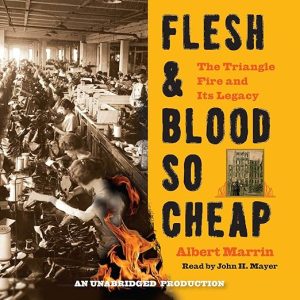
Quick Take
- Narration: John H. Mayer reads with the measured authority appropriate to serious historical nonfiction, giving the immigrant testimony sequences the weight they require without tipping into performance.
- Themes: Immigration and labor exploitation, the cost of activism and the legacy of tragedy, systemic inequality and legislative change
- Mood: Dense and sobering, with a historical urgency that carries across the century between the events and the present day
- Verdict: A National Book Award finalist that works as serious middle-grade history, demanding more of its young readers than most titles in the category and rewarding that demand with a genuinely illuminating account of how one disaster changed American labor law.
I finished Flesh and Blood So Cheap on a quiet weeknight, late enough that the house was settled and the weight of what Marrin had assembled could land without distraction. This is not a comfortable listen. It is not supposed to be. It’s a book about 146 people who died because their employers locked the doors to prevent them from taking unauthorized breaks, and it puts that fact in front of the reader with consistent clarity.
Albert Marrin is writing for a middle-grade audience, and Flesh and Blood So Cheap is a National Book Award finalist, which means it occupies a specific and demanding position in children’s nonfiction: serious historical inquiry that doesn’t condescend, aimed at readers who are ready for the full weight of documented history. At just over four hours in audio, it is the length of a documentary feature film, and it earns that runtime.
What Marrin Does Before the Fire
Marrin doesn’t begin with the fire. He begins with the immigrant communities, the Italians and Eastern European Jews who came to New York City in the late nineteenth and early twentieth centuries, and builds the social and economic context that made the Triangle Shirtwaist Factory possible as a labor system. These opening chapters establish the specific texture of poverty and ambition that defines the workers as people rather than statistics, which is what makes the fire, when it comes, genuinely devastating rather than abstractly terrible.
This structural choice is what separates serious historical nonfiction from disaster journalism. Marrin is interested in the conditions that produced the fire, not just the fire itself. The locked doors, the overcrowding, the inadequate fire escapes, the deliberate suppression of labor organizing, all of these are presented as choices made by specific people operating within a specific economic system, not as accidents or inevitable features of the era. That argument, that these deaths were preventable and that their prevention was actively resisted, is the book’s central claim.
The Activism That Followed and the Laws That Changed
Marrin’s handling of the aftermath is the most historically substantial section of the book and the one most likely to generate conversation between younger listeners and adults. The shirtwaist workers had been striking and organizing before the fire; Marrin covers the 1909 Uprising of the 20,000 with enough specificity that the labor movement is not a background detail but a living antagonist to the factory system. The post-fire legislative changes, the New York State Factory Investigating Commission, the labor laws that eventually became national standards, are traced with a clarity that makes the contemporary relevance of those laws visible.
John H. Mayer’s narration handles this historical density competently. He maintains a consistent authority throughout without becoming flat, and the immigrant testimony sections, including firsthand accounts from survivors, receive slightly warmer and slower delivery that signals their different register from the analytical passages. The PDF of photographs included with the audiobook is a significant supplement; the visual documentation of the factory, the workers, and the aftermath adds a dimension that audio cannot replicate, and listeners with screen access should use it.
The Question of Age Appropriateness
This book is listed as middle-grade, and the National Book Award committee’s recognition places it in that category, but it is emphatically not a light or undemanding listen. The fire sequences include specific descriptions of people choosing to fall from windows rather than burn, and Marrin does not euphemize this. The labor exploitation described in the preceding chapters involves real poverty, real coercion, and real death. One reviewer’s comment about using this as summer school reading for an eleven-year-old is accurate: it works for that age, but requires a certain maturity and ideally an adult willing to discuss the material.
The reviewer who connected the book’s labor history to ongoing contemporary labor conditions was reading it exactly as Marrin intended. The phrase about laws we take for granted in the synopsis is doing real work: the protections that workers have today have an origin story, and that story involves 146 people dying because there were no such laws yet.
Who Should Listen, Who Should Skip
Flesh and Blood So Cheap is appropriate for listeners aged 10 and up, with parental engagement recommended for the younger end of that range. It is ideal for classroom use in units on immigration, labor history, or early twentieth-century American social history. Adults listening independently will find it a well-constructed historical account. Listeners expecting narrative adventure rather than rigorous historical nonfiction should look elsewhere; this is a serious, demanding text that asks genuine intellectual engagement from its audience and rewards that engagement with lasting historical understanding.
Frequently Asked Questions
Is this book too intense for its middle-grade designation?
The book contains detailed accounts of people dying in the fire, including those who fell or jumped from windows, and does not soften those accounts. It is within the middle-grade category as a National Book Award finalist, but it is at the serious and demanding end of that category. Most educators recommend it for ages 10 and up, and parental engagement is helpful for listeners at 10 to 11.
Does the audiobook cover only the fire itself, or does it go into broader labor history?
Marrin explicitly structures the book to cover the immigrant communities and labor conditions before the fire, the fire itself, and the legislative and activist aftermath. The 1909 Uprising of the 20,000 garment workers is covered in detail. The fire is the center but not the totality of the narrative.
How does John H. Mayer handle the firsthand survivor testimony?
Mayer modulates his delivery for the testimony sections, using slightly warmer and slower pacing to distinguish them from the analytical historical passages. He reads with consistent authority throughout without becoming theatrical, which is appropriate for serious historical nonfiction aimed at middle-grade listeners.
What does the included PDF of photographs add to the audiobook experience?
The photographs include documentation of the factory, its workers, and the aftermath of the fire, including images that directly illustrate conditions Marrin describes in the text. For listeners with screen access, they provide significant context. The visual record of the factory conditions and the faces of the workers is part of what makes this history humanizing rather than abstract.