Quick Take
- Narration: Sy Montgomery self-narrates with the ease of someone who has lived the material, her voice carries genuine scientific wonder rather than performed enthusiasm.
- Themes: Octopus intelligence and behavior, fieldwork methodology, reimagining animal consciousness
- Mood: Wonder-struck and intimate, like being handed binoculars by someone who knows exactly where to point them
- Verdict: A standout entry in the Scientists in the Field series that uses octopus biology to genuinely shift how listeners think about intelligence itself, works for children and adults in equal measure.
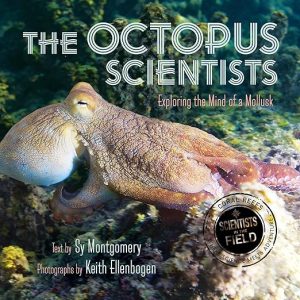
I put The Octopus Scientists on after reading Remarkably Bright Creatures, which is exactly the sequence one reviewer suggests and which I can now confirm is the ideal approach. Shelby Van Pelt’s novel made me feel things about an octopus named Marcellus. Sy Montgomery’s scientists-in-the-field memoir made me understand why those feelings have a scientific basis. The two books in succession produce something rare: a genuine shift in how you understand animal consciousness.
Montgomery is one of the best working writers in the animals-and-humans subgenre of nature writing, and The Octopus Scientists represents her at something approaching her best. The Scientists in the Field series is designed to put young readers inside actual research processes, and Montgomery’s Pacific Island fieldwork following a team studying octopus cognition is precisely the kind of project that the series exists to document. But what distinguishes this book from the series standard is that the subject keeps complicating the researchers’ assumptions in ways that are genuinely interesting to think about.
Three Hearts, Blue Blood, and Eight Problem-Solving Arms
Montgomery’s opening description of the octopus as an apparent alien, a creature unconstrained by jointed limbs or gravity, whose suckers can both taste and feel, who can change color and shape-shift and pour itself through any opening, is one of the most arresting passages in the middle-grade science nonfiction catalog. It establishes immediately that this is not a book about a familiar animal we already think we understand. The octopus’s strangeness is the book’s premise, and the science that follows demonstrates that the strangeness runs deeper than morphology.
The book’s central intellectual argument, introduced carefully enough for a middle-grade audience but substantive enough to hold adult attention, is that octopus intelligence challenges existing categories. Classified as mollusks, related to clams, they shouldn’t by conventional biological reasoning be as smart as they are. And yet they are. They demonstrate problem-solving, individual personality, spatial memory, and behavioral flexibility that researchers keep finding new evidence for. Montgomery is not anthropomorphizing; she’s reporting what the science shows while asking what the science means about the broader definition of mind.
Montgomery’s Self-Narration and Its Specific Authority
Sy Montgomery has been in the water with these animals. She has watched them recognize individual researchers and respond differently to different people. She has had her hand grabbed by an octopus who seemed curious about her. When she narrates her own material, that history is audible. The voice carries the particular quality of someone reporting rather than performing, there are places where her pace slows slightly, where you can hear her arriving at the significance of an observation, that a hired narrator would have rehearsed out of the recording. That spontaneous quality is what makes self-narration the right choice for field memoir.
Reviewers describe it as a book for grandchildren that grandmothers equally love, and as an explorers’ trip to a Pacific Island to find octopods. That cross-generational appeal is a reliable quality signal for the Scientists in the Field series more broadly, but the octopus volume generates particularly broad interest because the subject itself is having a cultural moment. Post-My Octopus Teacher, post-Remarkably Bright Creatures, the question of octopus intelligence is part of mainstream conversation. Montgomery was there early, and the audiobook benefits from arriving in a context where listeners are already curious.
The Series Context and Entry Points
The Scientists in the Field series includes dozens of titles covering everything from wolves to monarch butterflies to mushrooms, and The Octopus Scientists is consistently cited among the strongest entries. The format, following a real researcher or research team through actual fieldwork, is a more sophisticated approach to science education than the factbook model or the story-driven adventure model. It shows science as a process, with uncertainty and unexpected findings, rather than science as a collection of settled answers. For middle-grade listeners, that process orientation is more educationally valuable than any specific fact about octopus physiology.
At two hours and twenty-two minutes, the runtime is well-calibrated for its audience. Long enough for a real immersive experience, short enough to complete in a single afternoon. Montgomery’s writing density means the two hours feel substantive rather than padded.
Who Should Listen, Who Should Skip
Ages nine through adult. Strong for anyone who loved My Octopus Teacher, Remarkably Bright Creatures, or other animal intelligence nonfiction. Excellent for homeschool units on marine biology or the philosophy of mind in a science context. Reluctant nonfiction listeners may find the absence of a strong character-driven plot less engaging than story-format science books, but anyone with genuine curiosity about animals will be held from beginning to end. One of the best audiobooks in this category regardless of age range.
Frequently Asked Questions
Is this appropriate for children who are afraid of or uncomfortable with sea creatures?
Montgomery’s approach is wonder-based rather than threatening. The book emphasizes how strange and fascinating octopuses are, not how dangerous. A child nervous about ocean creatures might find the detailed physical descriptions slightly unsettling, but there is nothing frightening in the content.
Does the book get into the specific research methodology the scientists use, or is it more focused on the octopuses themselves?
Both. The Scientists in the Field series is specifically designed to show fieldwork process, so readers see how researchers design observations, record data, and interpret results. The octopus behavior is the subject, but scientific method is the frame. This is one of the series’ greatest educational strengths.
The book is part of the Scientists in the Field series, does it reference other volumes, or is it self-contained?
The book is completely self-contained and requires no knowledge of other Scientists in the Field titles. The series is a brand rather than a narrative sequence; each volume is a standalone field report.
One reviewer compared reading this after Remarkably Bright Creatures, does a fictional octopus story actually enhance this nonfiction book?
Genuinely yes. The Van Pelt novel primes emotional interest in octopus cognition, and Montgomery’s science then provides the factual foundation that the novel was drawing on. The sequence produces more than either book does alone. But The Octopus Scientists is fully satisfying without having read the novel first.