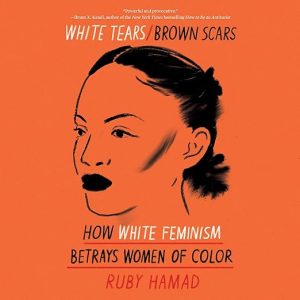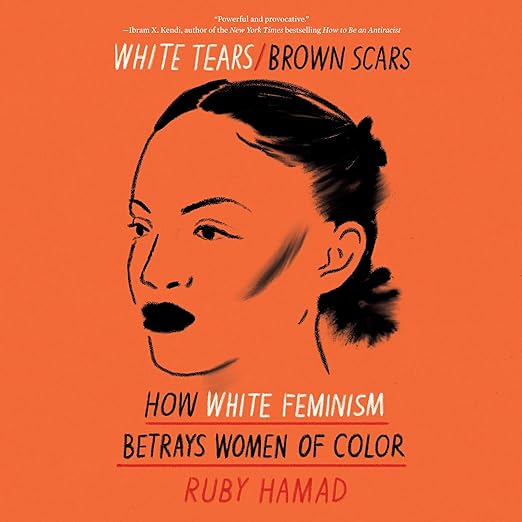
I had been putting off White Tears/Brown Scars for longer than I care to admit. Not because I doubted its relevance, Ruby Hamad's central argument, about the way white women's tears have functioned historically as a mechanism of control over women of color, had been circulating in cultural conversation long before the book arrived in 2020, but because I suspected it might be one of those titles that works better as a provocation than as a sustained analytical work. I was wrong to wait.
I listened to it across two weekday mornings, making notes. The book held up under that kind of close attention, which is the real test for any work of cultural criticism that makes sweeping historical claims.
What We Made of It
Hamad structures her argument across a wide arc of history, from the antebellum South, where white women actively participated in the legal defense of slavery, through the colonial period, where they served as a palatable face for brutal administrative violence, to contemporary incidents familiar from recent years, BBQ Becky, the various viral moments of white women calling police on Black people for ordinary daily activity. The range of reference is ambitious, and the book earns its historical scope more often than it loses control of it.
Mozhan Marnò is an astute narrator choice. Her voice carries a precision that matches Hamad's prose style, which is analytical and sometimes dry, and she navigates the more emotionally charged passages without tipping into performance. When Hamad is working through the mechanisms of racial stereotype, the Angry Black Woman, the hypersexualized Latina, the exoticized Asian woman, Marnò delivers these sections with the cool clarity they require.
What Makes White Tears/Brown Scars Worth Hearing
The book's most valuable contribution is its historical specificity. It is easy to make general claims about white feminism's failures; it is much harder to ground those claims in documented cases spanning two centuries and multiple continents. Hamad does the latter. The chapter tracing white women's role in 19th-century lynchings of Mexicans in the American Southwest is the kind of material that most American readers will not have encountered before, and it reframes the familiar racial geography of US history in useful ways.
The endorsement from Dr. Ibram X. Kendi positioned the book within a particular intellectual conversation, and it belongs there. But Hamad is also engaging with feminist theory on its own terms, not merely as an appendage to antiracist discourse, and the dual focus is what gives the book its particular edge. She is not simply arguing that white feminism got race wrong; she is arguing that the innocence of white womanhood was constructed specifically in relation to the guilt assigned to women of color.
What Might Not Land
Listeners who come expecting the book to be primarily about individual bad actors, specific white women behaving badly in specific documented cases, will need to recalibrate. Hamad is making a systemic argument, which means individual anecdotes serve the larger structural claim rather than being the point in themselves. Some readers find this frustrating; others find it clarifying. The BBQ Becky reference, for instance, is not there to condemn one woman but to illustrate a pattern with deep historical roots.
The 7-hour runtime is lean for the scope of territory covered, and there are moments where the argument moves faster than the evidence. A few of the contemporary cultural references, The Hunger Games, Alexandria Ocasio-Cortez, feel less fully developed than the historical material. That unevenness is real, but it does not undermine the core intervention.
Who Should Listen to White Tears/Brown Scars
Readers interested in the intersection of race and gender history, particularly those who want an analysis grounded in actual history rather than contemporary discourse alone, will find this essential. Those who are new to the subject and coming in with significant skepticism toward the premise will likely find the book frustrating rather than illuminating, not because it is unfair, but because it assumes a level of prior openness to its framework that not all listeners will bring.
- Narration: Mozhan Marnò brings controlled authority to Ruby Hamad's prose, grounding the argument's emotional charge without letting it tip into polemic.
- Themes: White feminism as a mechanism of racial control, the weaponization of white women's distress, the history of colonial complicity
- Mood: Rigorous and confrontational, dense with historical case material
- Verdict: A sharp and well-researched intervention in debates about race and gender that demands active listening and rewards listeners willing to sit with discomfort.
Does White Tears/Brown Scars focus primarily on the United States, or does it take a more global view?
Hamad draws examples from the US, Australia, and colonial contexts more broadly. The global perspective is one of the book's strengths, particularly the material on British colonial administration and the women who participated in it.
How does Mozhan Marnò's narration handle the emotionally charged subject matter?
Marnò keeps the delivery measured and controlled throughout. The book does not editorialize through performance; the tone stays academic in register, which serves the analytical nature of the argument and lets the historical evidence carry the weight.
Is this book primarily a work of history or cultural criticism, and how does that affect the listening experience?
It operates between both modes. The historical chapters are heavily researched and footnoted; the cultural criticism sections move more quickly and rely more on argument than documentation. Listeners who prefer one mode over the other will find the book shifts register accordingly.
How does White Tears/Brown Scars relate to other books in the same space, like So You Want to Talk About Race or Me and White Supremacy?
Hamad's book is more historically focused and more explicitly feminist in its framing than either of those titles. It is less a personal guide and more an argument about structural history, which makes it denser but also more useful for listeners who have already read the introductory texts.