The Short Version
- Performance: Amy Gordon carries a book built entirely from two-sided transcript, and the page never says how the Middle French quatrains are handled
- What it covers: hypnotic regression, prophecy and its interpretation, alterable futures, the quatrains of Nostradamus
- Feel: Patient, procedural, sincerely strange
- Our call: Coherent within its own premises and honestly presented, but nineteen hours is a long stay inside a framework you have to accept first.
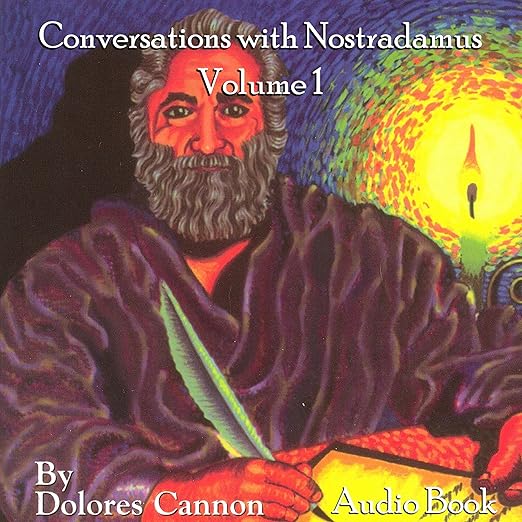
Hypnosis sessions produced this book, and the audiobook asks you to sit with nineteen hours of what Dolores Cannon presents as transcribed conversation between a therapist, her hypnotized subjects, and a sixteenth-century French physician. The publisher's description runs to two sentences and makes no attempt to soften the premise: communication from Nostradamus through several mediums, supervised by Cannon, together with the prophecies themselves in Middle French with an English translation. Whatever else it is, the page is honest about what it is selling.
The Verdict, Briefly
How you receive this depends entirely on a decision made in the first hour, and the fairest account of that decision comes from January 2012. John, awarding the book full marks, declines to argue for truth or falsehood and evaluates it on what it contains, then lays out the premise cleanly: while exploring a subject's past life, Cannon finds that the woman had been a student of Nostradamus, at which point he takes over the sessions to explain that his quatrains are too ambiguous to be understood unaided.
That framing is the right one for a reviewer and the right one for a listener. Read as documentary evidence, the material cannot be tested and will convince nobody who is not already inclined. Read as what it presents itself to be, a sustained record of sessions conducted over years with several subjects, it holds together with more internal consistency than the premise leads you to expect, and Cannon's own manner on the page is patient rather than evangelical, and she leaves the awkward moments in rather than tidying the sessions into something more persuasive.
She is also, by the standards of this shelf, unusually procedural. The book keeps describing the mechanics of how information arrived, who was under hypnosis, what was asked, and what came back. That methodological surface will not satisfy anyone applying scientific standards, and it is not meant to. What it does is let a listener follow the process rather than simply receive conclusions, and it is the reason this body of work has kept an audience for as long as it has.
Transcribed conversation is a natural fit for a recording. This is dialogue, question and answer, one voice asking and another responding, and hearing it removes the visual awkwardness of a printed transcript with speaker labels running down the margin. The pacing of a hypnosis session, the pauses and the returns to a question already asked, comes through better aloud than it reads on paper, and Amy Gordon has to carry both sides of the exchange alone.
The August 25 entry, full marks, describes the appeal precisely: fascinating conversations that clarify the meanings of the quatrains, the prophecies and their timelines, and the question of how a future might yet be changed. That last point is the genuinely interesting one, since a book of predictions insisting prediction is alterable is doing something considerably more complicated than fortune telling, and Cannon returns to the tension repeatedly rather than resolving it.
Three volumes await anyone who starts, a fact the reception makes clearer than the listing does. Two separate responses refer to a trilogy and to the volumes still to come, and one describes having bought the whole set at once. Beginning this is beginning a long project, and knowing so before the first session opens is a great deal better than discovering it at the end of a very substantial recording. The volumes are sold separately, so the total commitment is considerably larger than what this page shows.
Weak Spots in Conversations with Nostradamus: Volume 1
Arithmetic defeats the rating widget on sight. Exactly one rating is counted, a lone vote can only be a whole number of stars, and 4.7 is therefore unreachable by any route. Meanwhile five signed responses sit underneath, four of them at five stars and one a step below, so the widget is neither counting them nor reflecting them. Ignore the number entirely and read the responses, which are substantive and unusually thoughtful for a title of this kind. Several of them run to real length and engage with the content rather than the premise.
Series information on this page is wrong in a way that will cost people money. The book is Volume 1, and the series line reads Conversations with Nostradamus: Volume 2. Anyone who searched for the second book and landed here has every reason to believe they found it. Check the title on the cover rather than the series line before buying, and check it again if you are assembling the set volume by volume.
Then the matter of the French. Middle French quatrains with English translation are promised in the description, and nothing on the page indicates how a recording handles them. Whether the original is spoken before the translation, and by whom, goes unstated. One January 2020 reader adds another wrinkle worth having, noting that the text dates from the late 1980s and referring to the author as Dorothy Cannon, a misspelling that will return nothing if you search on it.
Who Will Get the Most From It
Readers already inside Cannon's body of work will want this, since it is the origin point of the method she used for the rest of her career. Listeners drawn to the quatrains themselves, who have found conventional Nostradamus commentary either credulous or dismissive, will at least encounter something structurally different: an approach treating interpretation as a conversation with a source rather than as decipherment performed from outside.
The October 2025 entry, rated at the top, captures the tone of this audience well, describing details felt and newly explained, anticipating the next two volumes, and wishing the author were still alive to write more. That is a devotional relationship with a body of work rather than a critical one, and the pool here reflects it throughout. Weigh the enthusiasm accordingly and understand what kind of readership you are joining before you commit. Nobody visible here approached the book as a doubter, which shapes every assessment on the page.
Skeptics who need falsifiable claims should stay away, and so should anyone expecting a scholarly treatment of the historical Nostradamus. The most useful warning comes from a reader who held back a star while calling it a slow read, not for them personally, though enjoyed by a spouse. A rating that generous attached to a plain admission of disinterest tells you how loyal this audience is. Nineteen hours is a long time to spend inside a premise you do not accept.
A Few Questions About Conversations with Nostradamus: Volume 1
Is this audiobook the first book in the series despite what the series line says?
Yes. The cover title reads Volume 1 while the series line on the listing names Volume 2, which is a straightforward error in the catalog. Readers here describe a three-book set and buying the whole thing at once, so plan accordingly and verify each cover before purchasing the next installment.
Are the Nostradamus quatrains read in Middle French on the audiobook?
The publisher's copy promises them in the original alongside an English rendering, but the listing gives no detail about how a recording delivers that. Nothing indicates whether the older French is voiced at all, or handled purely through the English rendering. Sample the recording if the original language is part of the appeal.
When was the original text written?
The description gives no date for the sessions themselves. What the page does establish is that this audio edition was released in December 2020 while the material behind it is considerably older, so treat any predicted timeline as something written well before the events it names, and check dates yourself.