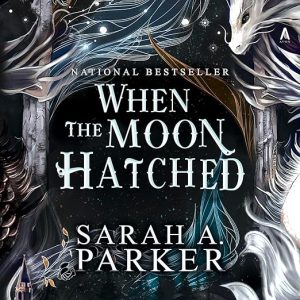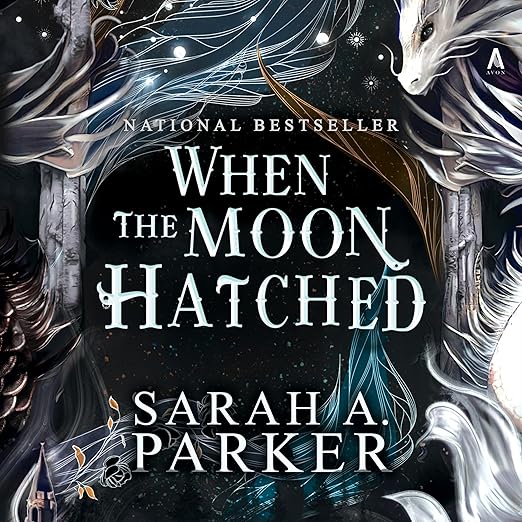
Can a world where dead dragons become moons support a love story heavy enough to outlast lifetimes? When the Moon Hatched answers that question with remarkable conviction, and this audiobook, narrated by Sarah Mollo-Christensen, delivers Sarah A. Parker's fantasy romance debut with the atmospheric intensity the source material demands. Raeve, an assassin for the rebel group Fíur du Ath, and Kaan Vaegor, a conqueror-king with an unhealing grief, orbit each other across an impossible world with a cosmology unlike anything else in the genre.
Dead Dragons Become the Moons in This Sky
The world-building conceit at the heart of When the Moon Hatched is genuinely original: the dragons that once populated this world, upon their death, ascended to become the moons that now drift and fall across the sky. That premise is not window dressing. It is structural. The fallen dragons, or fallen moons, are physical objects in this world, and their descent has consequences. The mythological history embedded in that image, the idea that the sky itself is a graveyard of things once great and living, infuses the romance with an appropriate sense of scale and loss.
Raeve is a compelling protagonist because Parker refuses to soften her. She is not waiting to be made softer by love; she is genuinely dangerous, professionally and psychologically formed by years of violent work, and her resistance to Kaan is not coyness but self-preservation logic. Kaan, meanwhile, is not simply a powerful love interest. He is a man consumed by grief so profound it reshaped an entire kingdom, who encounters in Raeve something that resonates with a past he cannot fully access. The second-chance romance element, complicated by the question of whether either character has enough information to recognize what they once were to each other, gives the plot its central engine.
One reviewer described the book as altering brain chemistry, which is a specific claim but not an inaccurate one for the right reader. When the Moon Hatched does something that the better fantasy romances do: it makes its world and its romance inseparable. Raeve's imprisonment by the Guild of Nobles and Kaan's infiltration of the high-security prison to find her are not setups for the romance; they are the romance, structured around who these specific people are in this specific world.
Sarah Mollo-Christensen Shifts From Cold to Grieving
Sarah Mollo-Christensen's narration is exceptional work. Raeve requires a voice that can be cold, dry, and occasionally brutal while remaining fundamentally sympathetic, and Mollo-Christensen navigates that balance with precision. Kaan's sections carry a different weight, the heaviness of sustained grief, and she shifts registers convincingly. The fantasy vocabulary of this world presents real challenges for audio narration, and Mollo-Christensen handles the pronunciation and delivery with the confidence of someone who has fully inhabited the material.
At twenty hours, this is a long audiobook, and the length is earned. Parker uses the extended runtime to develop the world in depth before fully delivering on the romance, which means the payoff when it arrives is substantial rather than convenient. Listeners who have been burned by slow-burn promises that resolve too quickly will find that When the Moon Hatched actually slow-burns. The tension does not dissipate prematurely, and the audiobook format, where you cannot easily skip ahead, actually serves the intended reading experience.
The second-chance romance structure, layered with amnesia and the weight of past-life connection, is handled with more discipline than the premise might suggest. Parker does not use the connection as an excuse to rush; she uses it as a reason to be careful, which is the correct narrative choice.
Significant Crying Is Part of the Experience
The descriptive density of Parker's prose is both an asset and a demand. Reviewers have noted that the writing style is very descriptive and detailed, and that is accurate. The world is immersive and specific, which is a genuine achievement, but listeners who prefer propulsive plotting over immersive atmosphere may find the pacing in the first third slower than their preference. The twenty-hour runtime is a commitment that the story honors but that requires patience in the early sections.
The spice level is moderate, which may surprise listeners coming to this from pure romance. When the Moon Hatched operates primarily in the territory of fantasy with a slow-burn romance at its core; it is not a romance with fantasy elements. That distinction matters for calibrating expectations. One reviewer described the emotional damage as substantial and noted significant crying, which is the kind of warning that functions differently depending on the reader. For listeners who want that intensity, it is an invitation. For those who prefer lighter emotional registers, it is useful caution.
As the first book in the Moonfall series, When the Moon Hatched establishes considerably more than it resolves. The world-building investment is real, and the ending, while satisfying on the central romantic question, positions the series for continued development.
Genre Newcomers Get an Illuminating Starting Point
When the Moon Hatched is the right audiobook for fantasy romance readers who want genuine world-building alongside their love story and are willing to invest the time it takes to be fully immersed. If you responded to the comparison points of Slaying the Vampire Conqueror or The Plated Prisoner, this occupies a similar register: high-stakes fantasy with a romance that the world itself seems to conspire toward. Listeners who want their emotional investment returned with interest will find the payoff proportional to what they put in.
Sarah Mollo-Christensen's narration makes the audio version a particularly strong format for this material; the atmospheric prose benefits from being heard rather than read, and her performance gives both leads distinct presence across twenty hours. Listeners new to fantasy romance who want to understand what the genre can achieve at its best will find this an illuminating starting point.