
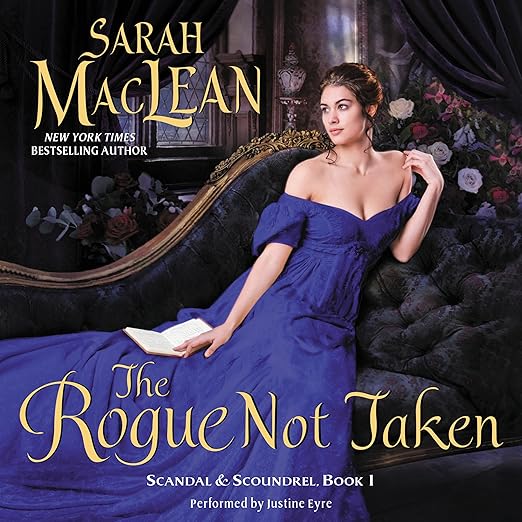
Sarah MacLean opens the Scandal and Scoundrel series with Sophie Talbot's most public humiliation and her most defiant response to it. The Rogue Not Taken, narrated by Justine Eyre and running 11 hours and 46 minutes, begins in audiobook form with a goldfish pond, a philandering brother-in-law, and a Lady Sophie who has just made herself the most talked-about woman in London for entirely the wrong reasons. Her solution, stowing away in the nearest available carriage, introduces Kingscote, Marquess of Eversley, and the road to Scotland where everything neither of them intended to happen proceeds to happen anyway.
The Review
MacLean writes Regency romance with a social critic's awareness that the world she is depicting was not especially pleasant for women who lacked either money or strategic marriages. Sophie Talbot is the least interesting of the Talbot sisters by society's accounting, which is to say she is the one who has not leveraged her appearance into aristocratic currency. That positioning gives MacLean room to develop a heroine whose intelligence and genuine decency are chronically undervalued by the world she inhabits, which is a better foundation for a romance than most of the genre's standard setups. King's reputation as a charming rake conceals a more complicated situation, which the carriage journey is designed to reveal gradually. MacLean uses the forced-proximity structure, close quarters, dark secrets, and the cumulative weight of shared hours, to dismantle the assumptions both characters carry about each other. The reviewer who compares the experience favorably to Lisa Kleypas and Julia Quinn is pointing at MacLean's register accurately. She belongs in that company: the heroines are specific rather than generic, the heroes are imperfect in earned rather than decorative ways, and the social world the romance navigates has genuine stakes. The reviewer who notes their eye twitching at aristocratic condescension in the early chapters is responding to something MacLean puts there deliberately. The aristocracy in this book is not lovable backdrop. It is a system, and Sophie's flight from it has actual weight. The goldfish pond incident is played for comedy, but the social machinery that makes it catastrophic for Sophie rather than merely embarrassing is where MacLean's real argument lives.
Why Listen to The Rogue Not Taken
Justine Eyre brings the banter that MacLean's prose demands. Historical romance in this register lives and dies by comic timing, and Eyre understands that Sophie's line readings need to carry the particular quality of someone who is sharper than she lets on in public. The scenes in the carriage, where neither King nor Sophie can maintain the social performances they rely on in London, are where Eyre does her best work. The dynamic shifts from mutual antagonism to reluctant cooperation to something neither character anticipated, and Eyre tracks those shifts with precision. MacLean's plotting in the Scandal and Scoundrel books is tighter than in some of her earlier series. The London scandal setup and the Scottish destination provide clear structural anchors, and the road-story structure keeps the pacing honest across the full 11-hour-and-46-minute runtime. The supporting characters, Sophie's sisters, the Scottish border community, the London gossip network that pursues them, are sketched with enough specificity to give the central story a populated world rather than an empty stage. This is the first book in a series, and it functions as an invitation rather than a self-contained experience that exhausts its world's possibilities. Eyre's voice for Sophie maintains consistency across the full production, which matters particularly in the middle section where the emotional ground between the two central characters is shifting daily. That consistency is what makes the emotional progression feel earned rather than convenient.
The Caveats
The first third of the audiobook leans heavily into the social indignation that triggers Sophie's flight. Listeners who find extended satirical treatment of aristocratic behavior less interesting than the central romance may find the early chapters slower going than the carriage sections that follow. MacLean's critique of how society treats women who do not perform their expected social functions is persistent and pointed, and some readers find that persistent edge more satisfying than others do. King's reasons for being summoned home to the Scottish border involve family complications that are revealed gradually. The mystery is not overly withheld, but it is held long enough that some listeners may find his motivations opaque in the early carriage scenes. The romance's slow-burn structure is genuine rather than cosmetic. MacLean earns the central characters' emotional connection across the full runtime rather than shortcutting to affection. Listeners who prefer faster romantic resolution should calibrate their expectations accordingly before committing to nearly 12 hours of material. The series sets up Sophie's sisters as future protagonists, and their presence in this first volume functions partly as world-building for what follows. Readers who intend to follow the series will find those moments rewarding; listeners who want a purely self-contained story should know that some of the ensemble texture is designed with future volumes in mind.
Who Should Pick Up The Rogue Not Taken
Readers of historical romance who enjoy heroines with genuine social consciousness and heroes whose rakish surface conceals something more complicated will find this series opener a strong entry point. Fans of Lisa Kleypas and Julia Quinn who want a comparable author to follow will find MacLean delivering in a similar register. Listeners new to the Scandal and Scoundrel series can start here without prior MacLean context. Those who want low-social-commentary, high-action Regency romance should note that MacLean's critique of the aristocracy is not incidental to the story but central to how it generates its emotional stakes.
Common Questions
How does Justine Eyre's narration handle the balance between comedy and emotional depth in this audiobook?
Eyre is particularly strong with MacLean's banter-heavy prose. She understands that Sophie's voice needs to carry both self-deprecating humor and genuine emotional vulnerability, and she navigates those registers without making them feel contradictory.
Does The Rogue Not Taken audiobook end on a cliffhanger, or is the romance resolved by the end?
The central romance is resolved. MacLean writes complete stories within each series entry. The world and supporting characters are set up for subsequent volumes, but Sophie and King's arc concludes within this audiobook.






