Key Details
- Narrator: Wendy Baran carries both teenage leads and the two cities that separate them, single-handed.
- Subjects: immigration enforcement, magical realism braided with documented history, found family under pressure
- Tone: Urgent and unsettled
- Bottom line: A short, ambitious YA fantasy that asks for more trust than its listing can repay.
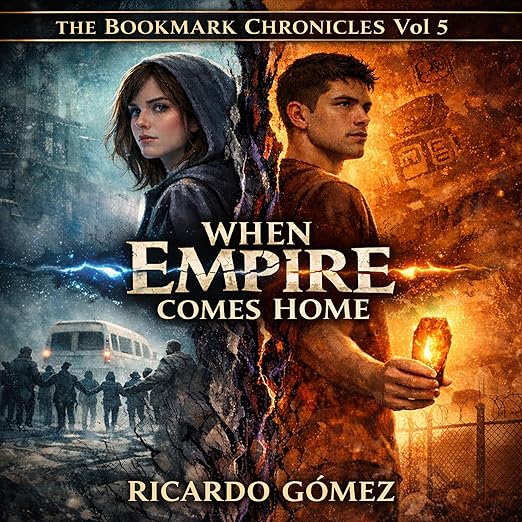
Novels rarely claim that the news outran them, and this one says so in its own description: as real events overtook the writing, the line between fiction and reality became terrifyingly thin. That is a publisher's sentence, and since the publishing credit here carries the author's own name, it doubles as a confession. When Empire Comes Home is the fifth Bookmark Chronicles book, six hours and eight minutes of audiobook read by Wendy Baran, and it drops two teenage Guardians into a federal immigration operation the copy calls the largest in American history. Whether that reads as bracing or presumptuous will depend less on the plot than on how much you trust a story to keep pace with the thing it is describing.
The Review
The book opens one month after Milo Parker and Zoe Williams exposed the Heritage Clarity conspiracy, which tells you precisely how much homework the listing assumes. The magical bookmarks are already established, the Guardian network is already running, and the description spends no time reintroducing either. What it does introduce is the new object: an obsidian witness, made during the Maya collapse, dormant for five centuries, waking now because it recognizes in America's crisis the same pattern it was built to document. As premises for a middle-grade-adjacent fantasy go, that one has real weight behind it, and it is the reason the book earns a hearing.
Zoe is trapped with detained families in a Minneapolis standoff. Milo is forced to witness processing operations at the Texas border. That geographic split is the structural bet of the whole recording, and in audio that is a real bet. On the page you can glance up at a chapter heading to check whose section you are in. Listening, you cannot, so the seam between the two threads has to be audible in the reading itself. Wendy Baran carries both sides alone across six hours, which is a considerable ask for a book built on separation and cross-cutting.
One name occupies both the writing credit and the publishing credit, which is worth knowing before committing six hours to a fifth volume. Independently released fiction can be edited to a professional standard or barely edited at all, and this record gives you no way to tell which. What it does show is a title produced with intent: a credited reader, a numbered place in a series, a clean runtime, a description that knows what it wants to sell. Few self-released young-adult fantasies assemble that much infrastructure, and it counts for something before the first chapter starts.
The Best Parts of When Empire Comes Home
Magical realism against documented history is a harder trick than it sounds, because the fantastic element has to earn its place beside material the reader already knows to be true. The obsidian witness is built for exactly that job. It anchors witnesses to moments of civilizational fracture, which is a neat way of describing what a novel about detention and displacement is trying to do anyway. The device is the thesis. Whether the execution lands is something the record cannot tell you, but the design is coherent, and coherent design is not the norm in series fantasy five volumes deep.
Six hours and eight minutes is also, quietly, an argument in the book's favor. Politically engaged young-adult fiction has a habit of arriving at four hundred pages and asking teenagers to sit still for fifteen hours. This one fits inside a school week of commutes and dishwashing, and for a title whose whole subject is urgency, brevity is a formal choice rather than a shortfall. The copy names The Book Thief, The Hate U Give, and Long Way Down as touchstones. Two of those three are short books that hit hard, and the runtime here suggests the comparison was made with the shape in mind, not just the subject.
The Caveats
Nothing has been posted under this title. No star rating, no vote count, no written response of any kind, which for a book released in March 2026 is unremarkable but still leaves you without the ordinary sanity check. Nobody is going to warn you that the middle sags or that the ending lands too neatly. Add to that a publishing credit identical to the author credit, and you are buying entirely on the strength of the description and whatever sample you can get to. That is not a mark against the book. It is a statement about how much of the risk sits on your side.
Read the last line of the description and you hit a second problem. The series is listed as one unpunctuated run: Fighting Book Bans Across Time The Unwritten World Fighting Deepfakes Across Time The Donroe Doctrine When Empire Comes Home. Where one title stops and the next begins is anybody's guess. The listing puts this volume at number five, so five titles is the arithmetic that fits, but the string itself refuses to confirm it. If you want to start at the beginning, you will need to find the running order somewhere other than this page.
Topical fiction written alongside the events it depicts carries a specific risk, and the description raises it without quite addressing it. A novel that keeps pace with the news can feel electric on release and dated within eighteen months, and the claim that reality overtook the writing is offered as a selling point rather than examined as a hazard. Add the fact that a fantasy artifact is doing the moral framing for a real enforcement operation, and you have a book that needs to be handled with care by the adults recommending it. Handled well, it opens conversations. Handled carelessly, it flattens them.
The Right Listener for When Empire Comes Home
Teenagers already four volumes into the Bookmark Chronicles are the obvious audience, and they will need nothing from this review. Beyond them, this suits listeners who want current-affairs fiction that does not pretend the world is fine, and who are comfortable with a fantasy frame around it. Classroom and library use is plausible if the adult in the room has read it first. Give it a miss if you want an entry point into the series, because the opening chapter treats the previous book's plot as settled ground, or if political fiction aimed at young readers strikes you as inherently suspect.
What you are trading is certainty for immediacy. Six hours, one reader, a premise with genuine ambition, and a record that offers no independent evidence of how well any of it works. The listing gives you a premise and a runtime and asks you to trust the rest.