
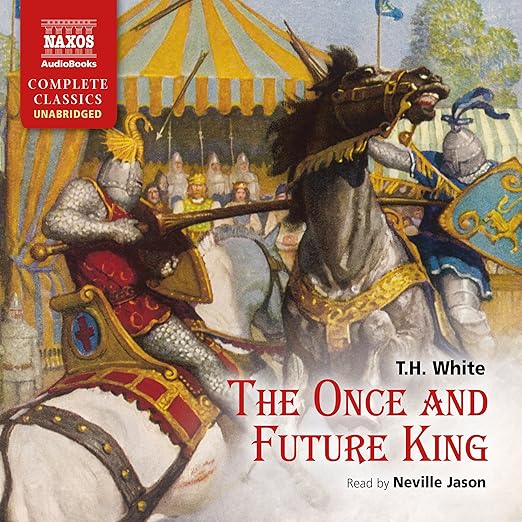
Thirty-three hours is what it takes to move through the complete box set of T. H. White's Arthurian epic in this audiobook, five parts written and published across two decades and finished, in one case, only after White's own death. That production history is almost as tangled as the plot itself, worth understanding before diving into Merlyn's tutoring of a boy who does not yet know he will become King Arthur.
Five Books Become One Continuous Arthur Story
Kez's review lays out that history in useful detail: the 1958 book most readers now think of as one continuous novel is actually a rework of four previously published books, The Sword in the Stone from 1938, The Witch in the Wood from 1939, The Ill-Made Knight from 1940, and The Candle in the Wind, also 1958. A fifth section, The Book of Merlyn, was written in 1941 but only published after White's death, with some of its material already folded back into the earlier books, mainly The Sword in the Stone, before that posthumous publication happened. Listening to this as a single thirty-three-hour whole means hearing a genuinely composite work: not one sustained act of writing, but five different books written across a career, stitched into a single continuous story of Arthur's life from untested boy to failed king.
Arthur's life takes shape across that runtime starting with Merlyn instructing the Wart, not yet known as Arthur, and his brother Sir Kay, through a kingless realm where a rightful heir must be found by pulling a sword from an anvil set in stone. Once Arthur becomes king, the realm faces a threat from the north, and the final two parts turn considerably darker: an aging king confronts the specific horror of his own son turning against him. Only in The Book of Merlyn does the tutor reappear to argue that hope survives even inside apparent ruin, a note the synopsis frames as necessary, not simply comforting, given everything Arthur has lost by that point in the story.
Devoted Readers Call It a Hopeful Tragedy
Reader devotion to this book runs remarkably deep for something built from such a patchwork history. Zoeeagleeye calls it a lifetime top-ten title, read three times, and coins a phrase for it worth repeating: a hopeful tragedy, tragic on a genuinely classical scale yet never losing Arthur's basic belief in the goodness he sees in people. That same review recalls once hearing the book called the Harry Potter of its day, a comparison passed along secondhand, not claimed outright, but still a useful sense of how central this book once was to popular fantasy reading. DoubleVision's review describes wearing out an actual paperback copy across repeated readings, a physical detail standing in for exactly the kind of loyalty that makes a book worth a full thirty-three-hour audio commitment.
Semon Strobos offers the most useful counterweight: a four-star review admitting the book only got picked up after publicity for a different work, H is for Hawk, kept referencing White's hawking history, and finding the result stranger than expected, original in ways that are not always comfortable. That review's description of a classic at war with itself is a fair warning that this is not a tidy, consistently paced epic, and listeners should expect real tonal whiplash across five books written years apart. Even The Mighty Ernie's brief, five-star review, calling it a great masterpiece that should be required reading, arrives with none of Strobos's caveats, which is its own useful data point about how differently this book lands depending on what a listener expects going in.
Four Votes, Five Reviews, and a Math Gap
Rarely does a rating on this kind of listing get pinned down as exactly as this one does. Four counted votes must total precisely 18 out of a possible 20, meaning the grades land two points short of a clean sweep of perfect scores, a calculable fact rather than an estimate. What makes the page more interesting is the mismatch sitting right beside that math: five separate written reviews are visible, not four, so at least one voice contributing a rating here left no review behind at all, or the counter itself has not caught up with the page's own comment section. Either way, the visible written reviews, five stars, five stars, four stars, five stars, five stars, sum to twenty-four on their own, further evidence that the four-vote counter and the five-review comment section are not describing quite the same population of readers.
Thirty-Three Hours Turn Dark for a Teen Tag
Thirty-three hours puts this among the longest single audiobook commitments a listener is likely to make this year, and the composite five-part structure means the pacing genuinely shifts partway through, lighter and more instructional early on, considerably darker by the final two sections. Anyone expecting uniform tone across the full runtime should recalibrate given how differently the parts were originally written and published.
Genre classification is worth a second thought too: the listing files this under both general literary fiction and teen-and-young-adult categories, despite how dark the later sections get. The Sword in the Stone alone, with its younger protagonist and lighter instructional tone, fits a younger readership comfortably; a son's betrayal of an aging father in the final parts is a considerably heavier proposition, closer to adult tragedy than typical young-adult fare, regardless of how the listing happens to be tagged.
Consider Just The Sword in the Stone First
Fantasy readers curious about the genre's roots, plus anyone drawn to Arthurian legend specifically, will find a natural home here, and Zoeeagleeye's secondhand Harry Potter comparison gives a useful sense of scale for how influential this book once was. Listeners who appreciate a story willing to earn real tragedy instead of manufacturing easy triumph will find the final two parts, and especially the aging king's confrontation with his own son, genuinely difficult in the way Strobos's review suggests.
Anyone who wants a tightly plotted, consistently toned single narrative should adjust expectations heavily, or consider starting with just The Sword in the Stone instead of the full five-part box set. Thirty-three hours is a genuine commitment, and Strobos's own admission of finding the book strange in ways not always comfortable is worth taking seriously before starting the complete version.
Is this audiobook one continuous novel or several books combined?
Technically five: The Sword in the Stone, The Witch in the Wood, The Ill-Made Knight, and The Candle in the Wind, published between 1938 and 1958, plus The Book of Merlyn, written in 1941 but published only after T. H. White's death.
How long is this audiobook, and does the tone stay consistent throughout?
It runs thirty-three hours, and no, the tone shifts considerably. Early sections read as lighter and more instructional, while the final two parts turn notably darker as an aging Arthur confronts his own son's betrayal, reflecting the five-part structure's different original publication dates.
What does the rating on this audiobook actually tell listeners?
More than most, in this case. Four counted votes must total exactly 18 of a possible 20 points, a determined figure, not a guess. Oddly, five written reviews are visible instead of four, so the vote counter and the comment section do not fully align with each other.
Should listeners start with The Sword in the Stone instead of the full audiobook?
It is a reasonable option for anyone wary of a thirty-three-hour commitment. One reviewer specifically found the later, darker sections stranger and less comfortable than expected, so sampling the first part alone is a fair way to test fit before continuing.







