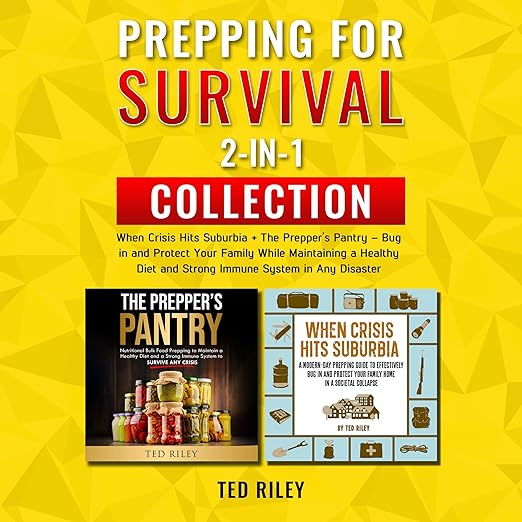
Quick Take
- Narration: Paul Nicholls reads with a calm, practical authority that suits the subject matter; he does not sensationalize the scenarios, which is exactly right.
- Themes: Emergency preparedness, suburban vulnerability, family resilience
- Mood: Methodical and practical, with underlying urgency
- Verdict: A solid entry point for households starting to think seriously about preparedness, strongest on the psychological framing of why most people delay.
I listened to Ted Riley’s preparedness guide on a Tuesday afternoon shortly after a water main had broken near my building and my taps had been dry for six hours. That is a trivial inconvenience compared to what the book addresses, but it concentrated my attention in a way that reading on a calm day might not have. By the time Paul Nicholls finished the first chapter I had already opened a note on my phone and started a list. That is probably the correct response to this book.
When Crisis Hits Suburbia targets a specific and underserved audience: people who live in ordinary suburban neighborhoods, who depend entirely on municipal infrastructure, and who have not seriously considered what would happen if that infrastructure failed for more than forty-eight hours. Riley is not writing for survivalists or people with rural land. He is writing for the family on a quarter-acre lot in a mid-sized American city, and he takes that context seriously throughout.
Our Take on When Crisis Hits Suburbia
The book’s organizing argument is deceptively simple: the things modern households take for granted – tap water, gas, electricity, sanitation, waste removal – are each a single point of failure. Flooding, hurricanes, and pandemics have demonstrated that these systems break in precisely the situations when you most need them, and that the people who suffer most are those who assumed they would always work. Riley does not frame this as a political argument about government reliability; he frames it as a practical observation about infrastructure, which keeps the book from becoming polemical and makes it more broadly useful.
The six priorities of survival – which Riley identifies and addresses sequentially through the book – give the text its structure. Water safety receives the most detailed treatment, including specific guidance on purification, storage, and the distinction between short-term stockpiling and longer-term redundancy. The stay-versus-evacuate decision framework is one of the more useful sections: Riley provides a clear set of criteria for when sheltering in place is appropriate and when leaving becomes necessary, which is a decision most people have no pre-existing framework for making under pressure.
Why the Audio Format Works for Preparedness Content
Nicholls’s narration is steady and unfussy, which suits a book that is fundamentally a reference text in narrative clothing. He reads the checklists clearly and the explanatory sections with appropriate weight without leaning into the disaster scenarios for dramatic effect. One reviewer, a military veteran and Eagle Scout with extensive preparedness experience, found the book useful and recommended it as a starting point. That endorsement from someone who knows the subject suggests the fundamentals are accurate even if experienced preppers will find it introductory.
The included bonus content, The Prepper’s Pantry, addresses nutritional preparedness and long-term food storage. This section focuses on building genuine dietary redundancy rather than simply accumulating calories, which is a distinction that matters for health over an extended disruption. Riley covers fermentation, dehydration, and the revival of food preservation skills that most households lost in the transition to refrigeration – a thread that connects personal preparedness to a longer history of household self-sufficiency that the book frames with appropriate nostalgia.
What to Watch For in the Suburban Preparedness Framework
One experienced reviewer noted the book could benefit from greater depth in some subject areas and pointed out that the discussion of essential oils carries real risk if readers follow it without additional verification. That is a fair critique: some sections gestures toward alternative health practices that deserve more careful qualification. Riley’s core infrastructure and logistics content is solid, but readers should approach the wellness-adjacent material with appropriate skepticism and supplementary reading.
The checklists are the book’s most practically valuable feature. Riley provides comprehensive inventories for what to stock, organized by priority, which can be used directly for purchasing decisions. These work better in audio than might be expected because Nicholls reads them at a pace that allows listeners to follow along, and the categories are logical enough to be memorable.
Who Should Listen to When Crisis Hits Suburbia
Households in flood zones, hurricane corridors, or regions with aging infrastructure who have not yet taken preparedness seriously will get the most from this. The book is explicitly designed for beginners, and its value lies in covering the psychological barrier to starting – the sense that preparation is either unnecessary or too overwhelming to begin – before providing actionable steps. Experienced preppers will find the content too introductory. Those with children will find the section on preparing kids for emergency scenarios without inducing fear particularly useful, as this is a dimension that more technically focused preparedness guides tend to skip.
Frequently Asked Questions
Does this book address apartment dwellers or is it focused only on homeowners?
The book primarily addresses suburban homeowners with storage space and outdoor access, but the core principles around water, food, and communication preparedness apply to apartment dwellers with appropriate modifications. Riley does not specifically address apartment-specific constraints in detail.
What is The Prepper’s Pantry bonus content and is it included in the audiobook?
Yes, The Prepper’s Pantry is included in the audiobook as bonus content following the main text. It covers nutritional preparedness, food preservation techniques including fermentation and dehydration, and building dietary redundancy for extended emergencies.
Is the book’s content suitable for someone already experienced with emergency preparedness?
An experienced reviewer with military and firefighting background found the book helpful but noted it could be deeper in some areas. It is explicitly entry-level in its approach and works best as a starting framework for households new to preparedness rather than an advanced reference.
How does the book handle the stay-versus-evacuate decision?
Riley provides a specific framework of criteria for making the stay-versus-evacuate decision, covering factors like the nature of the threat, available supplies, household vulnerabilities, and local infrastructure conditions. It is one of the more practically useful sections and is designed to be internalized before an emergency rather than consulted during one.