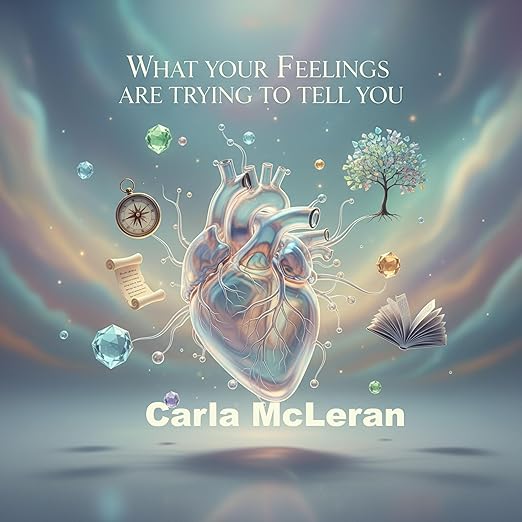
Conscious complaining sits right alongside boundary-setting and grounding work in this audiobook's toolkit, and that one unusual phrase tells you most of what you need to know about how its author approaches emotion. The credits list the narrator and author as Carla McLeran, though listeners who know this material from The Language of Emotions will recognize her as Karla McLaren, the emotion researcher whose name appears to have been transcribed slightly differently here. Whatever the spelling on file, the voice belongs to someone who spent more than a decade researching how shame, anger, and anxiety function as sources of information rather than problems to eliminate. This updated edition runs over twenty hours, and that length signals a genuine curriculum rather than a quick self-help pep talk.
Twenty-Plus Hours Taught Like a Workshop
McLaren's core argument is that every difficult emotion, including the ones we're trained to suppress or fear, carries specific, usable information. Rather than offering generic coping strategies, she builds a framework around distinct emotional signals: what anger is actually telling you, what shame is protecting, what anxiety is trying to prepare you for. The audiobook format suits this material better than you might expect from a reference-heavy psychology book, mostly because McLaren isn't writing in academic register. She's teaching, in the way a good workshop facilitator teaches, with direct address and concrete examples rather than dense citation. Twenty-plus hours sounds long for a self-help title, but the pacing reflects genuine depth rather than padding.
As the author's own voice, the narration carries an authority that a hired narrator simply couldn't replicate here. This is someone describing frameworks she built from years of research and teaching, not reading someone else's conclusions aloud, and that distinction is audible in how naturally she moves through complex material like the five empathy-building skills or the mechanics of trauma recovery. The updated edition adds expanded material on anxiety and a new section on loneliness, both areas where McLaren's grounded, non-alarmist tone does real work; anxious listeners in particular tend to need a voice that doesn't escalate the very feeling it's trying to help them understand, and that's the register she maintains throughout.
Grounding Exercises That Need to Be Heard Aloud
The single strongest argument for choosing audio over text here is McLaren's own delivery of frameworks meant to be practiced, not just read. Grounding exercises, boundary-setting language, and the deliberately odd-sounding technique of conscious complaining all benefit from hearing tone and pacing modeled aloud rather than inferred from a page. Self-help audiobooks live or die on whether the narrator can guide a listener through an exercise without sounding scripted, and an author narrating her own decade of clinical and educational work has a natural advantage there. No listener reviews had accumulated for this edition at the time of this review, so treat this assessment as based on the material and McLaren's established teaching reputation rather than broad audience consensus.
This is explicitly framed as an updated edition of The Language of Emotions, so longtime readers of the original should know what's new: expanded guidance on anxiety, a dedicated exploration of loneliness, and additional practices woven throughout rather than appended as a bonus chapter. For listeners entirely new to McLaren's work, the book functions as a complete standalone introduction; nothing here assumes prior familiarity with her earlier writing. The five-core-skills framework and the emotion-by-emotion breakdown are both explained from the ground up, which makes this a reasonable entry point whether or not you've encountered her research before.
McLeran on the Cover, McLaren in the Research
Twenty hours and twenty-three minutes is a real commitment, and this isn't a book designed for a single weekend binge. It's structured more like a course than a narrative, which means listeners who prefer to absorb self-help material in short, digestible chunks may want to break this into sessions organized around specific emotions rather than working straight through front to back. One thing worth flagging directly: the credited author name shows a spelling discrepancy in this listing, so if you're searching by name and only find Karla McLaren under a different spelling, double-check the credits before assuming you have the wrong edition. The audiobook and the well-known author appear to be the same person under a transcription variant.
Because no listener reviews exist yet for this specific audio edition, I can't speak to pacing complaints or audio quality issues the way I could for a more established title. What I can say, based on the source material itself, is that the content leans heavily on emotional vocabulary and internal reflection rather than external exercises you'd need to pause and physically perform, which makes it more suited to passive listening, during a commute or a walk, than most workbook-style self-help audio. Anyone expecting a strictly clinical or citation-dense approach should recalibrate; this reads as personal and practice-oriented throughout.
It's also worth considering how this fits into the broader landscape of emotion-focused self-help audio. Compared to more clinical trauma literature or purely motivational self-help, McLaren's approach sits in a distinct middle register: rigorous enough to reference real research, accessible enough to function as a daily companion rather than a textbook. Listeners who've tried more prescriptive self-help audio and found it too simplistic, or academic psychology texts and found them too dense, may find this particular balance, emotional depth without either extreme, exactly what they've been looking for in this specific format.
Deep Emotional Work Over a Quick Boost
This audiobook suits listeners who want a genuinely deep, hands-on framework for working with difficult emotions rather than a quick motivational boost. If you're drawn to trauma-informed approaches, emotional literacy work, or the specific idea that anger and shame carry usable information instead of just needing management, McLaren's own voice guiding you through more than twenty hours of material is a strong fit.
Skip it if you're looking for something shorter or more clinical, or if author-narrated self-help without professional voice acting isn't your preference. This also isn't the right choice if you want citation-heavy academic psychology; McLaren writes and speaks as an educator and practitioner first. For everyone else navigating anxiety, anger, or the harder emotional territory the title promises, this is a substantial and personally delivered resource worth the time investment.
Frequently Asked Questions
Is the narrator of this audiobook the same person as Karla McLaren, author of The Language of Emotions?
All available evidence points to yes. The credits here list a slightly different spelling, Carla McLeran, but the content, subject matter, and biography match Karla McLaren's well-known work precisely, so this appears to be a transcription variant rather than a different person.
How long is the What Your Feelings Are Trying to Tell You audiobook?
It runs twenty hours and twenty-three minutes, which reflects a genuinely comprehensive framework rather than a quick self-help overview, so budget for a real time commitment rather than a single sitting.
Do I need to have read The Language of Emotions before listening to this audiobook?
No. This updated edition is designed to work as a complete standalone introduction, though it also includes expanded material on anxiety and loneliness that longtime readers of the original will find new.
Is this audiobook more clinical or more personal in approach?
Personal and practice-oriented. McLaren writes and narrates as an educator and practitioner guiding listeners through frameworks, not as an academic reading citations aloud, so expect direct address rather than dense research language.