Quick Take
- Narration: Jennifer Jewell reading her own work brings an unhurried, observational quality that mirrors the book’s year-long structure, patient, specific, and genuinely in love with its subject.
- Themes: Seed sovereignty, industrial agriculture’s grip on biodiversity, personal observation and wonder
- Mood: Reflective and quietly urgent, like a long walk with someone who notices everything
- Verdict: A book that earns its place on the shelf of anyone who thinks seriously about food, land, and what we choose to preserve.
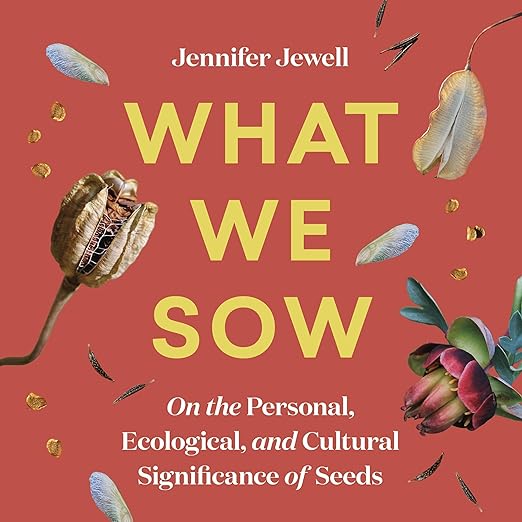
I started What We Sow in late October, which turned out to be unintentionally perfect, the book opens on October 16th, and one reviewer noted that they began reading on that exact day. There is something about the calendar-anchored structure that makes you want to match your listening to the season. Jennifer Jewell has written a book organized around a single year in Northern California, and the attentiveness of that choice carries through every chapter.
Published by Timber Press and running thirteen hours and twenty-three minutes, What We Sow is Jewell’s year-long exploration of seeds: their biology, their politics, their contested ownership, and their startling variety of forms. From the patented genomes of commodity crops to the heirloom seeds reclaimed from historical injustice, the scope of what a small subject can contain is one of this book’s genuine revelations.
Our Take on What We Sow
The book operates on two tracks simultaneously. The first is personal and observational, Jewell on her short daily walks around her Northern California hometown, marveling at seed forms that look like cups, saucers, ocean-going vessels, candelabras. The second is systemic and political, the concentrated control of multinational agribusiness over seed genomes, the patenting of organisms that communities relied on for generations, the advocacy work of activists trying to reclaim legal access to seeds stolen from Indigenous peoples and people of color.
That the book holds both registers without becoming incoherent is Jewell’s real accomplishment. A reviewer described it as part memoir and part botany guide, and that dual frame is accurate. The monthly chapter structure gives the book a built-in rhythm, though one reviewer noted that the chapter subjects do not always correspond tightly to their seasonal labels, which is a mild organizational quirk worth knowing before you start.
Why Listen to What We Sow
Jewell narrates her own book and the result is one of the better author-read performances in recent nature writing. Her voice carries what one reviewer called the patient observation and poetry of a seasoned gardener, and that description holds up. She is not reading at you, she is taking you along on the walk. The thirteen-hour runtime becomes less daunting when you realize the book functions well in half-hour increments timed to an actual walk, which is a listening context this book seems almost designed for.
The writing avoids two common failure modes: the apocalyptic register that lectures you into guilt, and the clinical tone that keeps you at arm’s length from the subject. Jewell writes with patient observation and poetry, neither performing outrage nor disavowing the personal. That voice makes the harder sections, including the Indigenous seed theft history and the agribusiness chapter, land with weight rather than lecture.
What to Watch For in What We Sow
Listeners coming purely for botanical wonder may find the political chapters heavier going. The agribusiness and seed patent sections are necessary to the book’s argument but they represent a tonal shift from the walk-and-observe passages that open each month. The book is at its most pleasurable in those observational stretches and at its most important in the chapters about seed sovereignty and activism. Both need to be there, but your patience with the latter will vary depending on what drew you to the title.
At a 4.2 rating with 48 reviews, this is a book that clearly polarizes along lines of expectation. Listeners who wanted practical gardening guidance sometimes felt misled by the title and cover. This is not a how-to book. It is a meditation that happens to be botanically rigorous.
Who Should Listen to What We Sow
This is the right listen for readers drawn to nature writing that takes ecological politics seriously, the Michael Pollan and Robin Wall Kimmerer shelf, or work like Braiding Sweetgrass in its willingness to hold the scientific and the personal together. It works particularly well for Master Gardeners and anyone engaged with seed-saving or sustainable agriculture communities who wants a broader frame for their practice. It is not for listeners expecting a gardening handbook or a straightforward botanical tour, the politics are load-bearing, not decorative.
Frequently Asked Questions
Is What We Sow a gardening how-to book or something else?
Something else entirely. It is a year-long meditation on seeds, their biology, their cultural significance, and the political struggle over who controls them. Practical gardening guidance is not the focus.
How does Jennifer Jewell handle the political material alongside the personal observations?
Jewell integrates the two tracks, personal nature walks and systemic agricultural politics, without losing the book’s contemplative tone. The agribusiness and seed patent sections are substantive but never feel like a separate lecture inserted into a softer book.
Does the monthly chapter structure work well as an audiobook?
Yes, with a small caveat: the chapter subjects do not always correspond tightly to their seasonal labels, as one reviewer noted. The structure gives the book a useful rhythm but should not be taken too literally as a seasonal guide.
Who is Jennifer Jewell and what gives her authority on this subject?
Jewell is a garden writer and the host of the public radio program Cultivating Place. She brings both horticultural knowledge and a radio journalist’s attention to craft, and her Northern California setting grounds the book’s observations in a specific, recognizable landscape.