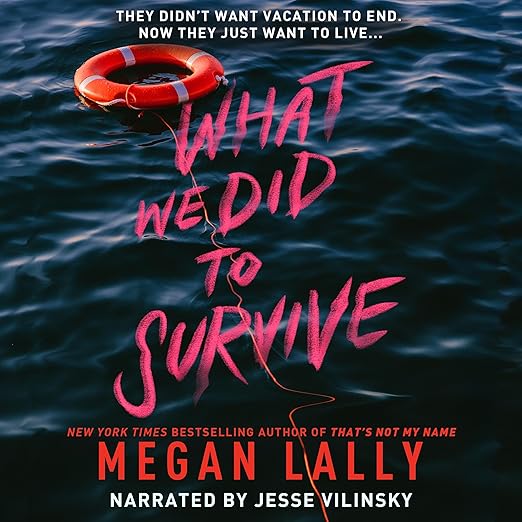
Can Hannah's dream spring break survive a storm that isn't really a storm? Megan Lally's What We Did to Survive audiobook opens with the kind of setup that lulls you before the real trouble starts: a resort vacation in Mexico, a best friend's family footing the bill, and a years-long crush on that friend's older brother Jackson that Hannah has mostly learned to sit on.
The literal storm arrives on the group's last day, when Emmy's wealthy new boyfriend charters a private sailboat for one final outing and the only boat still leaving the marina turns out to be theirs. But the more dangerous weather, per the synopsis's own framing, is building onboard well before the clouds do: Hannah's unspoken feelings for Jackson, her growing unease as the group heads further into open water, and a jealousy dynamic that turns out to matter just as much as the literal storm bearing down on them.
What We Made of It
Lally, a New York Times and USA Today bestselling author, builds this thriller around a genuinely tight setting, four teenagers on one boat, in worsening weather, with nowhere to go, and that closed-circle structure does a lot of the tension-building work before anything explicitly dangerous even happens. The romantic tension between Hannah and Jackson, complicated by Hannah's unwanted status as a third wheel to Emmy's new relationship, threads through the survival plot rather than sitting separately from it.
The synopsis's closing line, asking bluntly who will make it back to land alive, signals that this is a story willing to put its characters in genuine danger rather than manufacturing tension that resolves safely for everyone. That kind of explicit stakes-raising is a deliberate genre signal for readers who want their YA thriller to actually deliver on its premise.
Karen McManus's One of Us Is Lying helped popularize the modern YA locked-room thriller format, a small, sharply drawn group of characters, hidden histories, and a structure built around figuring out exactly what happened and to whom, and What We Did to Survive applies that same basic architecture to open water instead of a classroom, trading a fixed physical space for a boat that cannot simply be left when tensions rise.
Lally's choice to root the danger in something as mundane and universally recognizable as a sudden storm, rather than a supernatural threat or an outright villain established from page one, keeps the early chapters genuinely ambiguous about how dangerous the situation will actually become, letting dread accumulate gradually rather than announcing itself immediately.
Setting the story's opening acts at a Mexican resort before moving the real danger onto open water gives the book a clear geographic and emotional turn partway through, from a controlled, amenity-filled vacation setting where danger feels remote to an uncontrolled natural environment where rescue is not guaranteed, a shift in setting that mirrors the shift in the plot's actual stakes.
The Best Parts of What We Did to Survive
The dual-threat structure here, real physical danger from the storm layered against interpersonal tension that the synopsis describes as just as deadly, gives Jesse Vilinsky's narration real material to work with, shifting between vacation-romance beats and mounting dread without needing supernatural or fantastical elements to generate suspense.
At eight hours and forty-seven minutes, plenty of room remains for the vacation setup, the romantic tension, and the escalating danger to each develop properly before the storm forces everything to a head, rather than rushing straight to peril without establishing why the characters, and listeners, should care about who survives.
Setting a thriller at sea rather than in a more conventional confined space, a house, a school, a cabin, raises the stakes mechanically: no cell service to call for help, no neighbor to notice something is wrong, and no way to simply walk away from an escalating conflict once the boat is far enough from shore. That isolation does real structural work for the plot beyond just atmosphere.
What Might Not Land
No ratings or reviews accompany this listing yet, so early listeners are working without established crowd-sourced feedback on pacing or narration. This review's assessment draws on the synopsis and Lally's track record as a bestselling thriller author rather than an existing audience response.
This is a closed-circle mystery built around a specific reveal, who survives and how, so listeners hoping to avoid spoilers should go in without reading ahead in reviews or plot summaries once the sailing trip actually begins. Part of this book's appeal depends on not knowing the ending in advance.
At close to nine hours, this runs longer than many YA thrillers built around a single confined setting, so listeners expecting an extremely fast, single-sitting read should know the pacing allows real space for character development before the crisis fully escalates.
The romantic subplot involving Hannah, Jackson, and the mystery guy Emmy meets in the surf adds genuine complication to group dynamics once the danger escalates, since characters who are jealous of or distracted by each other make objectively worse decisions under pressure, a realistic touch that raises the stakes beyond the physical danger of the storm alone.
Because the synopsis frames the interpersonal tension as being just as dangerous as the literal weather, listeners should expect the thriller elements to be as much about who the characters can and cannot trust onboard as about surviving the storm itself, a dual focus that rewards paying close attention to the relationship dynamics established early on.
Who Should Listen to What We Did to Survive
YA thriller fans who enjoy tightly confined settings, closed-circle mysteries in the vein of a locked-room story translated to open water, and readers who liked Lally's earlier work are the clear audience for this one.
Skip this one if you want supernatural or fantastical elements in your thriller, since this story stays entirely grounded in realistic danger, or if you prefer slower contemporary coming-of-age pacing over a more overtly propulsive thriller structure.
Fans of Karen McManus's ensemble casts more broadly will also recognize the emotional device at work here, a group who already know each other well rather than strangers thrown together, so the danger activates existing tensions, Hannah's crush, Emmy's new romance, years of unspoken third-wheel resentment, instead of manufacturing new ones from scratch.
In Brief
- Performance: Jesse Vilinsky balances Hannah's romantic distraction and mounting dread well, letting the tension build without tipping into melodrama too early.
- What it covers: A vacation romance curdling into danger, jealousy and third-wheel resentment, survival under a closing timeline
- Feel: Tense and propulsive, with real romantic-thriller crossover appeal
- Our call: A strong pick for YA thriller fans who like their mysteries confined to one tight, inescapable setting, though this is another early listing without much reviewer feedback yet.
Common Questions
Is What We Did to Survive audiobook a standalone story or part of a series?
This listing presents it as a complete, standalone thriller with no series indicated, built around one specific sailing trip and its aftermath rather than an ongoing storyline.
How does Jesse Vilinsky's narration handle the audiobook's shifting tension between the romance plot and the survival plot?
The narration needs to move between vacation-romance beats and mounting physical danger within the same storyline, and the synopsis's own framing of onboard tension as being as dangerous as the literal storm suggests the audiobook is built to sustain both registers simultaneously rather than switching between them cleanly.
How long is the What We Did to Survive audiobook, and is it a single uninterrupted timeline?
The audiobook runs eight hours and forty-seven minutes, and the synopsis describes events unfolding across a single spring break trip, culminating in one specific sailing outing, suggesting a compressed, largely linear timeline rather than a story that jumps widely across time.