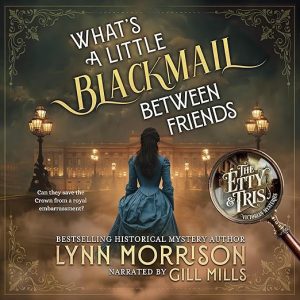
London in 1868 and one compromising sketch: that is the entire engine of this audiobook, and it runs for six hours and seven minutes. Something else on the page is worth noticing before you buy. Four of the five written responses were filed between February 28 and March 2, 2026, while the recording went up on March 13. Four out of five people wrote about this book before anybody could have listened to a minute of it.
Edith Redgrave, called Etty, has spent two years perfecting what the description calls quiet rebellion, and it collapses the moment her closest friend asks for help. That friend is Princess Louise, and the favor is retrieving a scandalous sketch before it takes the royal family down with it. Etty says yes, which is how a woman with a carefully arranged independence ends up inside a blackmail case she has no standing to investigate.
Tristan Bankes-Fernsby, Duke of Rockingham, arrives on the same errand from the opposite direction. Cold, controlled and employed as the Queen's personal fixer, he is sent to contain the problem and has no patience for an amateur working the same leads. The book keeps colliding them in drawing rooms, artists' studios and the untidy edges of polite society until cooperation becomes the only route either of them has left.
Two weeks before release, the longer of the two February 28 responses mapped something the description leaves out entirely: Etty is the young version of a character who already exists in the author's earlier eight-book series, set two generations later, where she turns up as a dowager and the grandmother of its hero. This book is her backstory. For readers of that run the appeal is obvious, and none of it appears on the listing.
Mills Voices a Duke No Review Has Heard
Royal scandal makes an efficient mystery engine because the stakes are legible from the first minute. Nobody has to explain why a sketch matters when a princess is begging for it back, and the plot inherits urgency without a body on the floor. What starts as one compromised drawing opens into blackmail, misdirection and a threat the description says reaches well beyond a single reputation. The trail runs through drawing rooms, artists' studios and the parts of polite society that prefer not to be examined, which gives a short book a surprising amount of territory.
Spunk is the word the March 1 five-star reaches for, describing an immediate affection for Etty and a much slower warming to the rigid duke, whose reactions to her rule-breaking turned out to be the pleasure of the book. That is exactly the shape an opposites-attract partnership should take, and it suggests the humor lands where the author intended: in his responses rather than in her defiance.
Gill Mills is credited with the recording, and the page contains no assessment of that work at all. The reason is unusually clear here: four of the five written responses predate the release date, so their authors were reading rather than listening, and the fifth says nothing about the delivery. On a book carrying two distinct registers, a defiant debutante and a controlled duke, that is the one thing a buyer would most want to know.
Etty or Etta, Nobody Can Agree on Spelling
Spellings wobble badly across the responses. The description gives Edith 'Etty' Redgrave and Tristan Bankes-Fernsby, while the written accounts variously produce Etta, Etsy, Triss and a reordered surname. That matters practically rather than pedantically: a listener trying to find the sequel, or the earlier series these characters connect to, will search for a spelling nobody agrees on and the listing offers no character list to check against.
Marketing scaffolding sits inside the description itself, which closes with a bulleted list of things listeners who love this book supposedly love: loyal friends, opposites attract, forced partnership, political intrigue, secrets hidden in the art world. That block is search-engine furniture rather than description, and it takes up room the copy could have used telling you how the mystery is actually structured.
Slow starts are the one complaint anybody registers. A four-star filed on February 28 says it took a while to get into before turning into a good book, which is a recognizable pattern in series openers that have to introduce a period, a household, a friendship and a case before the plot can move. Budget the first hour accordingly, in a book only six hours long.
Loyalty Costs More Than Violence Ever Could
Historical mystery listeners who want manners rather than menace are the target, and the March 2 five-star catches the tone in two sentences: if a friend needs help, you help, but when the friend is a royal princess you tread carefully. That is the whole book compressed. Loyalty drives the plot, and the period supplies the constraints that make loyalty expensive.
Romance listeners expecting heat should check elsewhere first, since the description signals attraction and friction without indicating anything beyond that, and nobody on the page discusses content. Anybody wanting a hard-edged Victorian crime novel is in the wrong place too: the threats here run through reputation, blackmail and access, not through violence. The danger is social ruin, which in 1868 was quite enough to be going on with.
Start here if a duke and a rule-breaking debutante circling the same investigation sounds like a good six hours, because that is precisely what the book delivers, and ninety-six ratings inside a few months suggest an audience found it fast. Just know that almost everybody who wrote about it had a copy in hand rather than a recording in their ears.