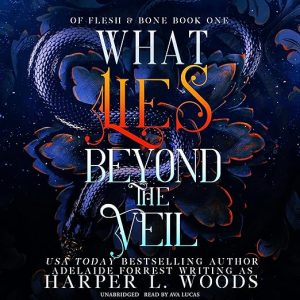
Estrella has spent her life tending gardens at the boundary between Nothrek and Alfheimr, drawn to the Veil's shimmering magic. Harper L. Woods opens What Lies Beyond the Veil with a world that feels like an uneasy negotiated peace, nearly four hundred years since the fae last touched human life, a civilization rebuilt on virtue and survival in place of the decadence and sin the fae apparently inspired. The audiobook narrated by Ava Lucas establishes this world efficiently before dismantling it: the Veil shatters, the fae return with their marks and their swords, and Estrella must run. This is the first book of the Of Flesh and Bone series, and it knows exactly what kind of story it is.
That knowledge is a genuine asset. Woods is writing in a specific lane: fae fantasy romance with a female protagonist in mortal danger, a mysterious marked stranger who becomes ally and then something more, escalating threat from multiple directions, and the kind of slow-burn romantic tension that requires a first volume to establish the foundation for subsequent payoffs. The 'tentative alliance to all-consuming passion' the synopsis describes follows a recognizable arc, but Woods executes it with enough specificity to Estrella and Caelum to keep it from feeling like assembly-line fantasy romance.
Estrella's voice is the book's primary distinction. Reviewers noted that she has a 'sharp tongue' and genuine vulnerability, which is the combination that elevates a fae romance protagonist from passive object to active participant in her own story. The 'touch-her-and-you-die' quality assigned to Caelum, the fae-marked fighter who saves her from the Wild Hunt, positions him within a familiar MMC archetype, but Woods complicates the dynamic by giving Estrella genuine agency within her constrained circumstances. She is running because she has no other viable option, not because the plot requires her to be rescued.
The worldbuilding is functional rather than spectacular. The New Gods, the Mist Guard's role as enforcers of a specifically anti-fae religious order, and the mechanics of the fae mark are established clearly enough to generate stakes without overwhelming the romantic arc. For a first volume in a series, this is the right call: Woods is building the foundation rather than attempting to deliver the complete picture in a single installment.
Why What Lies Beyond the Veil Works as an Audiobook
Ava Lucas's narration suits the material. The first-person female POV benefits from a narrator who commits to Estrella's specific register of sharp observation and suppressed vulnerability, and Lucas maintains that consistency across the book's tonal shifts from flight-and-survival to the emerging tension with Caelum. The emotional beats of the romantic arc require a narrator who can make the transition from wariness to attraction feel earned rather than convenient, and Lucas handles those transitions with appropriate care.
One reviewer flagged the book as 'mildly predictable but still entertaining' with 'good character development' and 'spicy' content, and that's a fair accounting. The Of Flesh and Bone series is not attempting to reinvent fae fantasy romance but to execute it well, and for listeners who love the genre, execution is often what matters most. The spice level is present and intentional; this is an adult fantasy romance and the synopsis doesn't obscure that.
Weak Spots in What Lies Beyond the Veil
This is the first book of a series, and it ends where first books of this kind typically end: the romantic foundation established, the world's larger threat clarified, the resolution deferred. Listeners who want closure within a single volume will find the ending appropriately positioned for a series opener but not satisfying as a standalone conclusion. The Of Flesh and Bone series currently runs several volumes, and committing to this first audiobook means committing to the broader arc.
The predictability noted by one reviewer is real. The romance arc follows familiar beats, the antagonist structure is conventional, and the destination of the emotional journey is visible from early in the book. What Woods provides is confident execution of a familiar genre frame rather than innovation of it. For readers who love fae romance specifically and want a well-constructed example with a protagonist who pushes back, this is a solid choice. For readers looking for genre subversion, the series is unlikely to provide it.
The Veil itself is one of the novel's more interesting world-building choices. Four hundred years of human civilization constructed around the absence of fae, a specific culture of 'virtue and survival' built on the premise that the fae-influenced past was a time of decadence and sin: this is not neutral worldbuilding but a political history embedded in the world's cosmology. The New Gods who replaced the fae in human religious life, and the Mist Guard who enforce their order, represent a civilization that has defined itself through exclusion and denial. When the Veil shatters and the fae return, what's being disrupted is not just a physical barrier but an entire ideological structure, which gives Estrella's flight more political weight than a typical survival-from-monsters opening would carry.
The Right Listener for What Lies Beyond the Veil
Readers who have worked through Sarah J. Maas's ACOTAR series or Jennifer L. Armentrout's From Blood and Ash will recognize the genre territory and find the execution comfortable and satisfying. Listeners who are new to fae romance and want a first-volume entry point with a competent, sharp-tongued female protagonist and a morally protective MMC will find this a clear introduction to the subgenre's conventions. The spice content makes this an adult recommendation rather than a YA crossover despite the college-aged protagonist.
Listeners who are exhausted by the specific conventions of the fae romance subgenre, or who require genre subversion to engage, should look elsewhere. Woods is writing for readers who love the form and want it done well rather than reimagined. But for the substantial audience that comes to fae fantasy romance precisely for those conventions executed with confidence, What Lies Beyond the Veil delivers a first installment that earns continued investment in the series.
- Performance: Ava Lucas maintains Estrella's sharp-tongued first-person voice through the book's tonal range, handling the transition from survival flight to romantic tension with appropriate calibration.
- What it covers: Fae worldbuilding and the collapse of a protective barrier, survival romance with mortal stakes, religious oppression versus ancient power structures.
- Feel: Propulsive and atmospheric, with the slow-burn romantic tension that defines competent fae romance.
- Our call: A well-executed fae fantasy romance opener that delivers on its genre promises for readers who love the form and want Estrella's sharp voice at the center of it.
Is this audiobook the start of a series, and does it end on a cliffhanger?
Yes on both counts. What Lies Beyond the Veil is the first book of the Of Flesh and Bone series. It ends at a point that establishes the foundation for subsequent volumes rather than resolving the central arcs. Committing to this audiobook means committing to the series.
How explicit is the romantic content in this audiobook?
The content is described as spicy by reviewers and adult in orientation. The romantic and sexual content is intentional and present; this is adult fantasy romance rather than a clean or YA-adjacent title despite the young female protagonist.
How does Ava Lucas's narration handle the fae world and character differentiation in this audiobook?
Lucas narrates in Estrella's close first-person perspective throughout, which means the differentiation is primarily tonal and contextual rather than through distinct character voices. The Caelum dynamic and the Mist Guard threat receive different registers in her performance, which maintains the narrative clarity the close POV requires.
Does this audiobook work as a standalone or does the series need to be completed?
As a standalone, it provides a complete first act for a larger story. The romantic foundation is established and the world is fully functional. But the series arcs introduced here are not resolved, and listeners who need conclusions within individual volumes will find the ending more setup than payoff.