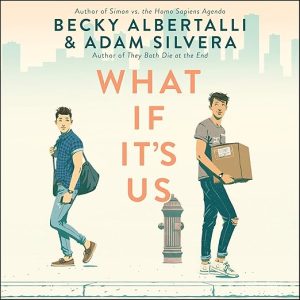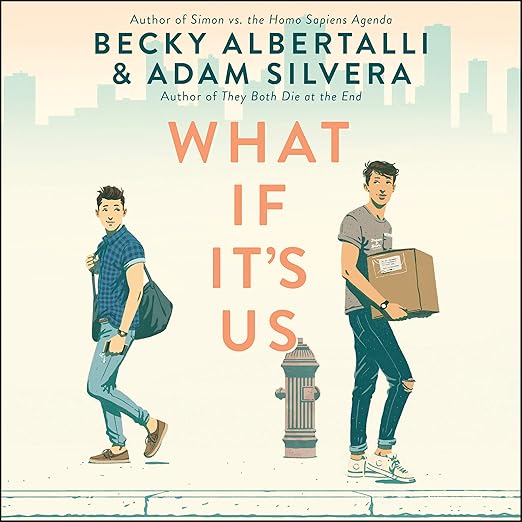
Can a romantic comedy built around repeated failed first dates actually generate sustained momentum? Becky Albertalli and Adam Silvera answer this in What If It's Us through a structural bet that most single-author YA romances would not make: they give each of their two leads a distinct voice, a distinct comic register, and a distinct relationship to the question of whether the universe is on their side, then let those voices talk past each other in ways that feel genuinely funny without undermining the emotional stakes that accumulate underneath. This audiobook is among the stronger entries in co-authored YA, and Noah Galvin's narration is a significant part of why it works as well as it does.
First, the Big Picture
Arthur, spending the summer in New York while his mother works there, is the kind of teenager who has absorbed enough Broadway mythology to believe in the universe as a reliable delivery mechanism for the right person at the right moment. Ben is carrying a literal box of his ex-boyfriend's belongings to the post office, and the universe's timing in delivering Arthur into his path is, from his perspective, an imposition rather than a gift. The meet-cute at the post office is structured around that mismatch of interpretive frameworks, and Albertalli and Silvera use it efficiently to establish two characters who want the same thing for reasons that are almost incompatible.
The repeated first date structure, which sees Arthur and Ben attempting to recreate or build on their initial meeting across three separate do-over attempts, is the book's most interesting structural choice. It refuses to let the meet-cute remain magical. Each attempt accumulates more knowledge about the other person, more opportunity for genuine connection and genuine disappointment, and more evidence that romantic narratives imposed on real relationships are as likely to create friction as to resolve it. The meta-quality of two teenage boys who are themselves aware of romantic narrative conventions trying to enact one is handled lightly enough not to become self-consciously arch.
The characterization is what the dual-author format produces at its best. Arthur and Ben feel like they were written by people who understood them from the inside, because Albertalli and Silvera each took the character closer to their own sensibility and register. That authentic grounding gives the dialogue a specificity that co-authored YA sometimes loses in the negotiation between two distinct styles trying to produce a single consistent voice.
The New York summer setting is used well. Arthur's orientation to the city as a place of theatrical possibility and Ben's relationship to it as somewhere he has lived through multiple emotional seasons give the same environment two distinct textures. The city does not feel generic, which matters for a story whose emotional logic depends on the idea that the right place and the right moment might actually produce something real between two strangers.
Why Listen to What If It's Us
Noah Galvin narrates the entire audiobook, and the choice to use a single narrator across two first-person voices is handled through vocal differentiation rather than a full cast production. Galvin gives Arthur and Ben distinct registers while keeping the audio tonally consistent. His timing in the comedic sequences is strong, particularly in Arthur's chapters where the Broadway-inflected enthusiasm needs to land as charming rather than exhausting over the course of nearly ten hours.
Reviewers noted that both characters feel 'real and fun to follow' and that the gay relationship is written 'with warmth and honesty.' Both observations are accurate and worth saying explicitly: this is not a book that treats its central relationship as problem or exception to be narratively resolved. It is a book about two teenagers figuring out whether they like each other enough to try, in the same register that any such book would use, without making the LGBTQ+ element the organizing dramatic tension.
The book runs just under ten hours, which suits a long weekend or a week of commutes. The pacing moves briskly in the first half and slows appropriately as the emotional stakes become clearer. The do-over date structure gives each section a clear organizing question that prevents the middle from losing shape.
The Caveats
Listeners expecting the kind of resolution-focused arc that most romances deliver will encounter a more ambiguous ending than the genre usually provides. Albertalli and Silvera are more interested in honesty about how relationships actually develop and fail to develop at seventeen than in delivering the expected narrative conclusion. Some reviewers found this fully satisfying given the thematic consistency; others found it deflating after investing in Arthur and Ben across nearly ten hours. Knowing ahead of time that the ending prioritizes emotional realism over genre fulfillment is useful preparation.
The sequel, Here's to Us, continues Arthur and Ben's story, which is relevant for listeners who find the first book's ending incomplete. The first volume stands on its own as a complete character study even without that additional context, but the sequel exists for listeners who want more resolution than the opening book provides.
Should You Listen to What If It's Us?
Teen listeners and adult listeners who enjoy YA with genuine wit and emotional honesty are the natural audience. The LGBTQ+ representation is central rather than supplementary, and listeners who want to see gay teenage romance handled with the same warmth and comedic texture as any other YA love story will find this among the best examples in the genre. Fans of Albertalli's Simon vs. the Homo Sapiens Agenda and Silvera's They Both Die at the End will recognize both authors' voices and find the collaboration generative rather than a diluted hybrid of the two.
If you are already familiar with one of the authors and have been reluctant to try co-authored work, this is a strong argument for reconsidering that hesitation. The dual-voice structure plays to the format's strengths rather than compromising them, and Galvin's narration makes this audiobook a satisfying primary format for the story rather than a lesser alternative to reading it.