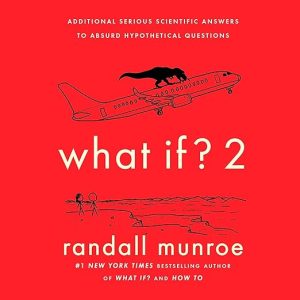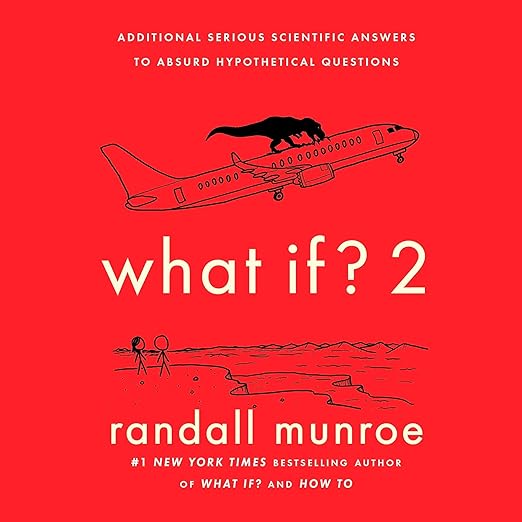
Randall Munroe's What If? 2 audiobook answers questions that no reasonable person would ask, in exactly as much mathematical and physical detail as they deserve. Narrated by Wil Wheaton, this second installment in the What If? series takes the xkcd creator's approach to absurd hypothetical scenarios, consult the research, apply the correct physics, follow the consequences to their logical extreme, and add a stick figure diagram, and extends it to questions about fire poles from the moon, global freezer-door synchronization, helicopter blade riding, and the logistical challenges of feeding Manhattan to a T. rex. The audiobook runs six and a half hours, which is exactly the right length for material that works best in concentrated doses rather than marathon sessions.
Wil Wheaton's casting is one of the better narrator-material pairings in recent science audiobooks. He has been Munroe's narrator for the series, and his delivery by this second volume has settled into a specific voice for the material: smart, slightly self-amused, comfortable with the pivot from serious scientific explanation to escalating catastrophe, and able to read a sentence like "before you go on a cosmic road trip, feed the residents of New York City to a T. rex" with the straight-faced commitment that makes it funnier than it would be if he played it for obvious comedy.
Where This One Lands
The structural premise of the What If? franchise, taking absurd questions seriously, is philosophically more interesting than it first appears. Munroe's method is to establish that no question is too silly to deserve a rigorous answer, and then to demonstrate that the rigorous answer is usually more surprising, more alarming, and more illuminating than anything a casual consideration would have produced. The fire pole from the moon question is not actually about fire poles; it is about orbital mechanics, materials science, and the specific physics of very long rigid structures. The freezer door question is not about freezers; it is about thermodynamics and the limits of individual actions on systemic energy budgets. The comedy is the delivery mechanism for real physics.
This is what distinguishes the What If? books from other popular science that uses humor to make difficult material accessible. Munroe is not simplifying the science; he is using extreme hypotheticals to access it from an angle that removes the usual emotional resistance. The reader who would glaze over a chapter on thermodynamics in a conventional textbook will follow the freezer-door thought experiment with full attention because they genuinely want to know if it would work. Munroe's answer is no, and the explanation of why is a more efficient thermodynamics lesson than most introductory physics courses deliver.
Why Listen to What If? 2
The audiobook format has specific advantages for this material that the print edition, which includes Munroe's hand-drawn diagrams, cannot replicate in the same way. Wheaton's timing on the comic pivots, the moments where the apparently straightforward calculation suddenly reveals that you have vaporized New Jersey or destabilized the solar system, is a significant part of the listening pleasure. These pivots work on the page, but Wheaton's delivery gives them a beat that the written punctuation cannot. The audiobook is not better than the print edition; it is a different and complementary experience.
Listeners who are new to the What If? format will find this second volume fully accessible without having listened to the first. The format is episodic and self-contained; each question is treated independently, and the only continuity between chapters is Munroe's consistent methodological approach. That said, the first book established the format's conventions and built a relationship between Munroe and his readers that makes the second book's callbacks and in-jokes slightly richer for people who came in with prior knowledge.
Wheaton's narration of the scientific passages is notably competent in a way that matters. He is not a scientist, but he is someone who has demonstrably read and understood the material, and his delivery of equations and units is accurate and unself-conscious. There is no performance of bewilderment at the hard parts, no apology in his voice when the physics gets specific. He reads it as what it is: interesting information about the world, delivered at appropriate speed.
What Gives Us Pause
The audiobook format loses Munroe's diagrams, which are occasionally load-bearing for the humor of a specific chapter. Some of the setup-and-consequence jokes depend on a visual element, and those passages are slightly less sharp in audio than in print. Wheaton handles the gaps professionally, and Munroe's writing is descriptive enough that listeners can follow the reasoning without the drawings, but first-time What If? readers who can access both formats should consider reading the print alongside the audio for at least a sample of chapters to appreciate what the diagrams add.
The format's episodic nature also means that the audiobook does not build to anything. There is no narrative arc, no accumulating argument, no payoff in the final chapter that rewards having listened to all the previous ones. This is a feature for some listeners and a limitation for others. Those who prefer nonfiction audiobooks with a progressive argument will find What If? 2 more like a very good podcast than a traditional book. Those who prefer dipping in and out according to their interest in specific questions will find it perfectly suited to that mode of listening.
The Right Listener for What If? 2
This audiobook is for anyone who finds genuine pleasure in watching careful reasoning applied to ridiculous premises. Science educators and students who want accessible examples of physics thinking applied with humor will find it pedagogically useful. xkcd readers who have not yet tried the What If? audiobooks are overdue for a correction. The format is also excellent for listeners who are science-adjacent but not expert, particularly those who want to maintain their conceptual grasp of thermodynamics, orbital mechanics, and basic physics without sitting through another introductory course.
Listeners who prefer their nonfiction to build a sustained argument or who find episodic formats frustrating will want to adjust expectations. What If? 2 is structured as a collection of extended thought experiments rather than a book with a thesis, and its pleasures are cumulative and tonal rather than architecturally progressive.
At a Glance
- Performance: Wil Wheaton is an excellent match for Randall Munroe's voice; his delivery is nerdy in exactly the right register, neither too earnest nor too ironic, and his timing on the comic pivot from setup to absurd scientific consequence is sharp.
- What it covers: Hypothetical physics and engineering, scientific reasoning applied to ridiculous premises, humor as pedagogy
- Feel: Delightfully absurd and genuinely educational, with rapid-fire intellectual energy
- Our call: A joyful audiobook that makes serious science entertaining without diluting it, and the best possible format for Munroe's specific brand of impractical problem-solving.