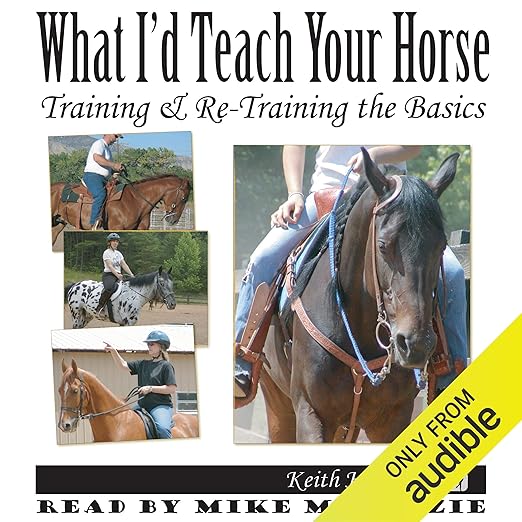
I came to What I'd Teach Your Horse as someone who has reviewed enough equestrian books to know how quickly they can become either too basic or too specialized to be genuinely useful. Keith Hosman avoids both problems through a combination of structural honesty and a voice that feels like advice from a knowledgeable friend rather than a professional positioning himself above you. That tone is harder to sustain than it sounds, and Hosman sustains it across five and a half hours.
The book opens with a declaration of its own limits that immediately earns trust. Hosman is not claiming to make you a competition trainer or to replace discipline-specific instruction. He is offering the foundation that every horse needs before any of the specialized work begins, and the two entry points he defines are clear: if you just broke your horse to saddle, start at Chapter 1. If you have an older horse that has been trained but not well, or has been left to go rusty, start at Chapter 2. That structural clarity is the book's first gift.
Why Basics Are the Substance of Good Training
The conceptual core of Hosman's approach is that basics are not preliminary to good training, they are the substance of it. This sounds obvious stated plainly, but a significant portion of the horse training literature, and a significant portion of what horse owners do in practice, skips over foundational work in the rush to get to more interesting things. Hosman's patient insistence that the fundamentals are the work, not the prelude to the work, is the kind of argument that takes on new meaning the more time you spend with horses that have been inconsistently trained.
The two-section structure of the book reflects this. Section I is the stuff your horse needs to know. Section II is the theory you as a trainer need to understand. Hosman is explicit that practice comes before theory in the recommended reading order for the first few chapters, then you are free to move through the material according to your specific situation. That flexibility respects the reality that no two horse-owner situations are identical, and the book's explicit acknowledgment of prerequisites, Hosman spells out which chapters depend on which, prevents the common problem of applying a technique before the necessary foundation is in place.
Mike McKenzie's Dry, Conversational Delivery of Hosman
Mike McKenzie's narration carries Hosman's voice effectively. The author's prose is conversational in a specific way: dry without being dismissive, funny without undermining the seriousness of the subject, practical without being cold. McKenzie maintains the register across the runtime, and the wry humor that reviewers have noted in Hosman's books, the example of teaching your horse its ABCs aside, lands as it should rather than feeling amplified or flattened.
One reviewer described Hosman's approach as an untangling of the relationship between horse and rider when things have gone wrong. That is an accurate characterization. The diagnostic sections on what rusty or problem behaviors actually indicate about the training history give the book a depth that purely instructional texts often lack. Hosman understands that a horse behaving badly is most likely a horse that was not clearly taught, and he builds his method around that premise rather than around correction of the horse's character.
Body Mechanics Are Harder to Absorb by Ear
The audio format creates a specific challenge for a training book that, at its heart, is about physical instruction. Hosman describes exercises and positions in clear language, but some of the spatial and body-mechanics content will be easier to absorb in print, where you can re-read a passage immediately, than in audio, where you need to hold the description in memory long enough to understand it. Listeners who are actively working through training problems in real time may find themselves pausing and replaying more than they would with most audiobooks.
The book is also specifically written for Western-influenced training traditions. While Hosman is clear that the foundation he teaches applies before any discipline, whether barrels, roping, eventing, or dressage, the context and examples draw on a Western horsemanship background. Listeners from an English or classical tradition will find the fundamentals transferable but the cultural frame familiar in different ways.
Any Experience Level Welcome, Except Competitive Specialists
This audiobook works for anyone who has a horse with training gaps, behavioral problems, or simply an unclear foundation, regardless of experience level. Experienced trainers may find value in the clarity of Hosman's articulation even if the techniques are familiar. Complete beginners with a newly started horse will find it a practical roadmap for the early months. The book is not aimed at competitive specialists or those looking for advanced discipline-specific instruction. Those listeners should come here first and then move to their discipline. For anyone who has wondered whether their training problems are rooted in a foundational gap rather than a horse problem, Hosman's answer to that question is both direct and useful.
Common Questions
Is this audiobook useful for complete beginners, or does it assume prior horse handling experience?
Hosman explicitly structures the book with two starting points: Chapter 1 for horses you have just started, and Chapter 2 for horses with some training history that has become inconsistent or problematic. The tone is accessible to beginners, though some concepts will be easier to absorb with even minimal hands-on experience.
How practical is a horse training book in audio format, given that the content is physical instruction?
It works well for conceptual and theoretical content, and for the diagnostic sections about why certain problems occur. The spatial and body-mechanics descriptions are clear but will sometimes require replay to fully absorb. Many listeners use this as pre-session preparation rather than in-arena reference.
Does Hosman's foundation approach apply to all riding disciplines, or is it Western-specific?
Hosman explicitly states the foundation applies before any discipline, including eventing, dressage, jumping, and roping. But the examples and cultural context draw on a Western horsemanship background. The fundamentals transfer; the framing will feel more native to some traditions than others.
How does Hosman handle horses with significant behavioral problems or a long history of inconsistent training?
Chapter 2 is specifically designed for this scenario. Hosman's view is that most problem behavior reflects training gaps rather than horse character, and the re-training section is built around identifying and closing those gaps systematically rather than around correction or punishment.