Key Details
- Read by: Bruce Perry reads the scientific sections with the measured authority of someone who has spent decades in clinical practice, while Oprah's recorded conversational segments provide an emotional counterweight.
- At its heart: Childhood trauma and brain development, reframing behavioral patterns through a compassion lens, generational cycles of adversity
- Vibe: Open and searching, emotionally generous rather than clinical
- Short version: A genuinely useful book that shifts how you understand yourself and others, structured as conversation rather than lecture in a way that keeps the science from feeling inaccessible.
I picked up What Happened to You? during a period when I was trying to understand something specific about my own history, not looking for a diagnosis, just looking for a framework that might help certain patterns make more sense. I want to be upfront about that because I think this book works differently depending on what you bring to it. If you arrive with a concrete question about why you or someone you care about responds to certain situations in ways that seem disproportionate or confusing, this book is genuinely illuminating. If you arrive looking for a comprehensive trauma therapy resource, it's less equipped to serve you.
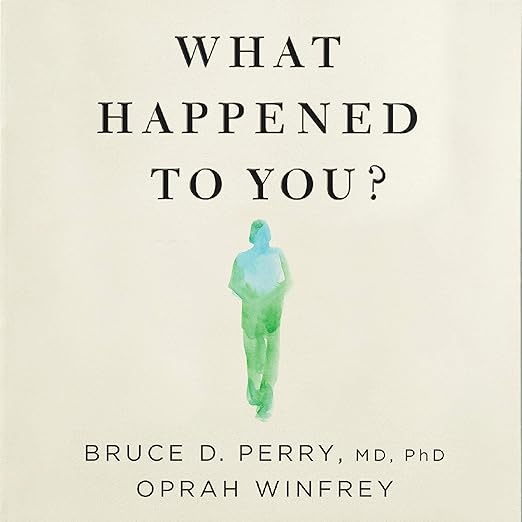
The format is distinctive. Oprah Winfrey and Dr. Bruce Perry conduct an extended dialogue, alternating between Oprah's personal disclosures about her own childhood and Dr. Perry's clinical and neuroscientific explanations of what those experiences do to a developing brain. Bruce Perry reads his own sections in the audiobook, and his narration is exactly right for the material: measured, clear, and free of condescension. He has spent decades explaining complex neuroscience to non-specialists, and it shows. The science doesn't get dumbed down; it gets translated.
From What's Wrong With You to What Happened
The book's central proposition is deceptively simple: when we ask someone who is struggling what's wrong with you, we locate the problem inside the person. When we ask what happened to you, we acknowledge that behavior is often a response to external events, particularly early ones. This reframe sounds small and isn't. It changes how you read other people's reactions, including your own. It changes what questions you ask about the patterns you notice in yourself.
Dr. Perry explains the neuroscience behind this shift with reference to how the brain develops sequentially from the brainstem upward, and how early traumatic experiences disrupt that development in ways that affect the body's stress response systems long after the original threat has passed. This is not speculative. It's grounded in decades of clinical research and in Perry's direct experience treating children who have experienced severe trauma. One reviewer with a background in related clinical work praised the clarity of his explanations. A general listener who recommended the book after her therapist suggested it reported it opened new ground in her treatment.
Bruce Perry's Narration Gives the Science Authority
Oprah Winfrey is not a passive interviewer here. She brings specific experiences from her own childhood, documented with the kind of vulnerability that would be unusual from a public figure if she hadn't spent decades making her own story part of her public work. Her presence does something important for the book's accessibility. Dr. Perry's science could become abstract without a concrete human life running alongside it. Oprah provides that life, and her willingness to locate herself within the frameworks they're discussing models the kind of honest self-examination the book asks of its reader.
The alternating structure translates reasonably well to audio. The dialogue format means the listener is essentially eavesdropping on a conversation between two people thinking through difficult material together, which is more engaging than a straight lecture would be. Perry's narration of his own sections gives the clinical passages an authority they'd lose with a different voice, and the overall rhythm of science-then-story keeps both elements from becoming overwhelming.
An Introduction Rather Than a Treatment Guide
Honesty requires noting what What Happened to You? is not. It is not a treatment guide, a therapy substitute, or a comprehensive examination of trauma's full range of effects. It is an introduction, and a compassionate one, to a way of thinking about human behavior that has clinical backing and that most general readers have not been systematically exposed to. For someone who is already well-versed in attachment theory, developmental neuroscience, or trauma-informed care, there will be familiar territory here.
For someone who has never thought explicitly about how early experiences shape neurological development, the book can be genuinely life-changing in the modest sense that the best accessible nonfiction sometimes is: it gives you a language for things you've observed but couldn't name. Several readers reported their therapists recommending it, which is a meaningful data point about where the book sits on the professional-to-general spectrum.
Compassionate Language for Understanding Childhood Adversity
This free audiobook serves listeners who want to understand childhood adversity and its long-term effects on behavior and health without a clinical or academic framing. It's accessible without being superficial, and it's warm without being sentimental. The book is best approached as a companion to, not a replacement for, professional support. Recommended for adults who are curious about their own patterns, educators who work with children who have experienced adversity, and anyone who wants a more compassionate vocabulary for understanding the people around them. The eight hours and twenty-six minutes are well spent, and the conversation format makes the runtime feel shorter than it is.
Good to Know
Is this book appropriate for people currently in therapy dealing with their own trauma?
Many therapists actively recommend it to their clients, as reviewers confirm. It can provide useful vocabulary and context for therapy work. However, it's an introductory text and should complement rather than replace professional support.
Does Bruce Perry's narration of the scientific sections make them accessible to non-specialists?
Yes. Perry has spent decades translating neuroscience for general audiences, and that skill is audible in his narration. He explains the brain's developmental sequence and trauma's effects clearly without over-simplifying or burying the listener in technical vocabulary.
Is the book more useful for understanding your own history or for understanding other people's behavior?
Both, and the reframe from what's wrong with you to what happened to you applies in both directions. Readers report it shifting how they interpret their own patterns and how they respond to behavior in others that previously seemed inexplicable or frustrating.