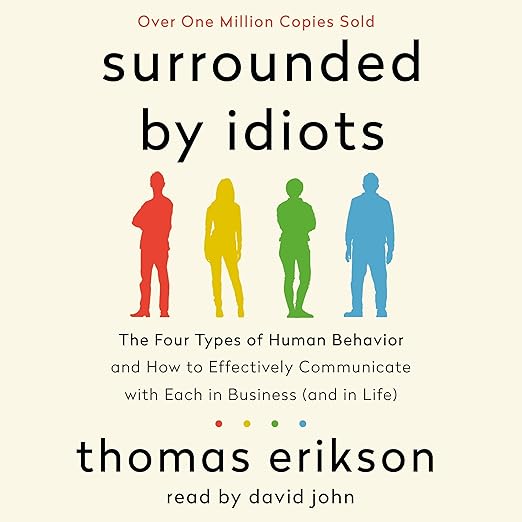
Four colors carry the whole system, and that is either the genius of this book or the reason to be careful with it in audio. Thomas Erikson's Surrounded by Idiots sorts everyone you deal with into "Reds who are dominant and commanding, Yellows who are social and optimistic, Greens who are laid-back and friendly, and Blues who are analytical and precise", and the audiobook runs ten hours and forty-seven minutes on that foundation. The listing carries only fourteen ratings for a title the publisher describes as having "sold more than a million copies worldwide", so the five written reviews are doing all the work, and one of them is genuinely useful about the format.
Erikson's premise is a communication tool disguised as a complaint. His argument is that friction with colleagues, partners and in-laws comes from mismatched behavioral defaults rather than from anyone being stupid, and that once you can identify which default you are dealing with you can adjust how you speak. The copy promises practical material built on that: "the strengths and weaknesses of all the profiles", how to give each type positive and negative feedback, and even "the best way to word an email when writing to someone with a different profile".
Two reviewers describe the appeal in almost identical terms without using the same words. One calls it "a fun dive into why sometimes it feels like you're the only sane person in the room" and reaches for the right metaphor, "kind of like having a cheat sheet for dealing with everyone from your boss to your in-laws". Another praises the framework as a refreshing take on personality and communication and pointedly notes that the book does not actually treat anyone as an idiot, despite what the cover shouts.
The most credible endorsement is also the most qualified. A four-star reviewer came to it straight from a DiSC assessment and reports that in that context it was genuinely helpful, with the color scheme making earlier results click and prompting quick recognition of "coworkers, family members, and even my own communication patterns". That is exactly the use case where a simplified typology earns its keep: as a translation layer over a framework you already half-know. I would treat this book as a vocabulary rather than a science, and on that understanding it is a good one.
The Strengths
The performer credited here is David John, and the demand this material makes is more specific than it first appears. A four-color taxonomy is a visual mnemonic. On a page you see the scheme, and the label and the concept fuse. Spoken aloud, Red and Blue are just two more nouns competing for space in a listener's memory across eleven hours, and every worked example depends on you having kept the four straight. A reading has to lean on the color words hard enough that they stay tagged to their traits, and the publisher has kept the profile tables in an accompanying PDF instead of reading them out.
What the format does offer is repetition without effort, and that helps here more than usual. Behavioral typing only becomes useful once it runs automatically, and hearing the four profiles applied to a dozen situations over several commutes gets you there without effort. The conversational register also travels well: reviewers describe the tone as fun and refreshing rather than clinical, and the publisher's own promise to skip "overly technical categorizations" is borne out by the way reviewers talk about it.
Listeners who work in teams may get the most out of hearing it. The email-wording and feedback sections are the parts people actually apply, and they are short, concrete and easy to recall from audio in a way that a diagram is not. I would keep the PDF open on a first pass and then treat later listens as reinforcement.
What to Watch For in Surrounded by Idiots
Length is the complaint that matters most, and it lands harder in audio than the reviewer who raised it could have known. The four-star response says "the book felt much longer than it needed to be" and that "The core ideas are solid, but they're repeated often enough that it started to feel a little padded". In print you skim a paragraph you have already understood. Across nearly eleven hours you cannot, and a listener who has the four types secure early on will keep hearing them restated for most of what remains. Anyone impatient with repetition should consider whether a shorter treatment of the same framework would serve them better.
The title sets an expectation the book does not meet, and the pool's bluntest reviewer says so first: "The title is all wrong" and "The book has nothing to do with dealing with incompetent coworkers". That reviewer is right, and it matters commercially, because the cover promises a survival guide to difficult people while the contents deliver a neutral typology. Anyone who wants a playbook for handling an actively difficult colleague is buying the wrong book.
Weigh the audience question too, since the same three-star review draws a sharp line: "A good read for twenty-somethings who are learning how to navigate the workplace" and "Not a good book for older professionals", who may find it covers ground they already know. Note as well that the listing files this within a series of the same name without giving it a number, which suggests companion volumes exist and this is the entry point. And treat the fourteen ratings as a cataloging quirk rather than a verdict, given the sales figure the publisher claims.
Recommended For
Early-career professionals are the clearest fit, and the three-star review says so explicitly. It also suits anyone who has recently taken a workplace personality assessment and wants the results explained in plainer language, anyone managing a small team for the first time, and anyone whose home life involves repeatedly failing to communicate with a relative who processes information differently. The framework is memorable enough to use the same week you finish it.
Management advice for a senior career sits outside this book's range. Experienced professionals, HR practitioners and anyone with a psychology background should expect familiar territory presented simply, and the three-star review is candid that it would not have been a purchase after a browse. Readers who want peer-reviewed personality science rather than a popular four-color heuristic will not find it here, because the book trades rigor for usability by design.
Practical guidance for this edition: download the companion PDF first, and give yourself permission to speed up or step out once the four types are locked in. The reader carries no blame for that. A book whose own admirers call it padded produces exactly this problem. Get the vocabulary, apply it to three people you find difficult, and the eleven hours will have paid for themselves well before the end.
In Brief
- Narration: a four-color mnemonic is a visual device, so the labels have to stay welded to their traits by ear alone across eleven hours, with David John credited as reader.
- Themes: behavioral typing, workplace communication, feedback and email tone, understanding difficult relatives.
- Mood: chatty and pragmatic, closer to a workshop than a study.
- Verdict: a genuinely usable communication vocabulary, padded enough that the audio edition tests your patience.
A Few Questions About Surrounded by Idiots
Do I need the PDF to use this audiobook?
It helps considerably. A color-coded scheme is inherently visual, and the profile charts sit in the supplied PDF rather than being spelled out in the recording. Keep it open on a first pass, then let repeat listening do the work of fixing the categories in memory.
Does the repetition hurt the audiobook experience?
It can. A four-star reviewer found the length well beyond what the argument required and the central points restated to the point of padding. You cannot skim a recording, so anyone who grasps the four profiles early will keep hearing them for hours afterward.