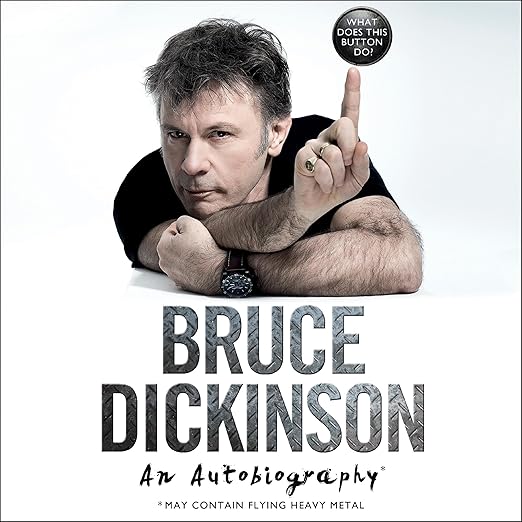
Rock memoirs usually promise the parts an artist will not actually hand over, and this audiobook is unusual for stating the deal up front. Bruce Dickinson wrote it by hand first, reads it himself, and declines to open his private life. What arrives instead is three decades with Iron Maiden, a commercial airline career, competitive fencing, a brewery, and an illness he beat.
Eight Occupations Before It Reaches Singing
An Italian-language response filed on January 11, 2018, from somebody who opens by declaring the bias of a fan, gives the frankest account of what this book withholds. That reader went in eager for personal facts and found them carefully avoided, exactly as the author explains in the afterword, and reports the disappointment turning into respect for the reserve. Start your buying decision there, because the reticence is deliberate and stated.
Range is the selling point and also the structural problem. Airline captain, aviation entrepreneur, motivational speaker, beer brewer, novelist, radio presenter, film scriptwriter, world-class fencer: the publisher's own list reaches eight occupations before it arrives at singing. A memoir covering that spread in eleven hours cannot go deep on any one of them. You get a man's curiosity rather than a career study.
Four Votes That Can't Display a 4.6
Counting on this page fails in a precise way. Four whole-star votes can land on 4.5 or on 4.75 and nowhere between them, so a displayed 4.6 sits in a gap no combination of the four ratings the counter admits could reach. Five separate accounts sit beneath that counter, one more than it allows for, and their grades come to 4.8.
Voice Is the Whole Argument for Audio
Somebody who has been a fan since the Piece of Mind album and its tour, writing at five stars, reports the thing worth knowing: hearing Bruce narrate it was the treat. That reader arrived already familiar with the music, the fencing, the aviation and the illness, so what was new was not the facts but the delivery. Worth noting that the entry is stored under August 11, 2018 while opening with an update stamped the twenty-third of the same month, so the timestamps here record something other than when a person stopped writing.
Anecdote is the unit here rather than chronology. Childhood inside what the description calls the eccentric British school system, early bands, the years fronting Maiden, then a solo career and the illness, each handled as a story worth telling rather than a milestone worth logging. Humor is the connective tissue, and it runs anarchic in a way authorized memoirs almost never do.
Voice is the whole argument for choosing this format over the page. Dickinson's profession is projection: an operatic singing style, decades of stage presence, a room full of people to reach. Reading a memoir aloud is a different discipline, closer to the radio presenting he has also done for a living. Sample a passage from the childhood material, where the comedy is dry rather than loud, and see whether the pacing holds you.
No Audio Producer Identified Anywhere
Discretion is the price of access. A thirty-five-year fan, posting on November 13, 2017 at four stars, sets the expectation correctly: this is not a biography of the band, it is just the one guy. The same account describes the book as ranting along rapidly, telling you enough to perk your ears and never enough to cost anybody their job. That is the single response holding back a star, and what it holds back for is discretion.
Absences are worth listing before you commit. Band controversy is kept to a minimum, the private life stays closed, and none of that is concealed from you. It is a choice made openly, and the consequence is that the book works as a self-portrait rather than as an account, with all the blind spots a self-portrait carries. Anybody wanting the Maiden story, the lineup changes and the studio arguments, is buying the wrong memoir.
Publisher information is thinner than it first appears. The imprint line names Dey Street Books, a print house, and no audio producer is identified anywhere on the record. On a memoir whose central selling point is that the author reads it himself, a missing studio credit is a strange gap, and it leaves the direction, the editing and the sound unattributed to anyone.
Shelving files this under arts and entertainment with a Music tag, which covers roughly half the contents. Aviation, fencing, brewing and a hospital ward make up the rest, and none of them shows in the categories. Prose runs dense in places too, and the description signals as much by promising unbridled creativity and anarchic humor rather than clarity. Expect long sentences and British idiom delivered at speed.
Cancer Survivors Are a Fourth Audience
Iron Maiden fans will find plenty here, though not the tell-all some of them are hoping for. The other November 13, 2017 response, at five stars, describes what actually arrives: a good amount of detail about the childhood, which sheds light on how the driven personality got assembled, plus the hobbies and enough funny stories to keep the whole thing moving. Fans of the music get the man's formation rather than the group's.
Aviation people and fencers should not be put off by the metal on the cover, since both pursuits get real space and come from somebody who pursued them at a serious level. Anyone curious about how a person builds several careers at once will find this more useful than most business memoirs. Cancer survivors and their families make a fourth audience, the illness being one of the subjects the book names for itself rather than an epilogue.
Anyone hoping for the band's story should look elsewhere, because the lineup history, the studio arguments and the internal politics are all deliberately out of frame. Buyers who need a confessional will spend the entire book being charmed by a man who is friendly, funny and completely closed on the subject of himself. As memoirs by musicians go, this one is unusually well made and unusually well guarded.
Good to Know
Is this audiobook worth it if you are not an Iron Maiden fan?
The October 19, 2018 five-star answers that directly. It comes from a metal listener who was never a Maiden devotee, bought on impulse, and had been busy with a band of their own through the eighties. What sold that reader was the writing and the intelligence rather than the fandom. No knowledge of the catalog is assumed anywhere.
Does the audiobook give flying and fencing as much room as music?
Close to it. The publisher's own list sets airline captain, aviation entrepreneur, beer brewer, novelist, radio presenter, scriptwriter and world-class fencer alongside the singing, which is eight occupations competing for eleven hours. Treat this as a life rather than a career, and do not expect any single strand to be finished.
Does he write about his cancer?
Yes. The illness is named in the description as one of the book's subjects and the copy calls it recent, so it sits inside the memoir rather than trailing off the end of it. What is not promised is a redemption arc. The reserve applied to the rest of the private life applies here too.
Why does the book avoid the band's internal history?
Because a memoir written in the subject's own hand answers to nobody else's agenda. The private life stays shut and the group's internal arguments stay outside the frame, which narrows the book and sharpens it at once. What you are buying is a self-portrait rather than the story of a band.