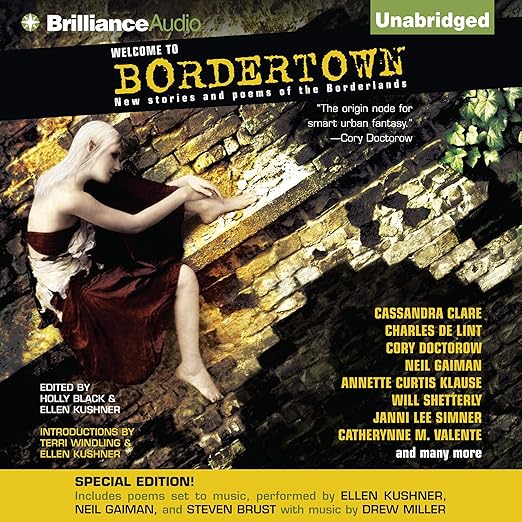
Bordertown has always been a collaborative fiction project as much as a publishing category, and the craft behind Welcome to Bordertown: Special Edition is inseparable from that history. This audiobook, narrated primarily by Cassandra Campbell with original music by Drew Miller and Neil Gaiman reading his own poem "The Song of the Song," collects thirteen interconnected stories and eight poems from an extraordinary roster: Holly Black, Neil Gaiman, Ellen Kushner, Cassandra Clare, Charles de Lint, Cory Doctorow, Nalo Hopkinson, Amal El-Mohtar, Catherynne M. Valente, and more than a dozen others. The city on the Border between the human world and the elfin realm (where neither magic nor technology functions reliably and elf and human runaways find each other in the wreckage) gets its first major anthology in years with this collection.
The Special Edition designation is earned rather than marketing. Drew Miller's fully-produced track of "Run Back Across the Border," with Steven Brust himself on lead vocals, is the kind of audio-specific addition that transforms an anthology from a performance of a text into something native to the listening format. Music has always been central to Bordertown's DNA: the city is a place where bands form in abandoned buildings and the soundtrack matters as much as the streets. The audio additions honor that without overwhelming the fiction.
Our Take on Welcome to Bordertown: Special Edition
The anthology reopens Bordertown after a thirteen-year gap within the fiction's internal timeline: thirteen days inside Bordertown's elastic time, thirteen years for those who remained outside. That framing gives the collection's internal structure a real emotional charge: characters returning to a city that kept moving without them, or encountering it for the first time after growing up in its absence. Reviewer L. Carey's response captures the emotional mathematics of this: even without having read earlier Bordertown collections, the gap resonates because it is built into the anthology's logic from the opening pages.
What makes this collection exceptional rather than merely accomplished is the consistency of quality across contributors who write very differently from each other. Holly Black's story, Cassandra Clare's contribution, and Ellen Kushner's presence connect this anthology to the urban fantasy tradition that preceded and followed it. Nalo Hopkinson and Amal El-Mohtar bring voices that expand the city's geography. Bordertown has always been multiethnic, but this collection is the most fully realized version of that commitment. Catherynne M. Valente's prose operates at a different register from most of the others, and the juxtaposition makes both hers and the more accessible pieces sharper by contrast.
Cassandra Campbell is a skilled anthology narrator, and the challenge with a collection like this is maintaining sufficient distinctiveness between thirteen different authorial voices without turning each story into a performance exercise that draws attention away from the fiction. Campbell threads that needle with characteristic care, giving each story space to breathe in its own register rather than imposing a uniform interpretive overlay. Her voice suits the urban fantasy register of the material: neither too formal for the gritty street-level stories nor too casual for the more literary contributions.
Reviewer Tara O'Shea describes being introduced to a world where Faerie had returned and human and fey runaways flocked to a crumbling city where technology and magic were equally wonderful and equally unreliable. That description explains why this anthology works well as both entry point and continuation. The world-rules are established through immersion rather than exposition: you understand how Bordertown functions by experiencing it across multiple stories rather than having it explained in a preamble.
What to Watch For in Welcome to Bordertown: Special Edition
Reviewer Bill Reich notes that the collection may not be fully appreciated without familiarity with earlier Bordertown stories. That caveat is honest, though the anthology's editorial structure makes it more accessible to newcomers than Reich's assessment implies. The thirteen-year gap is itself a narrative device that puts returning characters and new arrivals on relatively equal footing: the city has changed for everyone. Listeners who want to go deeper can seek out the original anthologies, but this collection is not dependent on that prior reading for its immediate pleasures.
The eighteen hours and ten minutes of runtime reflects the genuine scope of the collection. Anthology audiobooks present a specific listening challenge: the shift between stories requires slightly more active orientation from the listener than a single-narrative listen. The interconnected nature of the thirteen stories provides some continuity across that challenge, since Bordertown is the constant even when the characters change, but listeners who prefer the sustained world of a single novel may find the anthology format requires more adjustment than they prefer.
The editing by Holly Black deserves specific acknowledgment. Anthology editing at this level (selecting pieces that work individually and resonate collectively, balancing established contributors with newer voices, ensuring the shared world feels inhabited rather than merely referenced) is genuinely difficult, and the collection shows the evidence of that difficulty being met well. The thirteen stories and eight poems do not feel like a grab-bag; they feel like a city, which is exactly what Bordertown requires its fiction to do.
Who Should Listen to Welcome to Bordertown: Special Edition
Urban fantasy readers with any attachment to the genre's foundational texts will want this. Fans of individual contributors (particularly Gaiman, Black, Kushner, or Valente) who have not yet encountered Bordertown will find this a worthwhile introduction to the shared world project. The original music and Gaiman reading his own work make the Special Edition the clear choice over the standard version. Readers new to urban fantasy or anthology fiction who want a single-narrative introduction to the genre would be better served starting elsewhere, but those who enjoy short fiction and can orient to an ensemble setting will find eighteen hours of this richly rewarding.
Common Questions
What makes the Welcome to Bordertown: Special Edition audiobook different from the standard edition?
The Special Edition includes original music by Drew Miller, a fully-produced track of 'Run Back Across the Border' with author Steven Brust on lead vocals, and Neil Gaiman reading his own poem 'The Song of the Song.' These audio-specific additions are built into the audiobook and make it genuinely distinct from a print reading.
How does Cassandra Campbell handle narrating thirteen different authors' stories in this audiobook?
Campbell gives each story its own tonal register without creating dramatic performance shifts that draw attention away from the fiction. Her approach suits the anthology format well, maintaining enough consistency to hold the collection together across its eighteen-plus hours while respecting each contributor's distinct voice.