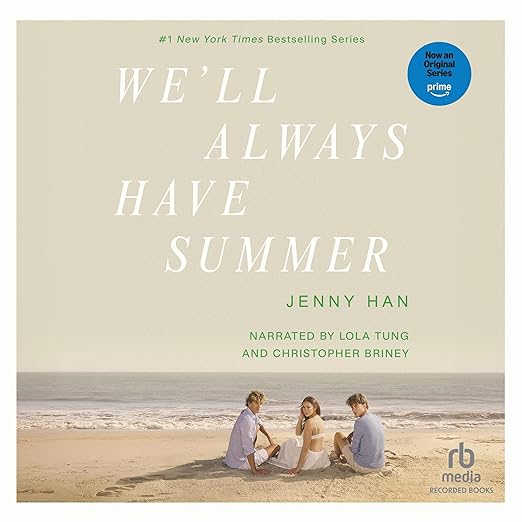
Belly Fisher stands at the kind of crossroads that only works in the last book of a trilogy: two boys, both of whom love her, both of whom she has loved, and a summer that has been the organizing principle of her life since childhood. Jenny Han built the Summer I Turned Pretty series on the specific ache of growing up inside a place you visit, a borrowed house and a borrowed life that exists only in the heat between June and September. We'll Always Have Summer is the closing of that loop, and narrator Lola Tung, who also played Belly in the television adaptation, brings something to the audiobook that most final-installment narrators cannot: she knows this character from the inside out.
When two people love the same person in a love triangle that concludes a series, the audiobook has a structural problem. Listeners who have spent two prior books wanting Belly to end up with one Fisher brother versus the other will arrive at the conclusion having already made up their minds. Han does not try to make the choice feel genuinely open; she is honest that this is a story about Belly arriving at a decision she already knows, even when she will not say so out loud. That is a braver narrative choice than keeping both options alive until the last page. It is also what makes the final confrontation between Belly and Conrad feel earned rather than manufactured.
Belly Already Knows the Choice She's Making
Han's prose throughout the trilogy has been built on sensory accumulation: the smell of the beach house, the particular light of late summer, the physical geography of a place that carries emotional history in every room. Tung's narration captures that quality well. She has the same slight hitch in Belly's voice when Conrad appears that Han writes into the text, and in audio that involuntary tell is more visible than on the page. Listeners who have not read the prior two books should begin at The Summer I Turned Pretty. The emotional payload of this conclusion depends entirely on the history built across the first two installments.
The central tension in this book is not really between Jeremiah and Conrad as choices. It is between the version of Belly who chose safety and the version who chose truth. Jeremiah is warm, devoted, and present. Conrad is mercurial, self-sabotaging, and real to Belly in a way she cannot reason her way around. Han does not make Jeremiah a villain to justify the conclusion. He is genuinely good, and the audiobook is honest about the cost of Belly's decision to whichever brother she leaves behind.
Lola Tung Brings the Screen Belly to Audio
The casting of Lola Tung as narrator is the audiobook's significant asset. Her television performance as Belly in the Prime Video adaptation was noted for physical restraint and interior complexity, and she brings both of those qualities to the audio performance. She does not impose the character she played on screen over the character Han wrote on the page; the two are consistent, and Tung inhabits the text rather than illustrating it. Reviewer 'Goose Girl' noted that the series 'finally' delivers 'closure,' and the audiobook pacing supports that arc: Tung does not rush the emotional reckoning in the final chapters, which is exactly the right instinct for a story that has been building toward a specific moment across three books.
At six hours and three minutes, this is the shortest of the three Summer books in audio. It does not feel compressed. Han writes efficiently in this installment because she knows she has done the foundational work in the earlier volumes, and Tung's narration trusts that the listener already carries the emotional weight. The result is an audiobook that moves quickly without feeling rushed.
Decent for Outsiders, Personal for True Fans
Reviewer Tara Clark described this as 'a decent ending to the series' that 'didn't fully pull me in emotionally the way I hoped it would.' That is a fair calibration for listeners coming in from outside the core audience. The series is written for readers who will feel the Conrad-versus-Jeremiah question as something personal. If you have been following Belly's story across two books and investing in her relationships, the conclusion lands with genuine weight. If you are arriving here as a general YA fiction listener without that investment, the emotional intensity will be harder to access.
Tung Performs Conrad's Name in a Catch
The book assumes complete familiarity with the first two installments. Tung's narration does not recap or reestablish characters; the Fisher family dynamics, the beach house history, and the specific texture of Belly's childhood feelings for Conrad are all carried as given information. New listeners who start here will find the story intelligible but emotionally thin compared to what series readers experience.
Tung's narration also carries the series' central tension in her voice's relationship to Conrad's name. Jenny Han writes Conrad as someone who occupies emotional space differently from Jeremiah, less present, more significant, and Tung understands that in audio the distinction cannot be stated. It has to be performed in the slight catch, the brief pause, the shift in register that Belly's narration cannot always acknowledge about itself. For readers who have been certain since the first book that the series would end this way, the audiobook's final chapters are not a surprise but an arrival. Tung's narration serves that experience: she knows where she is going, and the listening knows it too, and still the last few chapters hold.
Series Completionists Get Exactly What They Expect
Series completionists who have been with Belly since The Summer I Turned Pretty will find this audiobook delivers what it promises. Fans of the television adaptation who want to hear Lola Tung's narration of Han's original text will get a slightly different but deeply compatible experience. Listeners new to the series should start at Book 1 before coming here. This is precisely the audiobook it was built to be: a conclusion for readers who already know what it costs.
- Narrator: Lola Tung, who played Belly on screen, brings the character's interior complexity directly to audio without imposing her television performance over Han's text.
- Subjects: Closure versus safety, the cost of honest desire, summer as emotional archive
- Tone: Bittersweet and intimate, built for series readers
- Bottom line: A satisfying conclusion to Han's trilogy that rewards the emotional investment of listeners who have been with Belly from the beginning.
A Few Questions About We’ll Always Have Summer
Does Lola Tung narrate this audiobook the same way she played Belly in the TV adaptation?
Tung's narration is consistent with but not identical to her screen performance. She inhabits Han's prose directly rather than recreating her television characterization. The voice has the same interiority and restraint, and the result feels like a continuation rather than a divergence.
Can I listen to this audiobook without having read or listened to the first two books in the Summer series?
Technically yes, but the emotional impact will be substantially reduced. Han does not recap the prior two books, and Tung's narration assumes the listener already carries the history of Belly's relationships with both Fisher brothers. Start at The Summer I Turned Pretty for the full arc.
Is the conclusion of the audiobook satisfying for readers who wanted Belly to end up with Conrad?
Han does not manufacture a false open ending. The story arrives at its conclusion with honesty about what Belly has always known. Whether the resolution feels satisfying will depend on where your investment has been across the trilogy, not on any fault in the audiobook's execution.