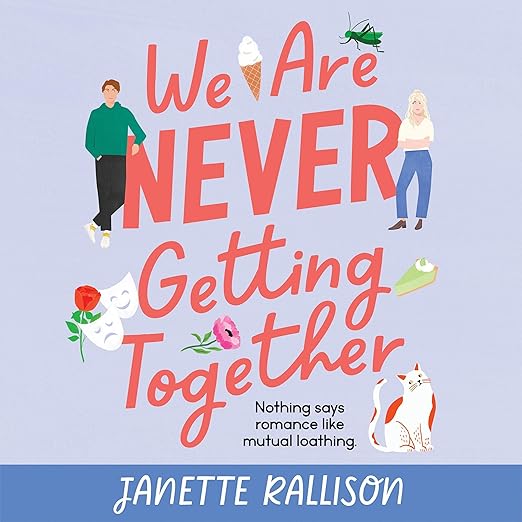
Can two years of glitter bombs and a plastic-wrapped car really end with Madeline and Cooper faking a relationship? That's the setup this audiobook runs with, a reverse Parent Trap where two feuding teenagers team up not to bring their single parents together, but to keep them apart. Madeline and Cooper's rivalry dates back to a stolen school play lead, and their prank war has only escalated since, right up to a viral video that lands them both in the principal's office.
That same office visit is where things go sideways: their parents, called in together, hit it off immediately and start planning a dinner date. Horrified, Madeline and Cooper strike a truce, faking their own relationship so their parents will see the pairing as a bad idea and back off. Janette Rallison builds We Are Never Getting Together around that reversal, and the fake relationship predictably starts generating real feelings neither teen signed up for.
First, the Big Picture
The reverse Parent Trap structure is the book's smartest move. Rather than recycling the familiar setup of kids scheming to reunite their parents, Rallison flips the emotional stakes: here the teens are actively sabotaging a relationship the adults actually want, which puts Madeline and Cooper in the position of villains in their parents' story even as they're cast as reluctant allies in their own. That inversion gives a well-worn premise real freshness.
The escalation history between the two leads, plastic-wrapped cars, glitter bombs, an actual viral video, does a lot of efficient groundwork before the fake-dating plot even starts, establishing a rivalry with enough specific, petty texture that the eventual softening between them has real distance to travel. Rallison, a USA Today bestselling author, leans into that history rather than starting the enemies-to-lovers arc from a blank slate.
The reverse framing is worth spelling out precisely: in the classic Parent Trap setup, kids scheme to reunite two people who used to be together. Here, Madeline and Cooper are actively working against a brand-new relationship their parents are excited about, which puts them in an adversarial position toward their own families rather than a matchmaking one. That distinction changes the emotional texture considerably, since the teens have to reckon with actively sabotaging their parents' happiness rather than restoring it.
Why Listen to We Are Never Getting Together
This is explicitly billed as a clean YA rom-com, which signals a specific, family-friendly register: comedic escalation and swoony tension without graphic content. Fans of enemies-to-lovers stories where the enmity is rooted in something concretely petty rather than vaguely established will find the school-play backstory and prank war give this version of the trope unusually solid footing from the very first chapter.
The family-blending angle also adds a layer beyond a standard high school rivalry-romance. Watching two teens sabotage their own parents' happiness while falling for each other themselves creates a kind of double romantic plot running in parallel, and readers who enjoy stories where the protagonists' actions have consequences reaching beyond their own relationship should find that structure genuinely satisfying rather than just a comic subplot.
That same prank history gives the audiobook's early chapters real comedic momentum before the fake-dating plot even begins, letting a narrator lean into broad comedy for the setup chapters before the story's more sincere back half takes over. That tonal runway matters in audio specifically, where a narrator needs room to establish a comedic register early so the later emotional turn actually registers as a genuine shift rather than jarring whiplash.
What Might Not Land
Aunah Johnson narrates, and I could not turn up a prior track record to draw on for how she handles YA rom-com pacing specifically, the comic timing a prank war requires versus the more sincere register the genuine-feelings turn needs later. Worth sampling a clip if narrator performance matters to your buying decision, since this is effectively an unknown quantity going in.
At 7 hours and 11 minutes, this runs on the brisk side for YA romance, which works well for a quick, energetic read but also means less room for the relationship to develop slowly. Listeners who prefer a longer, more gradually built enemies-to-lovers arc should know this moves at a faster clip than some comparable titles in the genre.
No reviews are attached yet, so no outside confirmation exists yet for how the humor or pacing land with actual listeners. That's not unusual for a newer release, but it does mean this recommendation rests more on Rallison's established reputation and the strength of the premise than on a chorus of confirmed reactions.
Whether the story is told from a single point of view or alternates between Madeline and Cooper isn't clear going in, which matters for how the fake-dating deception plays out on audio. If it's dual POV, listeners get to see both sides of the growing attraction develop in real time; if it's single POV, one side of that turn will necessarily happen off-page, so it's worth checking before you start if that structural detail matters to you.
The synopsis's closing question, how long the two teens can keep up the ruse before facing consequences, signals a book willing to let its comedic setup generate genuine emotional fallout rather than resetting to a tidy status quo once the truth comes out. That's a meaningful signal for readers who want their fake-dating tropes to actually cost the characters something rather than resolving too easily once the joke runs its course.
Should You Listen to We Are Never Getting Together?
Recommended for fans of clean YA rom-coms, reverse tropes done well, and rivals-to-lovers stories with a genuinely specific grudge behind them rather than a generic one. Readers who enjoy family-blending storylines, where the romantic stakes extend to parents and siblings rather than staying contained to the two leads, should find plenty to like in how thoroughly Rallison commits to that structure.
Skip it if you want higher-stakes or edgier YA content, since this stays firmly in comedic, low-heat territory throughout. Listeners who need a confirmed, proven narrator before committing to a new audiobook should also treat Aunah Johnson's performance as an open question rather than a known quantity, at least until more listener feedback becomes available.