The Short Version
- Performance: Zac Aleman holds the reading, with a first-person plural that belongs to two writers and five research vocabularies to keep straight in nine hours.
- What it covers: exponential technology, abundance and scarcity, longevity and gene editing, wisdom as the limiting factor
- Feel: Evangelical, fast-moving, unbothered by counterarguments
- Our call: A strong survey of what is now possible and a much weaker case for how to handle it, worth nine hours if the first half is what you came for.
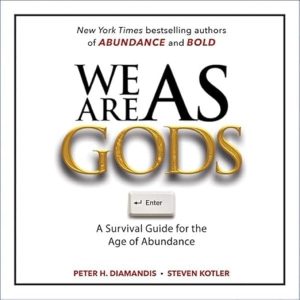
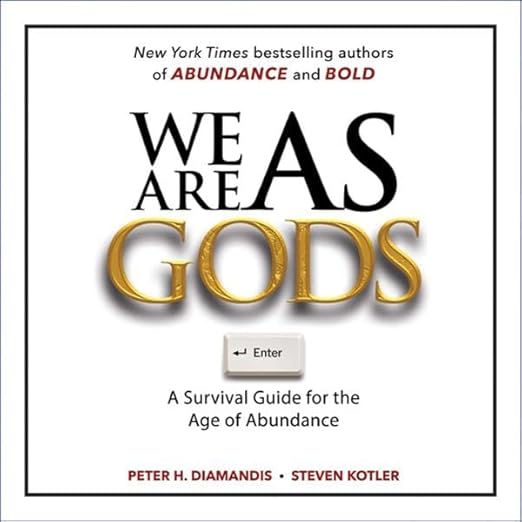
Stewart Brand's 1968 sentence gives this audiobook its title and its whole argument: we are as gods, and we might as well get good at it. Peter H. Diamandis returns to the abundance thesis that runs through his earlier books, and the nine-hour file Simon and Schuster Audio released in April 2026 sets out to explain why the powers humanity has acquired are running ahead of the temperament needed to hold them. Zac Aleman is credited with the reading. Before any of that, though, the record asks a question the copy answers and the byline does not.
Two Sentences Carry the Whole Argument
What you get here is a synthesis book rather than a research book, and it helps enormously to know that going in. The description names three earlier titles, Abundance, Bold, and The Future Is Faster Than You Think, and this one gathers those strands and pushes them past economics into something closer to moral philosophy. We can rewrite genes, edit embryos, build artificial minds, extend life and terraform worlds, the copy says, so the interesting question stopped being whether we can and became whether we can do it wisely.
That second half is where my attention went, and it is also the half carrying the least support. Two sentences do most of the load: abundance without meaning leads to collapse, intelligence without wisdom leads to extinction. Both are memorable. Neither is obvious. A book spending nine hours proving them would be a different and probably better book than one spending nine hours surveying the breakthroughs that make them urgent, and this file leans toward the survey. Listen for how much weight the closing stretch puts on humility, creativity and flow, because that trio does more work than its evidence base supports.
Aleman Must Hold Five Vocabularies Steady
Range is the honest selling point. The material moves across artificial intelligence, robotics, genetics, longevity and consciousness research, five fields that rarely sit inside one cover. If you have been reading about gene editing and know nothing about the longevity claims, or the reverse, the compression works in your favor. Nine hours is short for that spread, which keeps the pace high and the connective argument visible instead of letting each chapter dissolve into its own literature.
Framing gives it an unusual shape for the shelf. Most technology books pick a side, alarm or evangelism. This one calls itself equal parts warning and invitation, and the paradox it puts at the center, external power expanding faster than inner resilience, gives it somewhere to go beyond cheerleading. Whether you accept the conclusion or not, that structure hands you something to argue with, which a list of breakthroughs never does.
Zac Aleman carries the reading, and the casting load is specific rather than dramatic. The performance has to deliver a first-person plural belonging to two writers, hold five technical vocabularies steady across nine hours, and land a rhetorical register that closes paragraphs on lines like "Abundance is here. Are you ready?" without tipping into infomercial. Those are the pressures worth checking in a sample before committing to the full file.
Steven Kotler Vanishes From the Byline
Start with the credits, because the listing has a gap in them. The description states plainly that the book comes from "Peter H. Diamandis and Steven Kotler", the pair behind Abundance and Bold, and it uses "they" throughout. The author field carries Diamandis alone. Kotler appears nowhere in the record's metadata, so a co-writer of a jointly argued book is invisible to anyone browsing by author, and a listener who wants the rest of that work has nothing here to search on.
Its own title is clipped too. Inside its own description the book is called We Are As Gods: A Survival Guide for the Age of Abundance, and the survival-guide half is the part telling you what kind of book this actually is. The displayed title drops it, and the capitalization of the middle word shifts between the two versions. Add a series field reading Exponential Technology with no number attached, and three small metadata problems compound into one practical one: nothing on the page tells you where this sits in a sequence or what promise it makes.
Then the argument itself. Books written in this register tend to assert timelines rather than defend them, and the copy's closing move, "the future won't be built by those who fear what's coming," puts skepticism on the wrong side of the case before the case has been made. Hold that at arm's length. The descriptive passages in this thesis have always been its strongest, and the prophetic ones have always been its weakest, and an audio format removes your ability to flick back and check which one you just heard.
People Who Work Near These Technologies
Readers who already own Abundance or Bold and want the argument carried into ethics and psychology will find this the natural next step, and the nine-hour runtime makes it an efficient one. It suits people who work near these technologies without working inside them: founders, policy staff, investors, anyone obliged to form a view on gene editing or artificial minds without a lab. The business and technology shelving is accurate, and the politics and social sciences category is earned by the governance questions rather than by any partisan content.
Pass if you want primary research, hedged claims, or a sustained account of what could go wrong at the level of institutions rather than of individual wisdom. Pass if optimism about exponential curves has stopped persuading you, because this file spends almost no time on the counterargument. Nine hours of confident synthesis is exactly what some listeners want from this shelf and precisely what others have learned to distrust, and the description is honest enough about which of the two it intends to be.
Does the We Are as Gods audiobook include a PDF or supporting notes?
No field on this record mentions accompanying material, so plan on audio alone. That matters more than usual here, because the book moves across five research areas and the kind of claim it makes is the kind you would normally want to check against a citation while listening.
How long is the audiobook, and how is the material divided?
Simon and Schuster Audio lists nine hours, released in April 2026. Five separate research areas share that runtime, which averages to well under two hours each, so expect a briefing on every field rather than a deep dive into any one of them.
Do I need Abundance or Bold before starting this one?
Not strictly. The copy positions this as a return to a thesis rather than a continuation of a plot, and it restates the framework as it goes. No reading order is marked anywhere on the record either, since the entry carries a series name but no position within it.