- Narrator: Kirshner reads her own work with a quiet attentiveness that matches the book's pace, unhurried, observational, deeply present.
- Subjects: Traditional craft and its meaning, the slow work of belonging somewhere, Japanese rural culture and seasonal rhythm
- Tone: Meditative and sensory-rich, like sitting beside someone who knows how to be still
- Bottom line: One of the more genuinely transporting travel memoirs of recent years, Kirshner's Yamanaka is a place you'll wish you could visit, and this audiobook gets you as close as any book can.
I started Water, Wood, and Wild Things on a rainy Saturday afternoon with no particular plan, and finished it late that same night without having intended to. Hannah Kirshner's account of her years in Yamanaka, a mountain village in Japan's Ishikawa Prefecture, has a quality I find increasingly rare in travel writing: it doesn't perform its own enthusiasm. It simply pays attention, and trusts that attention will be enough. It was more than enough.
Kirshner, a Brooklyn-based food writer and artist, received an invitation to apprentice with a sake evangelist in Yamanaka, a town that had become a quiet destination for chefs and craftspeople drawn to traditional Japanese methods. She put on a vest and tie and went. What followed over several years of intermittent residence was a deep immersion in the working lives of woodturners, charcoal makers, hunters, paper artists, farmers, and foragers, people whose expertise formed the invisible substrate of local culture.
A Lacquerware Bowl Carries Yamanaka's Accumulated Knowledge
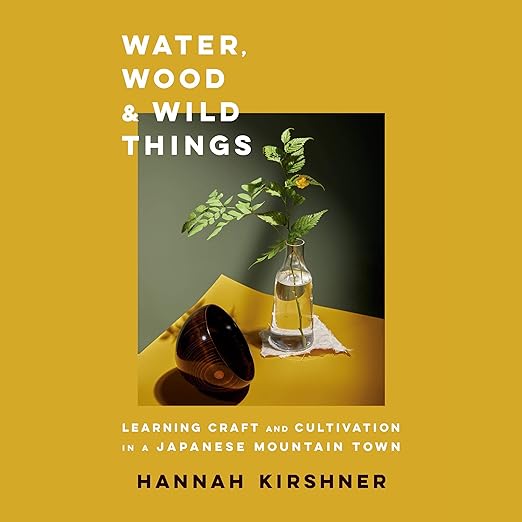
The book's great achievement is its refusal to exoticize. Kirshner describes watching duck hunters at work with the same attentiveness she brings to a sake brewery visit or an afternoon in a charcoal kiln, not as spectacle but as practice. She is interested in what it takes to do a thing well, and in the relationship between craft mastery and community. The thesis, if you want to call it that, is that every object of quality carries within it the accumulated knowledge of the people and place that produced it. A lacquerware bowl from Yamanaka isn't just a bowl. Kirshner shows you why, without ever stating it quite so directly.
Reviewers have noted, consistently, that the writing doesn't feel like what they've read about Japan before. One longtime Japanophile with four visits to the country described feeling envious of an experience he could only glimpse in days that Kirshner inhabited over years. Another reader, a geologist who had never put Japan on any wish list, found herself completely captivated within the first nine pages. That range of response tells you something about the book's actual subject: it's less about Japan per se than about what happens when someone commits to learning a place slowly, through work and relationship rather than tourism.
Kirshner Narrates With Years of Patient Attention
The audiobook format suits this material particularly well, because Kirshner's prose works through accumulation rather than argument. She's building a sensory and emotional world, and listening creates the right kind of immersive passivity, you receive rather than scan. Kirshner reads her own work, and her voice carries the attentiveness of someone who has spent years learning to observe carefully. There are no affectations, no performed warmth. The pace is appropriate: unhurried where the material requires stillness, quicker through the more narrative passages. The included PDF of her drawings and recipes is worth accessing alongside the audio, several of the craft descriptions land differently when you can see what she's describing.
Sake Brewing and Lacquerware Get the Most Depth
Listeners looking for conventional travel memoir structure, arrival, incident, departure, insight, will need to adjust expectations. The book has a more essayistic quality, organized around people and crafts rather than chronological narrative. Some readers may find this slightly disorienting at first. The payoff is cumulative: by the second half, you understand the community as a whole rather than as a series of vignettes. The sections on sake brewing and lacquerware are the most sustained and richly detailed. The chapters on hunting and charcoal-making are shorter but equally precise. The book includes some of Kirshner's own recipes, and listeners who cook may find themselves stopping the audio to take notes.
Rural, Seasonal Japan Corrects the Urban Focus
This is a book for people who have ever wanted to understand how something is made, and why that understanding changes the way you see the thing itself. Readers with an existing interest in Japanese culture will find it a corrective to the familiar urban-modern focus, Kirshner's Japan is rural, seasonal, and deeply traditional in the best sense. Craft enthusiasts, food writers, and anyone who has spent time in a workshop will recognize something in the way Kirshner describes the relationship between a maker and their medium. Those who need narrative momentum or a clear plot will find the pace slow. Everyone else will find it exactly the pace they needed.
A Few Questions About Water, Wood, and Wild Things
Does this audiobook work without the included PDF of illustrations and recipes?
Yes, though the PDF adds a meaningful layer. Kirshner's descriptions of craft processes are detailed enough to stand alone, but her drawings give visual texture to things like lacquerware forms and kiln structures that can be harder to picture purely through language.
Is Water, Wood, and Wild Things primarily about food or about craft more broadly?
Broadly about craft, with food as one thread among many. Sake brewing is the entry point, but the book ranges across woodturning, charcoal production, paper art, rice farming, and duck hunting. Food runs through everything, but as a lens on culture rather than as the primary subject.
How does Kirshner's own narration compare to what a professional narrator might bring?
Her self-narration is a genuine asset here. The book's quality of patient, careful observation comes through in how she reads, there's no performance, just presence. A professional narrator would likely deliver a technically cleaner recording but would lose the intimacy that makes the listening experience feel personal.