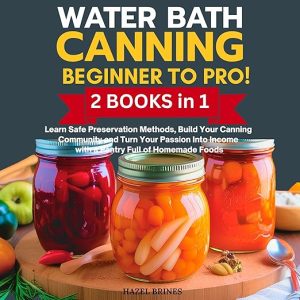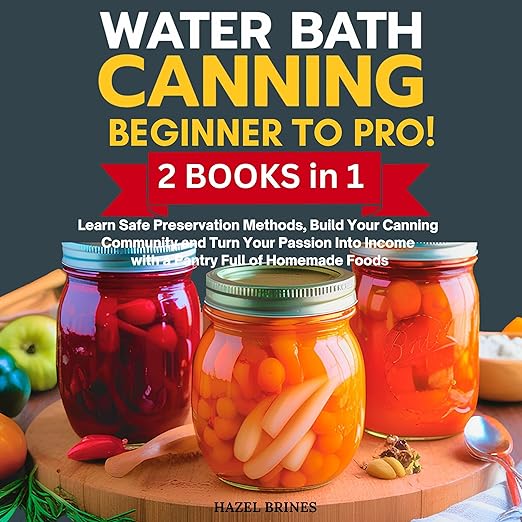
Preserving season arrives with a particular kind of anxiety. The tomatoes are on the counter, the jars are in the cupboard, and somewhere between those two facts sits a set of rules nobody wants to get wrong. Hazel Brines has bundled two separate guides into this audiobook, one written for people who have never sealed a lid and one for people who already have, and the combined runtime of seven hours and two minutes tells you it is not a quick orientation. It is a course, and it arrives with a PDF that matters more than the marketing copy suggests.
Two Guides, No Pressure Canner Required
The honest thing about the packaging is that it says what it is up front. This is a bundle of two titles: a step-by-step introduction using affordable equipment and easy recipes, and an advanced follow-on covering techniques, flavor-enhancing tips and more ambitious preserves. You are buying a beginner course and its sequel in one file, which is why the fundamentals get a full airing before anything difficult shows up.
The scope is worth pinning down before you commit, because the copy states plainly that no pressure canner is required. Read the recipe categories it lists and the boundary becomes visible: jams, pickles, sauces, salsas, chutneys and preserves. That is the high-acid half of home preserving, and it is a perfectly good half to master, but it means the low-acid work sits outside these seven hours entirely. Within that boundary the reception is warm. Walt Legion, one of three reviewers here, writes that "the instructions are clear, encouraging, and genuinely helpful for beginners while offering enough advanced tips to keep experienced canners inspired", and his sentence continues past the point the listing shows.
Chopping Along to the Reasoning Behind Canning
Canning is a hands-busy activity, and audio is the right medium for the parts of it that are reasoning rather than measurement. Why acidity does the safety work, what a failed seal looks and sounds like, how to tell spoilage from a harmless cloudiness, why headspace is not an optional refinement: all of that lands perfectly well through headphones while you are actually chopping. NCM puts the appeal of the whole category in one family: a grandmother who "helped rural families learn how to can as the County Home Extension Agent" from the 1940s to the 1960s, a mother who learned from her, and a daughter who never did. That transmission gap is precisely what a bundle like this exists to close.
The register is the other selling point, and the reviews are consistent about it. CRG describes the book as "a full-fledged canning journey wrapped in a warm, accessible, and encouraging tone", which is a fair characterization of copy that opens by picturing you looking at rows of gleaming homemade preserves and wishing you could do that. Encouragement is not a trivial feature in this subject. The most common reason people never start canning is not a lack of instructions, it is the suspicion that they will poison somebody, and a guide that keeps saying you can do this while explaining exactly why the rules exist does something a recipe list cannot.
The accompanying PDF is the third reason to consider the audio edition rather than a print guide alone. It carries the altitude charts, conversion charts and a seasonal produce guide, and those three things are the reference material you will open again every August. Having them as a separate file you can print or keep on a tablet is arguably more useful at the stove than having them buried on page 212 of a paperback.
Ashley's Untested Voice on a Small Sample
Audio is a poor container for numbers, and canning runs on numbers. Processing times, jar sizes, headspace measurements and altitude adjustments are exactly the details you cannot afford to half-hear over a boiling pot with a timer going. Download the PDF and have it open before your first batch. If you are not going to do that, this is the wrong format for you and no amount of clear narration will fix it.
The bundle structure creates its own redundancy. Two guides that both cover water bath canning will overlap heavily in the fundamentals, so a confident canner buying this for the advanced material has to travel through a beginners' course to reach it. The chaptering should make that skippable, but you are still paying for coverage you do not need. Someone starting from zero has the opposite experience and gets the better deal.
The narrator is credited only as Ashley, a single first name with no surname, which is unusual for a mainstream production and marks this out as an independent release. None of the three attached reviews comment on the reading at all; they praise the clarity of the instructions and the tone of the writing, which are qualities of the text. Forty-five ratings averaging 4.6 is a small sample by any standard, so the delivery is effectively untested by the pool and worth sampling on your own account.
For the First-Time Canner With a Garden Glut
The right listener is a first-time canner with a large pot, a cupboard of jars and no pressure canner, or somebody staring down a garden glut and unwilling to let it rot. It also suits the lapsed inheritor, the person who watched a grandmother do this every summer and absorbed the atmosphere without ever learning the steps. And it suits anyone making food gifts who wants them to be safe as well as pretty.
Skip it if the PDF is not something you will realistically open, since the charts are where half the value lives. Skip it too if you want pressure canning for low-acid foods, if you already own several preserving books and want one technique deepened rather than the whole subject re-taught at two levels, or if you prefer a reference you can flick through with wet hands rather than one you have to scrub up to scroll.
- Voice: Credited to a narrator listed only as Ashley; the attached reviews praise the writing's clarity and warmth rather than the reading, so treat a sample as part of the decision.
- Big ideas: Home food preservation, kitchen safety, seasonal cooking, self-sufficiency
- Atmosphere: Encouraging and practical, closer to a class than a cookbook
- Worth it?: A solid audio course for beginners, but only if you actually open the PDF that carries the charts.
Common Questions
Does this audiobook come with the PDF that holds the charts?
Yes. The listing states the accompanying PDF sits in your audio library alongside the recording. It carries altitude charts, conversion charts and a seasonal produce guide, which are the pages you will actually want at the stove. Download it before your first batch rather than halfway through one.
Can you learn canning safely from an audiobook alone?
Audio handles the reasoning well: why acidity matters, what a failed seal indicates, how to troubleshoot a batch that looks wrong. Exact processing times, jar sizes and altitude adjustments are numbers, and numbers belong on a page. Use the recording for understanding and the PDF for the batch itself.