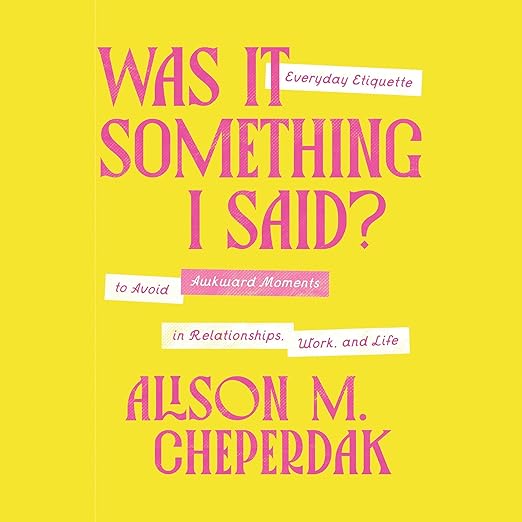
Key Details
- Read by: Cheperdak reads her own book, and her news anchor and legal background give her delivery natural authority without the self-congratulatory tone that some author-narrated titles fall into.
- At its heart: Social confidence, professional presence, the gap between what we intend to communicate and what actually lands
- Vibe: Warm and practical, like advice from someone who has genuinely navigated difficult situations and learned from them
- Short version: A modern etiquette guide that earns the category rather than hiding behind it, grounded in specific professional contexts and delivered with genuine warmth by its author.
I approached Was It Something I Said? with a slight wariness, because etiquette books tend to divide sharply into two types: the prescriptive rulebook that tells you which fork to use without explaining why social rituals evolved in the first place, and the vague affirmation text that tells you confidence is a choice without providing any actual tools to build it. Alison Cheperdak's book manages to occupy neither of those positions. It is specific, practical, and, what I did not expect, genuinely honest about the anxiety that motivates most social awkwardness in the first place. She names the feeling before she addresses it, which is the correct order of operations for this kind of material.
Cheperdak's credentials are unusually varied for an etiquette writer: she has worked as a lawyer, a news anchor, and a White House West Wing staff member across her career. Each of those roles requires navigating high-stakes social situations with very different audiences, different unwritten rules, and very little margin for misjudgment of the kind most people can afford to make and recover from quietly. The book draws on that range without using it primarily as a credential to establish authority over the reader. She mentions these professional contexts to illustrate specific and recognizable situations, not to remind you how impressive her background is. That restraint is itself a form of good social judgment, which is thematically appropriate for a book about exactly that set of skills.
Small Talk and Salary Talk, Side by Side
The structure of Was It Something I Said? is genuinely practical rather than conventionally organized by formality level or social setting. Cheperdak moves through categories of social interaction, which means the advice on navigating small talk sits near the advice on salary negotiations and both are in dialogue with the guidance on recovering from awkward moments that have already occurred. One reviewer called it smartly organized as a reference guide you can return to, and that is accurate, it is designed to be dipped into for specific situations rather than read solely front to back, and the organization actually supports that kind of use pattern. The book covers dress codes, dining etiquette, conversation skills, and digital communication, with particular attention to the gap between what we intend to convey and what actually lands with the other person in the room or on the other side of the message.
Cheperdak's News-Anchor Voice Earns Its Warmth
Author-narrated audiobooks are not automatically better than those read by professional narrators. Some authors are simply not trained for audio performance, and the results can be halting or flat in ways that make the content harder to engage with regardless of how strong the underlying material is. Cheperdak is a genuine exception to this pattern. Her news anchor background gives her a natural facility with paced, clear speech that is readable from the first chapter, and her legal training gives her a habit of organizing information in ways listeners can follow and retain without losing the thread. The warmth that reviewers consistently note throughout their responses to this book is genuine rather than performed, there is a quality in how she reads her own material that suggests she is talking to someone she actually wants to help rather than demonstrating expertise for its own institutional sake. One reviewer described it as big sister etiquette rather than mean girl etiquette, and the narration reinforces that precise tone in ways a different professional voice might not have managed as convincingly.
American Contexts, Weighted Toward Women's Scenarios
I want to be honest about the book's scope alongside its genuine strengths. This is not a cross-cultural etiquette guide or a deep historical analysis of why social norms exist and vary across different societies and traditions. It is grounded primarily in American professional and social contexts, and readers navigating international business situations or intercultural settings will need supplementary resources beyond what this book provides. The coverage is also somewhat weighted toward situations that women encounter specifically, both in its framing and in the particular scenarios it chooses to address in detail, salary negotiations, meeting a partner's parents, being a gracious host, navigating dress codes in professional settings that have shifted since the pandemic changed what formal means. That is not a flaw exactly, but readers seeking gender-neutral or exclusively corporate-context content should know the orientation before committing the eight hours. For the listener the book is actually written for and toward, it delivers real and immediately applicable value in a format that makes the time feel productive rather than merely pleasant.
Modernizing Etiquette for Texts and Read Receipts
One area where Cheperdak's background gives this book a specific advantage over older etiquette texts is her handling of digital communication, email, text messaging, and the particular social anxieties that social media has introduced into professional and personal life. These are not areas that Emily Post could have anticipated, and most traditional etiquette guides either ignore them or treat them as extensions of written letter-writing with different platforms, which misses most of what actually makes digital communication socially fraught. Cheperdak addresses these contexts with the same practical specificity she brings to in-person situations: when to use email versus a phone call, how to handle unanswered messages without spiraling, the etiquette of group texts, and the particular social weight that read receipts and response timing carry in relationships of different degrees of closeness. These are the sections where listeners in their twenties and thirties will find the most immediately applicable guidance, and they are handled with the kind of contemporary awareness the subject genuinely needs.
Common Questions
Does Was It Something I Said? cover workplace etiquette specifically, or is it primarily focused on personal social settings?
Both, and the interweaving is one of its strengths. Cheperdak draws on her legal and media backgrounds to address professional situations including salary negotiations, meeting dynamics, and email communication, while also covering personal social contexts like hosting, toasts, and navigating awkward moments with friends and family.
Is Cheperdak's narration of her own book better or worse than a professional audiobook narrator would be?
Better, in this case. Her news anchor training gives her natural pacing and clarity, and the warmth reviewers consistently describe reads as genuine when you hear her voice. She sounds like someone who actually wants to help the listener rather than someone delivering content from a prepared script.
Is this suitable for younger listeners who are just beginning to navigate professional social situations?
Very much so. The book is particularly well-suited for people entering professional environments, navigating networking for the first time, or building the kind of social confidence that formal education rarely teaches directly. The framing is encouraging rather than corrective, which makes it accessible without being condescending.
Is Was It Something I Said? available as a free audiobook, and does it include a companion PDF for any visual content?
Yes, it is available as a free audiobook through Audible membership. The audiobook companion PDF is available as a download and covers visual materials referenced in the text, including any formatted guides or charts that work better on the page than they do in audio format.