Before You Press Play
- Narration: Roger Davis handles the multi-narrator oral history format with consistency, giving each account enough individuality to feel distinct without disrupting the collective voice.
- Themes: Cold War nuclear deterrence, RAF aircrew identity, the Falklands conflict from the air
- Mood: Reverential and specific, with the warmth of shared memory
- Verdict: The firsthand accounts in Vulcan Boys make this the essential oral history of the aircraft, nothing you could read about the Vulcan from the outside compares to hearing the operators describe it from within.
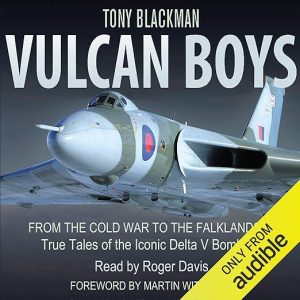
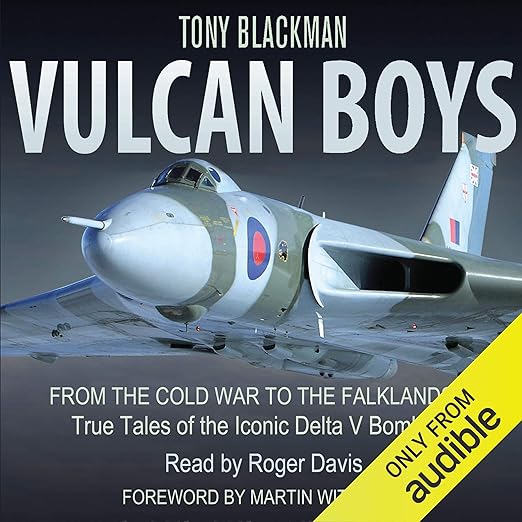
I came to Vulcan Boys knowing only the broad outlines of the aircraft's history, the delta silhouette, the howling engine note on takeoff, the Black Buck raids on the Falklands that gave the Vulcan its late celebrity. What I did not know was what it actually felt like to fly it, maintain it, or sit in readiness waiting for a scramble that, mercifully, never came. Tony Blackman's book answers all of those questions, not through synthesis or analysis, but through the direct testimony of the people who were there. It is an oral history in the truest sense, and the format is exactly right for the subject.
The Vulcan was the second of Britain's three V bombers, built to carry Britain's nuclear deterrent during the Cold War. Its role was deterrence by credibility, the ability to reach Soviet targets with nuclear weapons, which required that the aircraft and its crews be ready to launch within minutes of a warning. The hours spent on readiness, waiting for a scramble that would signal the end of everything, are among the more haunting passages in the book. The crews describe the mental discipline required to hold that readiness without succumbing to it, which is a form of psychological endurance the Cold War strategic history rarely dwells on at the individual level.
Falklands Raids Remembered by the Crews Who Flew Them
One reviewer, a former RAF technician who spent most of his career on the Vulcan at Waddington and Scampton, described the book as bringing back many memories of his time as a young man on the V-Force. That kind of reader response, the recognition of someone who was present, is the clearest possible indicator that Blackman's contributors got the details right. The book covers the full arc: from the aircraft's development at the Avro factory through the Cold War period to the extraordinary coda of the Falklands operations.
The Falklands accounts are particularly strong. The Black Buck raids, long-range bombing missions from Ascension Island to the Falklands, the longest bombing raids in history at the time, are described with the specificity of people who planned and flew them. The Shrike missile attacks, the landing at Rio de Janeiro that became a diplomatic incident, the details of Black Buck 2 that had not previously been documented with this level of accuracy: all of it is here, from the people who did it. One reviewer noted that the Falklands attacks using Shrike missiles are described accurately and in great detail for the first time, which is significant for a piece of operational history that had previously been covered mainly through official accounts.
Roger Davis Threads Many Voices Into One Flight Crew
The Cold War chapters are not exclusively about the readiness posture. Blackman's contributors describe in detail how the Vulcan crews honed their skills through Lone Ranger sorties, long flights to the United States and around the world, and through participation in Giant Voice and Red Flag exercises against American Strategic Air Command. These accounts give the book texture beyond the deterrence narrative, showing an aircrew culture that was competitive, technically demanding, and not without its own dark humor about the job they were doing.
Roger Davis's narration handles the transition between contributors with enough consistency to maintain the audiobook's flow while preserving the individual voice of each account. This is harder to do than it sounds with oral history material, which tends to flatten under a single narrator's interpretation. Davis generally succeeds, though the most memorable voices are the ones whose accounts have the most distinctive personal character.
An Aircrew View That Skips the Whitehall Politics
Blackman's approach is entirely from the aircrew and operational perspective. The wider political and strategic context of the Cold War, the decisions made in Whitehall about Britain's nuclear posture, the relationship with the United States over targeting and warhead development, is present only in outline. Readers looking for a strategic history of British nuclear deterrence will need to supplement this with other sources. What Vulcan Boys offers instead is irreplaceable: the interior experience of the people who maintained the deterrent, hour by hour, through the decades when it might have been needed.
At eleven hours and seventeen minutes, the book is substantial but never drags. The chapter structure follows a rough chronological arc from development to Falklands, which gives listeners a sense of progression even within the oral history format.
Cold War Aviation Fans Are the Right Audience
Listen if you have any interest in Cold War aviation, the RAF's V-bomber force, or the Falklands conflict from the air operations perspective. Listen if you prefer primary source testimony to analytical distance. Skip if you are looking for a strategic or political history of British nuclear deterrence rather than the operational and personal story. This book is for people who want to know what it was actually like, and for them it is definitive.