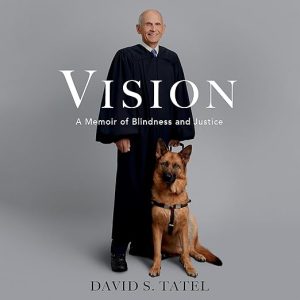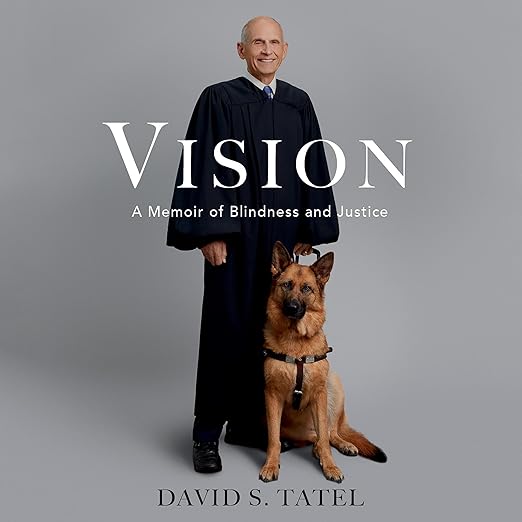
Nearly thirty years on the United States Court of Appeals for the D.C. Circuit, the country's second highest court where many of our most consequential federal cases are decided, and blind for fifty of those eighty-plus years: David Tatel's memoir Vision begins with that contrast and spends ten hours unpacking what it actually meant. This audiobook is the account of a man who spent decades treating his blindness as a problem to be managed in secret, and who only recently, partly through the arrival of his first guide dog, came to understand it as a constitutive part of who he is and how he has worked.
John Lescault's narration is well-matched to this material. Tatel's writing has the clarity and precision you would expect from someone who has spent a career crafting legal opinions designed to be both rigorous and legible, and Lescault honors that precision without making the memoir feel like a recitation of briefs. The personal sections, Tatel's relationship with his guide dog Vixen and the emotional opening that relationship catalyzed, are handled with a warmth that keeps the legal and professional material from crowding out the human story.
The Guide Dog Is the Emotional Hinge
Reviewer Amazon Customer, who read forty-seven books in 2025 across multiple genres, described Vision as the best book of that year: I came for the dog; I stayed for the lessons in how democracy is carved from courtroom litigation. That formulation captures the audiobook's particular pleasure. It offers entry through the personal and rewards you with the substantive. The guide dog thread is not a soft framing device for what is really a career retrospective. It is the genuine emotional hinge of the memoir, the moment when Tatel's long-maintained professional fiction about his blindness became impossible to sustain, and what he found when he stopped sustaining it.
The cases Tatel discusses are among the most significant in recent American legal history: landmark environmental decisions, voting rights cases, matters that have teed up crucial questions for the Supreme Court. He does not retreat into legal abstraction; he writes about what these cases meant and why they mattered, in terms accessible to someone with no legal background. Reviewer Stardust1949 noted learning substantially about retinitis pigmentosa, the degenerative condition responsible for Tatel's blindness, through the memoir. That reflects how effectively Tatel integrates the medical and personal dimensions of his story into the broader professional narrative throughout the audiobook.
Tatel Has Spent Decades Listening, Not Reading
The audio format is particularly fitting for this memoir in a specific and meaningful way. Tatel himself has spent decades listening to texts at high speed rather than reading them, which means that the audio version of his book carries a resonance that the print version cannot replicate. You are receiving his words in approximately the same form through which he has received the words of others for most of his adult life. That connection between form and content is not something Tatel labors over in the text, but it enriches the listening experience once you register it.
The guide dog thread, specifically Vixen's arrival in Tatel's life relatively late in his career and the ways that relationship shifted his self-understanding, is one of the most unexpectedly affecting elements of the audiobook. Tatel has spent decades managing his blindness as a logistical problem; Vixen requires him to manage it as a relationship, which turns out to be a completely different experience. Bryan Stevenson describes the memoir as moving, thoughtful, and inspiring, and the Vixen sections are where all three qualities converge most fully and most memorably for most listeners who come to this book.
A Trace of Self-Satisfaction Surfaces
Reviewer Jmac2555 offered a thoughtful four-star assessment that identified what some listeners may experience as the memoir's limitation: a degree of self-satisfaction that occasionally surfaces in the telling. A man who has achieved as much as Tatel has, in the circumstances he describes, has ample reason for pride, and the line between earned confidence and self-congratulation is genuinely subjective. Listeners attuned to that quality should be aware it may surface at points, though it does not undermine the memoir's substantial achievements or the genuine value of what Tatel has to say about law, disability, and identity.
The political dimension of the book, Tatel's concerns about the direction of the current Supreme Court and the health of democratic institutions, is present throughout and becomes more explicit toward the end of the audiobook. This is not a politically neutral memoir, and readers who strongly disagree with Tatel's judicial and political views may find those sections more effortful than the personal narrative that precedes them. The audiobook runs a full ten hours, and the balance between personal memoir, legal history, and institutional advocacy shifts across that runtime.
Structurally About Blindness, Intellectually About More
Listeners interested in disability, identity, and the long work of self-acceptance will find Vision a substantive and honest account of what that process looks like in a specific, high-stakes professional life. Those drawn to legal history and the workings of the federal appellate courts will find Tatel's insider account of landmark cases genuinely illuminating. Readers who love memoirs that are structurally about one thing, blindness in this case, but intellectually about something much larger will get everything they are hoping for. The caveat about occasional smugness is worth holding in mind, but for most listeners this audiobook delivers on the promise of its considerable premise and earns its ten hours.
A Few Questions About Vision
Is Vision primarily a legal memoir or a personal memoir about disability?
Both strands are present throughout and are genuinely intertwined. The legal career and the experience of blindness are not separate chapters in Tatel's account. They shaped each other, and the memoir's argument is specifically about how accepting his blindness changed his understanding of his own judicial philosophy and professional identity.
Does the audiobook assume legal background or familiarity with the D.C. Circuit's caseload?
No legal background is required. Tatel writes about landmark cases in terms accessible to general readers, explaining the significance and stakes of each without retreating into technical legal language. Reviewer Amazon Customer specifically noted arriving for the personal story and finding the legal history a reward, not a barrier.
What role does Tatel's guide dog Vixen play in Vision, and does that aspect carry significant weight in the audiobook?
Vixen's arrival is one of the memoir's emotional turning points. Tatel describes how caring for and working with a guide dog forced him to stop managing his blindness purely logistically and begin relating to it differently. The Vixen sections are among the most affecting in the audiobook and prompted at least one reader to engage with the book primarily because of them.
Is John Lescault's narration well-suited to the different registers of Vision, including legal analysis, personal memoir, and advocacy?
Yes. Lescault brings precision to the legal sections and warmth to the personal narrative without overcorrecting into either register. The memoir's emotional range is handled cleanly, and the ten-hour runtime does not feel padded in his delivery.