Before You Press Play
- Narration: Korey Jackson brings Tommie Smith's voice with the dignity and emotional precision the subject demands, capturing both the rural Texas childhood and the weight of the Olympic moment without melodrama.
- Themes: athletic excellence as political act, the cost of principled resistance, the long shadow of a single historic gesture
- Mood: Stirring and historically grounded, with a personal intimacy that lifts the material above conventional sports biography
- Verdict: Smith and Barnes have produced a young adult memoir that works precisely because it refuses to sentimentalize either the achievement or the sacrifice that followed it.
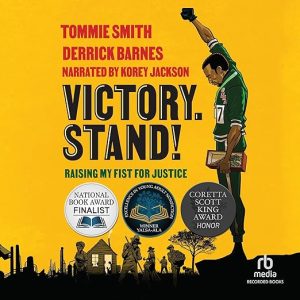
Tommie Smith raised his fist on the Olympic podium in Mexico City on October 16, 1968, and the gesture has been reproduced and debated and misrepresented so many times in the decades since that the actual person who made it can become lost in the symbol. Victory. Stand!, co-written with Coretta Scott King Award recipient Derrick Barnes and narrated by Korey Jackson, is Smith's first-ever memoir for young listeners, and its primary accomplishment is restoring the human being to the icon. This audiobook, at two hours and twenty minutes, is one of the shorter biographical listens in the young adult nonfiction category, but its compression serves the material. Barnes and Smith have organized the text to move from childhood in rural Texas through the athletic career to the Olympic moment and its aftermath without the pacing losing any of its essential weight.
The biographical details that frame the famous gesture are what make the memoir worth listening to. Smith grew up in a Texas shaped by poverty and segregation, and his path to competitive running was not the linear ascent that sports mythology prefers. The rural childhood, the physical work, the academic ambitions that ran alongside the athletic ones, the relationship with his faith and his community, all of these provide the context that transforms a photograph most people have already seen into something that makes sense as the act of a specific person with a specific history. Barnes's co-writing is invisible in the best sense; the voice feels consistently Smith's own.
Our Take on Victory. Stand!
The memoir's treatment of the aftermath is where it does its most significant work for a young audience. Smith and John Carlos were expelled from the Olympic Games, received death threats, and faced sustained economic and professional consequences that lasted for years. Smith does not present this simply as the price of heroism. He is honest about the difficulty, about the moments where the cost felt genuinely uncertain in relation to what the gesture had accomplished. For young readers and listeners, this honesty is more valuable than triumphalism. The memoir demonstrates what it looks like to hold a moral position through genuine consequences rather than through the narrative convenience that retrospective heroism tends to supply.
Korey Jackson's narration handles this honesty well. He does not perform gravity; he sustains it across the runtime by keeping Smith's voice grounded in the specific rather than the symbolic. The Olympic podium moment itself, which arrives with all the weight the preceding biographical context has built, is narrated without melodrama because Jackson and the text have spent the preceding runtime earning the moment's significance rather than asserting it. One listener noted that the memoir provided more knowledge about the meaning of the protest than they had previously held, even having witnessed it as a child. That depth is audible in Jackson's performance.
Why Listen to Victory. Stand!
The audio format is particularly appropriate for a memoir aimed at young listeners. At two hours and twenty minutes, the listen is practical for classroom use, for individual sessions, and for the kind of sustained attention span that longer young adult titles can strain. The bonus exclusive interviews with Tommie Smith and Derrick Barnes included in the production add a dimension that print cannot provide: the actual voices of the author and co-author commenting on what the book was attempting to do and why. This kind of production value transforms a strong audiobook into something closer to a primary source experience, especially significant for a memoir about a historical event still discussed in schools and communities today.
The memoir also benefits from the awards context it carries. The 2023 YALSA Excellence in Young Adult Nonfiction Award, the National Book Award finalist status, the Coretta Scott King Honor designation, and the multiple best-book-of-year recognitions from major review outlets represent an unusually complete critical consensus for a young adult title. Listeners trying to assess whether the material warrants the attention can treat that consensus as meaningful without being obligatory.
What to Watch For in Victory. Stand!
The memoir takes care to explain the symbolic layers of the 1968 protest that are not immediately visible in the famous photograph. John Carlos's choice of black socks, the positioning of the gloves, the lowered head, each element carried specific meaning that Smith explains here for the first time in his own words. Listeners who approach the audiobook already familiar with the image will find the explanation of the gesture's intentional components one of the memoir's most revealing passages. Those who come to the material without prior knowledge of the protest will have those visual details contextualized in a way that makes the symbol legible as communication rather than mere display.
The memoir's final sections deal with Smith's long journey toward public recognition, including the evolution from vilification to the kind of institutional acknowledgment that came decades later. This arc is rendered without bitterness, which is itself a form of testimony about the character that the memoir has been building throughout.
Who Should Listen to Victory. Stand!
Young adult listeners aged roughly twelve and up, students and educators in American history, civil rights history, and sport-and-society contexts, and adult readers who want a brief but substantive engagement with the 1968 Olympic protest and the life of the man at its center. The memoir is accessible to listeners with no prior knowledge of Smith or the historical context. Those looking for extended biographical depth across a full career rather than a focused memoir organized around a defining moment should be aware that the compression is intentional, and that the result is illuminating rather than comprehensive.