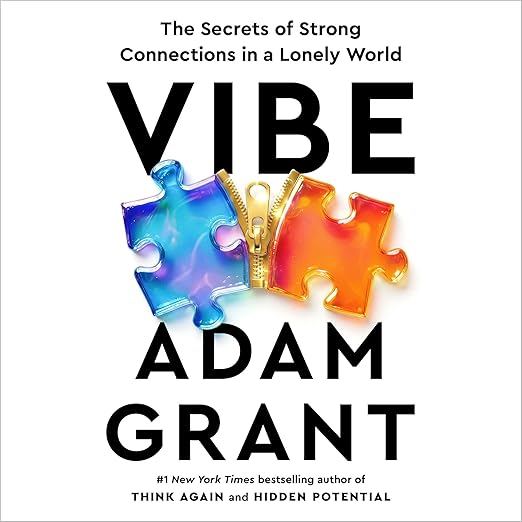
Adam Grant has made a career of taking concepts from organizational psychology and making them usable for readers who have never read a journal article. Vibe, his latest audiobook, turns that lens on connection itself, the particular quality of chemistry that arises between people and that Grant argues is far more engineerable than we assume. The book arrives at a moment when the loneliness crisis has become a genuine public health conversation, and Grant's timing is deliberate: he wants to address the structural and behavioral factors driving disconnection before offering the counter-moves.
The argument Grant builds is built on a core provocation: most of what we believe about how bonds form is wrong. Similarity is not required for solidarity. Chemistry does not always strike immediately. Closeness does not always require accumulated time. These reversals of common assumption are the engine of the book, and each one arrives with the kind of counterintuitive study or vivid case study that has become Grant's signature. The research base here feels genuinely current, and Grant integrates his personal disclosure about being a shy introvert who had to learn connection as a skill with enough specificity that it does not feel like a rhetorical device.
Seventy-Eight Marriages From One Deliberate Gathering
What Grant does well here that he has not always managed in previous books is stay close to the practical throughout. Vibe does not spend the first third building a theoretical edifice before pivoting to application. The tools and reframings are woven through the storytelling from the beginning, so readers never feel they are waiting for the book to become useful. The comedy troupe that takes deliberate time apart to stay together, the astronaut crew that had to build operational trust with colleagues they actively disliked, the journalist who designed a gathering that produced seventy-eight marriages - these are not just attention-holding anecdotes but illustrations of specific mechanisms Grant wants readers to adopt.
The book's central concept, the vibe as an engineerable rather than accidental phenomenon, does some work the subtitle does not fully prepare you for. Grant is not just describing social chemistry as a pleasant side effect of good circumstances; he is arguing that the conditions for connection can be deliberately created. This framing will feel liberating to introverts and those who have assumed they lack the natural social ease the extroverted world seems to reward. It will feel somewhat obvious to those who have already internalized relationship-science literature. Grant's signal contribution is synthesizing enough new research that even well-read listeners will find studies and conclusions they have not encountered before.
A Question-and-Reveal Structure Fills Eight Hours
Grant's books have a rhythm that rewards audio specifically: the pacing of his arguments tends to follow a question-and-reveal structure that translates naturally to spoken form, with each chapter operating almost like a self-contained episode with a setup, complication, and resolution. Vibe continues this pattern, and the density of the material, while substantial, never becomes exhausting because the narrative structure carries the listener forward. At eight hours, it is substantial but not overlong for the ground it covers.
For listeners interested in the overlap between social psychology and practical behavior change, this is a strong entry point. Grant does not require prior familiarity with the research tradition; he builds context as he goes. Those who have read Think Again or Give and Take will recognize the approach and find Vibe a natural extension, shifting the focus from individual cognitive patterns to the relational space between people. The New York Times bestselling pedigree here reflects a genuine popular readability rather than just marketing reach.
Principle Without Example Is Principle That Doesn't Transfer
Grant's style has its consistent limitations, and they appear here as they have in previous books. The optimistic frame sometimes papers over genuinely hard structural factors in disconnection: not everyone has equal access to the social contexts Grant's examples inhabit, and the book occasionally reads as more accessible to already socially confident readers than it acknowledges. The advice about building trust across ideological difference, for example, is sensible in the abstract but requires social capital and safety that are not evenly distributed.
Additionally, for all its merits, Vibe does not fully reckon with the ways that digital communication platforms are designed to exploit rather than serve human connection. Grant diagnoses the problem with clarity, but the solutions remain primarily individual-behavioral rather than structural-systemic. Readers looking for a critique of the attention economy will need to pair this with other sources. That said, within the frame Grant has set himself, the book is consistently well-executed and substantively useful.
Grant's structural decision to anchor each chapter in a specific story rather than a general principle is worth naming as a deliberate craft choice rather than just a readability technique. The astronaut crew, the comedy troupe, the journalist's marriage-generating gathering, and Grant's own account of his transformation from shy introvert to enthusiastic connector are not there to be charming; they are there because Grant has learned, from two decades of research and writing, that principle without embodied example is principle that does not transfer. The book's argument about connection is itself enacted in the way Grant writes about it: he connects with the reader by getting specific, by risking the personal, and by trusting that the universal emerges from the particular rather than being stated directly. That is both a writing lesson and the book's subject.
More a Reporter of Ideas Than a Storyteller
This audiobook is well suited to anyone who wants to approach their relationships, professional and personal, with more deliberate skill and less dependence on accidental chemistry. It will particularly reward listeners who have felt like outsiders to the easy sociability that seems to come naturally to others. Those in leadership roles, organizational development, or anyone designing communities or teams will find the frameworks immediately applicable. Listeners who prefer memoir or narrative nonfiction over research synthesis will find the style somewhat journalistic; Grant is a reporter of ideas more than a storyteller, and the book is structured accordingly.
Key Details
- Big ideas: The science of human connection, loneliness and belonging in a digital age, building trust across difference
- Atmosphere: Curious and energizing, with a streak of dry humor
- Worth it?: Adam Grant at his most practically useful, applying organizational psychology to the overlooked skill of actually connecting with other people.
Is the Vibe audiobook a standalone or do I need to have read Adam Grant's previous books first?
Completely standalone. Grant builds his arguments from scratch with each book, and Vibe introduces its concepts without requiring familiarity with Think Again, Give and Take, or any of his earlier work.
Is this audiobook research-heavy or is it more conversational and accessible?
Grant is known for making research accessible without dumbing it down. Vibe follows that pattern: the studies are specific and cited with enough detail to be credible, but Grant's prose translates findings into plain language that does not require a social science background.
How does the Vibe audiobook address loneliness specifically?
Grant frames the current loneliness crisis as the backdrop for the book's entire project, arguing that learning to create the conditions for connection is more urgent now than at any previous point. He addresses both the structural drivers of disconnection and the behavioral levers available to individuals within those structures.