In Brief
- Narration: Virtual Voice narration is functional for structured how-to content but flattens the energy of material that benefits from enthusiasm - manage expectations accordingly.
- Themes: AI-assisted software development, prompt engineering, democratization of coding
- Mood: Practical and forward-leaning, with occasional tech-hype undertones to filter
- Verdict: A well-structured introduction to AI coding tools for non-technical listeners, though the missing QR code access is a genuine gap in the audio version.
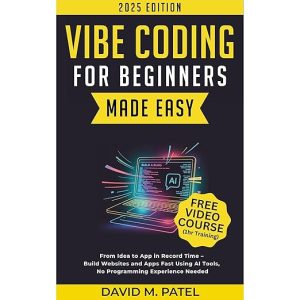
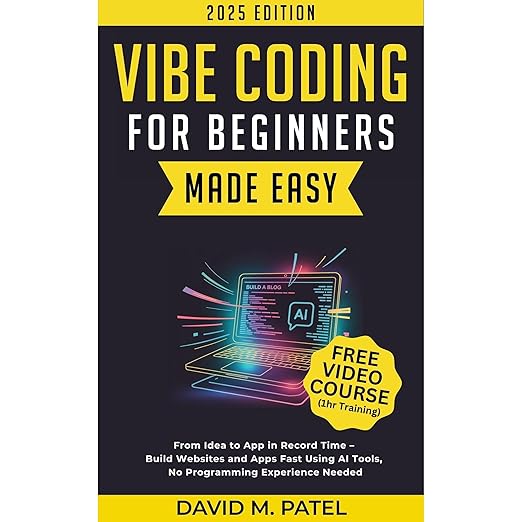
David M. Patel's Vibe Coding for Beginners Made Easy audiobook arrives as the seventh entry in the Artificial Intelligence for Beginners Made Easy series, and it addresses a question that is newly urgent for anyone who has looked at tools like GitHub Copilot, Cursor, or Replit Ghostwriter and wondered what they actually enable for someone with no programming background. The short answer Patel provides: considerably more than most people think, if you know how to prompt. The audiobook spends ten hours and fifty-seven minutes working out what that actually means in practice.
The concept of "vibe coding" - Patel's term for building software by describing what you want in plain language and letting AI systems interpret and execute - is presented as a paradigm shift rather than a productivity tool. His argument is that the old model, where software creation required deep knowledge of syntax, logic, and debugging procedures, has been disrupted by AI coding assistants to the point where the barrier is no longer technical competence but knowing what you want and how to describe it accurately. This is a real observation about a real shift, even if the promotional framing occasionally oversells how frictionless the process is.
The book is structured in three parts that map cleanly to a beginner's progression. Part one covers the conceptual landscape - what vibe coding is, why the AI coding revolution happened, and why the underlying large language models work the way they do without requiring a computer science background to understand. Part two is a practical toolkit section covering the major AI coding assistants: Copilot, Cursor, Replit Ghostwriter, and others. Part three moves into actual project construction, walking through a personal productivity tool, a side-hustle web app, and a game or interactive tool.
The project-based approach in part three is the book's most useful contribution. Theory about AI coding assistants is easy to find online; worked examples of how to move from a prompt to a functioning thing are less common and more valuable. Patel's treatment of the debugging process - what to do when the AI produces something broken or not quite right - is particularly helpful, because most introductory material on AI coding tools focuses on the successes and skips the failure modes. Knowing how to iterate with a coding assistant when its first output isn't what you needed is a skill this book actually addresses.
Virtual Voice Narration Cannot Modulate Enthusiasm
Virtual Voice narration, the AI-generated voice used here, is honest about its limitations in a book like this. Technical content organized into clearly demarcated sections - which this book is - performs reasonably well with Virtual Voice narration because the structural clarity of the content compensates for the flatness of the delivery. A section titled "Getting Started with GitHub Copilot" will convey its information whether read with enthusiasm or not. Where the narration limitation becomes more noticeable is in the book's occasional aspirational passages, where Patel is trying to communicate excitement about the potential of the tools. Those passages land differently when delivered by a voice that cannot modulate enthusiasm.
The ten-hour-fifty-seven-minute runtime is reasonable for the amount of content covered, though it skews toward the longer end for beginner-focused material. Listeners who find themselves clear on a concept earlier than the section ends can reasonably skip ahead - the three-part structure makes navigation straightforward.
QR Code Access Trapped Inside a PDF
The most significant practical limitation of this audiobook is the missing video course access. Patel promotes a free video course with live training throughout the audio, referring listeners to a QR code for access. At least one reviewer has confirmed that the QR code is embedded in a PDF companion that is not accessible in the audio version. This means the video course, positioned as a key bonus, is effectively unavailable for audiobook listeners unless they also purchase the print edition. If the video course is a deciding factor in your purchase, verify access before buying the audio version.
The series designation (book seven in Artificial Intelligence for Beginners Made Easy) is worth noting. While the book is designed to stand alone and explains its own foundations, listeners who have read earlier entries in the series may find some of the introductory AI conceptual content familiar. For a true beginner, that foundational material is useful rather than redundant.
The audiobook's coverage of prompt engineering - how to describe what you want precisely enough that an AI coding assistant produces something close to useful on the first pass - is a chapter that has broader utility than the coding context. The skill of translating an intention into a precise description is applicable beyond software development, and Patel's treatment of it is practical enough that even listeners who don't end up building apps will find the framework for structured prompting transferable to other AI interactions.
From an Idea to a Working Thing
This audiobook is for non-technical listeners who want a concrete understanding of AI coding tools and how to use them for actual projects - not for people who already code professionally and want to understand how these tools integrate with existing workflows. Creative professionals, solopreneurs, and people who have always wanted to build something digital but have been blocked by the traditional learning curve will find the content genuinely useful. Skip if you are an experienced developer looking for nuanced coverage of AI-assisted development best practices, or if access to the video course is central to your intended learning approach. For the complete beginner who wants to move from "I have an idea" to "I have a working thing," the framework here is a solid starting point.
Can audiobook listeners access the free video course Patel mentions throughout this audiobook?
Likely not directly. A reviewer has noted that the QR code for the video course is embedded in a PDF companion that is not available in the audio version. Listeners wanting access to the video course should check whether the print or ebook edition provides better access to that companion material.
Does this audiobook work as a standalone if you haven't read other books in the Artificial Intelligence for Beginners Made Easy series?
Yes. Patel explains the foundational concepts - what large language models are, how AI coding assistants function - within this book. Prior entries in the series are not required, though readers who have covered AI basics elsewhere may find the early sections review-level.
Is this audiobook suitable for someone who has never written a line of code?
That is the intended audience. Patel explicitly addresses listeners with no technical background, and the three-part structure moves from concepts to tools to projects in a way that assumes no prior coding knowledge. The project walkthroughs in part three are the most valuable section for absolute beginners.
How does this audiobook handle the limitations and failure modes of AI coding tools, not just the successes?
Part three includes a section on debugging AI-generated code and avoiding common pitfalls, which is more practical than typical introductory material on these tools. Patel acknowledges that AI assistants produce imperfect output and that knowing how to iterate with them is a skill separate from prompting well.