Key Details
- Read by: Susan Ericksen is the established voice of the In Death series, and her performance in this sixth entry continues to demonstrate why she defines how listeners hear Eve Dallas: authoritative, tough, and emotionally precise without ever becoming sentimental.
- At its heart: Justice versus vengeance, past secrets resurfacing, the vulnerability of those who protect others
- Vibe: Tense and morally charged, with undercurrents of dark intimacy
- Short version: A strong entry in J.D. Robb's long-running series that uses Roarke's personal history as the key that unlocks genuine stakes, making it one of the more emotionally resonant installments in the early run.
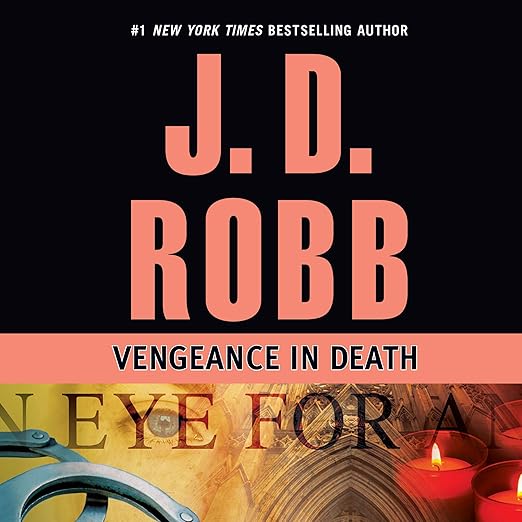
Vengeance in Death, the sixth audiobook in J.D. Robb's In Death series, opens with a killer who does not see himself as a criminal. He positions himself as an instrument of justice, selecting victims who share an ugly secret from a decade past. His riddles to the police arrive timed to be solved moments too late. The victims suffer unspeakably before they die. Lieutenant Eve Dallas, the near-future homicide detective who anchors the series, finds the first body in a private home and the second in a vacant luxury apartment, and she has to work out not just who is doing this but why, before the next riddle arrives. Susan Ericksen narrates this audiobook across eleven hours and nineteen minutes, and her work here reflects what she has built with the series from the beginning: precise, grounded, and entirely committed to the world Robb has constructed.
What makes Vengeance in Death a specific kind of inflection point in the series is what Eve discovers about the victims' shared secret: it directly involves her husband, Roarke. The man whose past life as an Irish criminal turned global entrepreneur has always cast a complicated shadow over their marriage now has personal ties to both the victims and the circumstances that produced them. That structural choice puts real pressure on the central relationship in a way that earlier entries gestured at without fully delivering.
Robb's particular skill in this series is building genuine procedural tension while simultaneously advancing a relationship that functions almost as a second plotline. Eve's investigation runs parallel to her reckoning with what it means that Roarke's past is not simply history but a living liability with consequences that arrive at her crime scenes. The killer's cryptic riddle format works because it establishes a rhythm: each riddle raises the stakes, each failure to solve it in time costs a life. That structure gives the audiobook a momentum that Ericksen's narration maintains even through the longer procedural sequences.
One reviewer who has worked through the entire series positioned Vengeance in Death at four and a half stars, placing it above the series baseline in her estimation. Roarke's butler Somerset, who appears throughout the series as a recurring character, is also implicated here through a framing subplot that adds another layer to the central investigation. For listeners who have followed Somerset across the first five books, his presence in this story lands with a different weight than it would for someone arriving at the series here.
What J. D. Robb Gets Right
Susan Ericksen is one of the primary reasons this series has developed such a committed audiobook following. At thirty-plus books, the In Death series requires a narrator who can hold the entire world consistent across years of listening without letting the material become mechanical or routine. Ericksen's Eve Dallas is instantly recognizable as a specific person: her bluntness, her loyalty, her complicated relationship with her own emotions, and her absolute professionalism under conditions that would break most people. The performance in this sixth entry reflects what Ericksen had built with the character across the five preceding books, and that accumulated familiarity shows in the ease with which she moves between procedural sequences and more intimate ones.
The audiobook format serves Robb's prose particularly well. Her writing has a rhythm that rewards reading aloud: short declarative sentences that build pressure, dialogue that moves fast, and moments of genuine emotional weight that land without the sentimentality that weaker thriller writing substitutes for real feeling. Ericksen honors that rhythm rather than overriding it with interpretive choices that belong to the narrator rather than the material.
Where J. D. Robb Loses Some Ground
This is the sixth book in a long-running series, and while Robb provides enough context for new listeners to follow the plot, the emotional resonance of what happens to Roarke and to the Dallas marriage depends substantially on knowing the history. The relationship dynamics that give the Roarke connection its weight in this entry are products of five books of accumulation. A listener who begins the series here will understand what happens but may not feel the full weight of why it matters in the way that a series reader will. The series is generally best listened to in order, and this entry does not change that recommendation.
The killer's riddle structure, while effective as a pacing device, invites comparison to other literary killers who communicate with investigators in cryptic terms. Robb is not reinventing that convention, but she uses it in service of the larger emotional architecture of this particular entry, where the riddles are not just procedural pressure but a form of psychological targeting aimed at people connected to a shared past. That specificity keeps the device from feeling merely conventional.
Who J. D. Robb Is Writing For
Established In Death series listeners are the primary audience, and this entry is particularly rewarding for those who have invested in the Roarke and Eve Dallas relationship as the emotional spine of the series. New listeners who are curious about the series would be better served by starting at book one, Naked in Death, and working forward. The procedural craft here is strong enough to stand on its own, but the emotional architecture depends on accumulated context that earlier entries build. Susan Ericksen's narration makes the entire series coherent as an audio experience, and listeners who have been following along will find everything they want from this entry and then some.