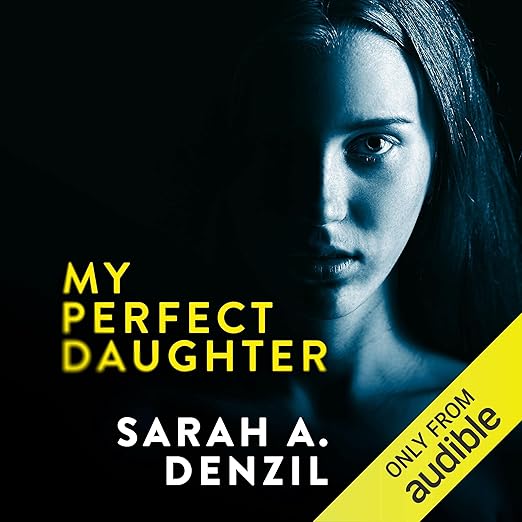
Zoe's problem is not that she adopted the daughter of a serial killer. It is that eleven years later she cannot tell whether she is raising a survivor or a successor, and this audiobook is honest enough to leave the question standing. My Perfect Daughter runs nine hours and fifty-eight minutes, and the ending is where the review column splits cleanly in half. One reader treats the refusal to resolve the central question as the best thing about the book. Another, filing four stars, says it left too many unanswered questions and was not wrapped neatly in a bow. Both are describing the same final chapter, and neither is wrong about what it contains.
Sarah Denzil sets the trap in the first paragraph of the description, and it is a good one. Zoe finds a five-year-old alone and dirty on a countryside road and does the decent thing, carrying her back to her father, without knowing that Maddie was never lost. She was bait, placed there to lure a serial killer's next victim. Everything afterward grows out of that one act of kindness: the escape, the bond, the adoption when no family member comes forward to claim her, the move to a safe house on the Cornish coast, the marriage, the baby brother. Zoe builds an ordinary life on top of a horror and then has to keep living inside it.
Lucy Paterson is credited across all nine hours and fifty-eight minutes, with the publisher line reading Audible Studios, and the assignment is more delicate than a thriller credit usually is. The book alternates between past and present, one reviewer notes, which means the narration has to make a five-year-old on a roadside and a sixteen-year-old under suspicion register as the same person at different distances from the same night. It also has to hold Zoe's love and Zoe's fear inside the same sentences without tipping the listener toward either, because the entire design depends on that balance staying unresolved for ten hours.
Why My Perfect Daughter Works as an Audiobook
Peggy Kindt writes the most analytically interesting response in the column, which works simultaneously as a warning about how much it discloses. That review describes an adult character with an abundance of patience who saw the colors she wanted to see and painted the world around her accordingly, which is a sharper reading of Zoe than the publisher copy manages in three paragraphs. It then names something the description withholds: that the adolescent carries the genes of two killers, not one. Whether that counts as a spoiler or a misremembering, the page will not say, and anyone who wants the twist intact should stop reading the column at exactly that sentence.
Suspense is doing the work the premise sets up, and the readers who loved it are specific about how. One says the book kept the guessing going right through to the end and recommends it plainly to anybody hunting a good mystery. Another describes a story impossible to put down, finished across two days, built around a question worth asking out loud: can you love a broken child so completely that you would protect her no matter what she has done? That is the real subject underneath the procedural furniture, and it is why the book lands harder than its logline suggests. The thriller machinery is a delivery system for a parenting question nobody wants to answer.
Weak Spots in My Perfect Daughter
An ending that refuses to close is the largest risk here, and the reviews make it unusually easy to assess in advance. Melissa Bartz, one of two four-star grades, loved most of the book and disliked the finish, objecting that it was not wrapped neatly in a bow and left many questions unanswered. Polish Girl reaches the opposite conclusion from identical material, arguing that everyone's answer is the good answer precisely because you will never know the truth. If ambiguity in a thriller reads to you as nerve, this was built for you. If it reads as an author declining to commit, ten hours is a long way to travel in order to be told to decide for yourself.
Top of the column is a five-star review consisting almost entirely of the publisher's own description, pasted in beneath a heading and a date, with a star count above it. It contributes nothing past the blurb you have already read on the same page, and it breaks off in mid-word where the character limit cut it short. That is one of the five responses gone. Another was posted on March 6, 2022, ahead of this edition's March 31 release, by a reader who pre-ordered because this author was already a favorite. The star figure sits at 4.4, and the visible grades run five, four, five, five and four, so the disagreement about the ending is exactly what the number is quietly encoding.
The Right Listener for My Perfect Daughter
Thriller listeners who prefer psychology to procedure are the right audience, because the novel turns on a diagnosis rather than an investigation. Maddie is described as still traumatized by what she experienced and identified with callous and unemotional traits, which is the clinical language the plot then spends ten hours interrogating. The question the description leaves hanging, like father like daughter, is the whole engine of the thing. That runtime gives it enough room to sit with the problem properly, and the domestic setting, a safe house on the Cornish coast with a husband and a baby brother in it, keeps the tension close to the ground instead of out chasing anybody. Nothing here needs a chase to stay frightening, because the threat already sleeps down the hall.
Steer clear if you have a low tolerance for stories that place children in danger or in the frame for it, because both are present from the opening scene onward and the description itself closes on a dead classmate and a missing girl. Steer clear too if you need a thriller to hand you a verdict at the end. What you get in exchange is a genuinely uncomfortable book about maternal love working against the evidence in front of it, carried end to end by one narrator, with a finish that half its readers rate as the best thing in it. Decide first whether you want to be told the truth, because this book has already decided not to tell you.
Before You Press Play
- Narration: Lucy Paterson reads all nine hours and fifty-eight minutes of a story that alternates between past and present, asking one voice to hold a five-year-old and a teenager apart.
- Themes: adoption and chosen family, nature against nurture, maternal fear, an ending left open
- Mood: Tense and domestic, quietly claustrophobic
- Verdict: Recommended with one caveat, since the ending declines to answer its own question.
Good to Know
What kind of thriller is My Perfect Daughter?
A domestic one, driven by psychology more than by investigation. The setup involves a serial killer, but the eleven years afterward are about a mother who adopted the child used as bait and now cannot read her own daughter. One reviewer calls the profiling the strongest element on offer.
Does the audiobook resolve whether Maddie is guilty?
Reviewers disagree about how satisfying the answer is, which tells you plenty. One four-star reader complains the finish leaves many questions unanswered. Another says every reader's answer is valid precisely because the truth stays out of reach. Expect ambiguity by design rather than a tidy final reveal.
Is this audiobook too dark for a listener who avoids child endangerment?
Probably. A five-year-old is used as bait for a killer in the opening premise, and the description closes on a dead classmate and a missing girl. The violence is not dwelt on in the copy, but children in peril are the whole subject, not a passing element.
Why does the top review look like the publisher's description?
Because it largely is. The highest-placed five-star entry opens with a date and a star count, then pastes the blurb under a heading, and gets cut off mid-word by the length limit. Treat it as a bookmark rather than an assessment, and read the four accounts below it instead.