In Brief
- Narration: Clara Parkes reads her own account, and the self-narration is pitch-perfect for a book that is fundamentally about one obsessive person's relationship with a material; her dry humor and genuine enthusiasm land exactly as they should.
- Themes: the fragility of American craft industries, the interconnected labor behind everyday objects, personal obsession as a path to expertise
- Mood: Curious and warmly comic, with an undercurrent of genuine alarm about what is being lost
- Verdict: Parkes self-narrating a book about turning 676 pounds of raw fleece into yarn is one of those rare audiobook combinations where voice, subject, and authority are completely aligned.
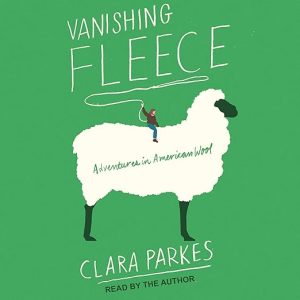
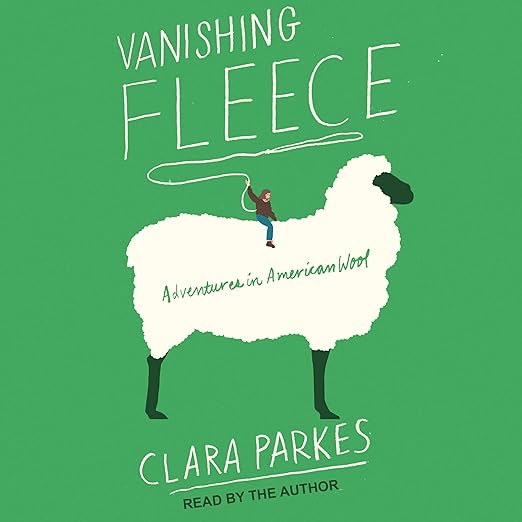
Clara Parkes's Vanishing Fleece begins with a 676-pound bale of Saxon Merino fleece and the decision to transform it, every ounce, into saleable yarn using only American mills, processors, and dyers. That premise sounds like a fiber arts curiosity but the audiobook, narrated by Parkes herself, turns out to be a five-hour-and-fifty-five-minute argument about how Americans make things, who does the work, and what happens when the infrastructure that transforms raw material into finished product quietly disappears. Parkes is the founder of The Knitter's Review and has spent her career as something close to a wool scholar, which means she brings to this journey both the obsessive's love of a material and the journalist's instinct to understand systems. The combination is what makes the book work as more than a craft memoir.
The scene the book sets up is deliberately cross-country: a sheep farm in upstate New York provides the Saxon Merino source, a scouring plant in Texas cleans the raw wool, a Maine dyehouse adds color, a Wisconsin mill transforms the processed fiber into yarn. Each stop introduces a cast of workers, mill operators, specialist dyers, sheep farmers, sorters, whose expertise represents a form of knowledge that cannot easily be recreated once it is gone. Parkes is explicit about this fragility: the title refers not to the specific bale she is following but to an entire industry that has been contracting for decades, taking with it not just jobs but the accumulated technical knowledge that made American textile manufacturing possible. Her year-long project is, among other things, an attempt to document what still exists before it does not.
The Comedy of Scouring Wool and Dyeing Chemistry
The review that describes the first three-quarters of the book as a college mini-course in history, science, agriculture, and creativity captures the unusual quality of Parkes's achievement here. She is writing for knitters and fiber arts enthusiasts who understand the end product of the industry she is documenting, but the education she provides is not basic. The mechanics of scouring wool, which involves removing lanolin, vegetable matter, and other contaminants through a hot water and detergent process before the fiber is usable, are explained with enough precision that the reader comes away understanding why scaling up or scaling down the process has specific consequences for quality. The same granularity applies to dyeing chemistry, to the operation of carding and spinning machinery, to the way a bale of raw wool is evaluated and graded. This is the kind of writing that requires both deep knowledge and the ability to make that knowledge accessible, and Parkes demonstrates both.
The comic register is the element that saves the book from becoming a trade document. Parkes's humor is dry and self-aware: she knows that most people, even most knitters, do not think about where their yarn comes from, and she brings that awareness to every encounter in the book with the amused exasperation of someone who wishes more people found this as interesting as she does. The detail about bales of compressed raw wool potentially exploding when opened, an actual industrial hazard that she describes with obvious relish, is characteristic of her approach: she goes looking for the strange and specific thing that nobody told you about this world, and she finds it consistently.
Parkes Narrates the Detour Through Wisconsin
Parkes narrating her own journey is the right choice both for the obvious reason and for a less obvious one. The obvious reason is that she is the one who did this, and the voice that describes standing in a Texas scouring plant understanding for the first time what that process involves carries the weight of actual experience. The less obvious reason is that her voice communicates enthusiasm without tipping into breathlessness, a quality that matters because the book asks you to share her investment in something that most of its audience did not know they cared about before they started listening. She is doing the work of making you care while also telling the story, and the self-narration makes that work visible in a productive way.
At five hours and fifty-five minutes, the audiobook covers the full transformation arc from raw fleece to finished yarn without feeling rushed or padded. The stops along the way are distinct enough that the book avoids the repetition concern the reviewer raises, the worry that chapter after chapter of industrial process would become monotonous. The characters Parkes encounters at each stage are sufficiently varied in personality and specialty that the narrative feels like a cross-country road trip with interesting passengers rather than a procedural document. The Wisconsin detour, which produces the observation that it is the most knitterly state, is characteristic of the book's capacity to find the specific, slightly absurd detail that makes a place particular.
Trading Backyard Chickens for a Flock of Sheep
The final quarter of the book, which the three-quarter review suggests is slightly weaker than the opening material, is where Parkes pulls back from the immediate cross-country documentation to assess the industry's situation more broadly. Her humor, described as a good balance to the concerning state of American wool, does not disappear in these sections, but the register shifts from discovery to assessment. For listeners who have been absorbed in the journey, this shift can feel like a gear change, though the reviewer who noted the decline in the final quarter also acknowledges that Parkes handles it professionally and fairly. The book earns the right to draw conclusions because it has done the ground work.
The backyard chickens line, the wry suggestion that after reading the book you will want to replace them with sheep, is not just a comic button but a genuine statement about what the audiobook accomplishes: it makes the listener want to participate in the material world Parkes describes, to be closer to the process that produces the things we use. That impulse, to understand craft from the raw material forward rather than from the finished product back, is the book's lasting contribution for listeners who encounter it.
For Knitters and Anyone Curious About American Manufacturing
Knitters and fiber arts enthusiasts are the obvious audience, and this audiobook is essentially essential reading for anyone in that community who has wondered where their yarn comes from. But the book works equally well for listeners interested in American manufacturing, in the labor and knowledge embedded in ordinary consumer goods, or in the particular kind of nonfiction that follows a single object through a complex system to reveal what that system actually is. Parkes self-narrating makes the audio version the recommended format, particularly because her dry humor in the narration is harder to catch on the page. Those who need their nonfiction to be formally structured with clear arguments rather than accreting through journalistic encounters may find the road-trip format slightly loose; everyone else will find it consistently engaging.
Common Questions
Do I need to be a knitter or involved in fiber arts to appreciate the Vanishing Fleece audiobook?
Helpful but not required. Parkes writes with the assumption that her readers care about yarn as a finished product, but the book's actual content is about industrial process, American manufacturing, and the knowledge embedded in craft labor. Listeners interested in how things are made, in supply chain storytelling, or in American economic history will find the book accessible and rewarding independent of any fiber arts background.
Does Clara Parkes narrating her own audiobook significantly affect the listening experience?
Yes, meaningfully. Her dry humor and genuine enthusiasm for the material are most legible in her own delivery; reviewers note that her voice provides a tonal balance between comic energy and genuine concern about the industry's fragility. A professional narrator reading the same text would almost certainly flatten the humor, which is one of the book's primary pleasures.
Is this audiobook primarily about the fiber arts and wool culture, or does it function as a broader critique of American manufacturing?
Both, but in proportion. The immediate experience is a cross-country journey following a specific bale of Saxon Merino through the processing chain, populated with specific workers and their specific expertise. The broader argument about the fragility of American craft industry accumulates through those encounters rather than being stated upfront. By the end, the concern about what is vanishing has been earned through specifics.
At just under 6 hours, does the Vanishing Fleece audiobook maintain its quality throughout or does it weaken as it progresses?
One detailed reviewer describes the first three-quarters as outstanding and the final quarter as slightly weaker, noting a shift from immediate documentary to broader industrial assessment. Parkes handles the assessment fairly and with her characteristic humor intact, but listeners should expect a register change in the book's later sections as the cross-country journey concludes and the implications are drawn out.