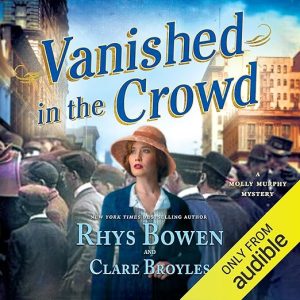
- Performance: Nicola Barber delivers a warm, well-calibrated performance after years with the series, finding distinct voices without ever overplaying the period.
- What it covers: Women's professional autonomy in the Edwardian era, divided loyalties, financial vulnerability behind a respectable facade
- Feel: Cozy and historically textured with a genuine undercurrent of moral unease
- Our call: A confident series entry that rewards longtime Molly fans with period richness and character depth, though newcomers should start at book one.
Rhys Bowen has always written historical fiction with a craftsperson's attention to period texture, and in this audiobook, the twenty-second entry in the Molly Murphy Mysteries series, that instinct pays dividends in abundance. The 1909 Hudson-Fulton celebration is not a vague backdrop but a breathing, jostling presence: two million visitors flooding New York's streets, electric lights dazzling the waterfront, parade floats threading through avenues that Molly has made her own across more than two decades of storytelling. Bowen and co-author Clare Broyles anchor every clue and every loyalty crisis in that specific festive chaos, so that the investigation feels genuinely tethered to its moment rather than floating in generic gaslit atmosphere.
Molly's Shaky Finances and Barber's Familiar Voice
Molly Sullivan in this installment is operating under constraints that give the novel its particular tension. She is, at least officially, a stay-at-home mother to Bridie, Liam, and baby Mary Kate. The detective agency she once ran is behind her. When Sid and Gus ask her to locate their missing Vassar colleague, a brilliant scientist who never appeared at the parade, Molly has personal reasons beyond professional pride: the family finances are shaky, and she is too stubborn to ask her friends directly for help. That collision of domestic pressure, financial anxiety, and investigative instinct keeps the character feeling human rather than purely heroic. Daniel's request that she spy on her own friends adds another layer of genuine moral discomfort, which Bowen handles with more nuance than the cozy-mystery genre sometimes allows.
Nicola Barber has been Molly's voice for many of these novels, and her performance here reflects that deep familiarity. She modulates Molly's Irish cadences without caricature, finds the right register for Sid and Gus's Greenwich Village wit, and slows down beautifully when the investigation turns serious. The Hudson-Fulton scenes, with their crowd noise implied entirely by Barber's pacing and pitch shifts, demonstrate what a skilled narrator can do when the material gives her room. At just under ten hours, this is a comfortable listen that rewards attentiveness without demanding marathon sessions.
Vassar's Missing Scientist Anchors the Series' Appeal
The series appeal is clear from listener commentary: people return for the historical accuracy woven into the procedural plotting, and for strong women who are permitted to be complicated. The missing scientist at the center of the mystery fits both criteria, representing the precarious position of educated women in 1909 America whose professional ambitions had almost no sanctioned outlet. The Vassar connection adds texture, grounding the victim's backstory in a specific institution that meant something in that era. When the parade itself turns deadly, the set piece delivers because Bowen has spent the earlier chapters making the celebration feel real enough to become dangerous.
For listeners new to the series, the book functions reasonably as a standalone, though reviewer consensus firmly advises starting at book one to appreciate the full arc of Molly's relationships. The dynamics between Molly and Daniel, her loyalties to Sid and Gus, and the way her domestic life strains against her investigative nature all carry weight accumulated over many novels. Jumping in here is possible, but something will feel muffled without that context.
Loyalty and Money Outlast the Investigation
The divided-loyalties subplot is the most interesting structural element. Bowen does not resolve it cheaply. Daniel is not simply wrong to ask what he asks, and Molly is not simply right to resist. The novel holds that tension rather than flattening it, which is one reason the series has sustained itself across more than twenty books without feeling formulaic. The historical research also rewards attention: the details about early electrical displays, the specific logistics of 1909 Manhattan parades, and the social norms around married women conducting paid professional work all feel grounded in genuine period knowledge rather than Wikipedia-level gesture.
Where the novel is less distinctive is in its pacing through the middle act, which can feel somewhat diffuse as Molly circles the investigation without quite landing on it. The mystery's resolution arrives with clarity, but the path to it meanders more than the festival backdrop might suggest. Listeners who prefer tight procedural plotting may notice the looseness; readers who come for character and atmosphere will not mind.
Bowen and Broyles have also built something durable over twenty-two books: the sense that Molly exists in a world that has its own ongoing life independent of any single investigation. The Hudson-Fulton celebration gives this installment a particular period richness, but the underlying social fabric, the friendships between Molly, Sid, and Gus, the complicated marriage with Daniel, the financial realities of a middle-class family in 1909 New York, is what keeps readers returning across a series this long. The mystery is the vehicle; the relationships are the destination.
The novel is also unusually honest about Molly's financial situation, which gives the domestic framing more texture than the genre typically allows. The gap between the Sullivans' respectable position and their actual financial strain in 1909 is a period-accurate detail that adds credibility to Molly's willingness to accept her friends' commission despite her pride. That tension between outward respectability and private difficulty is characteristic of Bowen's best work in the series, and it gives this installment a social realism that cozy mysteries frequently avoid.
Fans Who've Followed Molly Across Twenty-One Novels
This audiobook is best suited to listeners already invested in Molly Murphy's world, especially those who appreciate historical fiction that puts women's complicated social positions at the center of its plots. Fans of the cozy-adjacent historical mystery tradition, readers who enjoy well-researched period settings, and anyone who has been following Molly across twenty-one previous novels will find this a satisfying continuation. Listeners who want a tight, fast-paced thriller with a high body count should look elsewhere. The tone is warm, the historical texture is rich, and the mystery, while solved, is never the only point.
Before You Listen
Do I need to have listened to earlier audiobooks in the Molly Murphy series to enjoy this one?
You can follow the plot as a standalone, but the emotional weight of Molly's relationships with Daniel, Sid, and Gus carries context from twenty-one previous books. Reviewers consistently recommend starting at book one for full appreciation.
How does Nicola Barber handle the large cast in this audiobook?
Barber distinguishes the ensemble through careful tonal shifts rather than exaggerated accents, keeping the Irish, American, and upper-class British voices clear without caricature. Her handling of Molly's internal monologue is particularly strong.
How long is this audiobook and does the pacing work for commute listening?
Running just under ten hours, it breaks naturally into comfortable sessions. The episodic structure of the investigation makes it easy to pause without losing the thread, and Barber's measured delivery rewards short-burst listening.