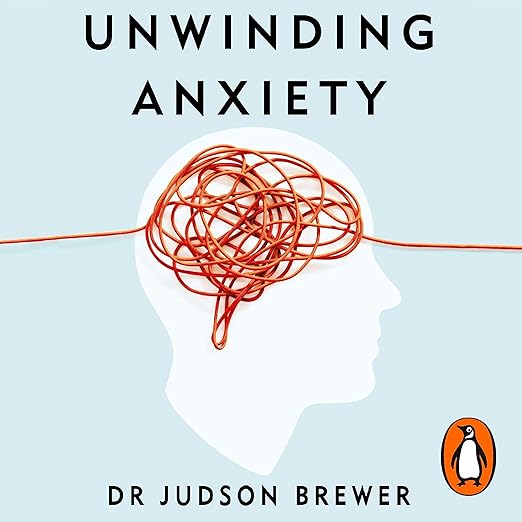
Dr. Judson Brewer built a career mapping anxiety habit loops in the lab, and this audiobook asks a fair question: can the same brain science that treats addiction actually untangle a mind stuck doomscrolling at midnight? Brewer, a psychiatrist and neuroscientist, narrates his own material across seven hours and twenty minutes, distilling more than twenty years of research and clinical work with patients ranging from Olympic athletes to government leaders into a program built around curiosity rather than willpower.
Brewer's core argument reframes anxiety as a habit loop rather than a fixed condition to endure: a trigger, a behavior such as stress eating, procrastination, or doomscrolling, and a reward that keeps the cycle running below the level of conscious choice. Because that loop lives in a part of the brain that resists rational argument, Brewer's proposed fix is not more willpower or more information; it is curiosity, a specific, trainable habit of noticing the loop as it happens instead of fighting it head-on. Self-narration suits this material unusually well, since Brewer is not just explaining a framework he read about, he is describing the clinical mechanism behind his own twenty years of research.
Reviewer S. Field bought a physical copy for a parent who prefers print, a small but telling detail: this is material that translates across formats because the underlying explanations, how habit loops form, why willpower fails against them, hold up whether read or heard. Brewer's own narration adds something a hired narrator could not: the specific, lived authority of someone describing his own lab's findings rather than performing someone else's research secondhand.
Brewer's public profile extends well beyond this book: his research on habit loops and mindfulness has reached wide audiences through talks and media appearances well before Unwinding Anxiety's publication, which means listeners may recognize his voice and central metaphors, the habit loop, the value of curiosity over willpower, from other formats already. That existing familiarity is an asset here rather than a redundancy, since hearing the fuller, book-length version of ideas often encountered first in a shorter talk format tends to deepen rather than dilute their usefulness.
Brewer's own academic and clinical research affiliations give Unwinding Anxiety's claims a specific institutional backing that a more generic wellness-influencer book could not offer. That credibility matters most in the sections asking listeners to trust a specific, sometimes counterintuitive mechanism, treating curiosity as more effective than willpower, since the argument leans on Brewer's research record rather than pure motivational assertion.
The book's structure moves from diagnosis (what a habit loop actually is, neurologically) to practice (specific curiosity-based exercises for interrupting one), a two-part shape that mirrors how Brewer says he actually works with patients in his own clinical practice. Hearing that progression narrated by the clinician himself gives the practice section a credibility a generic self-help audiobook narrator reading someone else's program would have to work harder to earn.
The book's title itself makes a promise worth noting precisely: unwinding, not eliminating or curing. Brewer is explicit that the goal is loosening anxiety's grip through a repeatable process rather than promising a single permanent fix, a more modest and arguably more honest framing than many anxiety-focused self-help titles offer, one that sets realistic expectations before a listener even presses play.
What Works
Self-help audiobooks narrated by their own authors succeed or fail on a simple test: does the author's speaking voice add credibility, or does it expose gaps a professional narrator would have smoothed over? Brewer passes that test because his material is clinical and evidence-based rather than purely motivational; the goal is not to hype a listener into feeling inspired but to walk them through a specific neurological mechanism, and his measured, clinician's delivery matches that goal better than a more theatrical reading style would.
One reviewer's note is worth calling out directly: an Amazon Customer initially expected a book specifically about anxiety and found instead a book about habits, only to realize a few pages in that Brewer explicitly frames habit formation as the mechanism anxiety runs on. That reframe, heard directly in Brewer's own voice explaining his own logic, lands with more clarity in audio than the same disclaimer might on a page a reader could skim past.
Brewer's decision to name doomscrolling specifically alongside older habit categories like stress eating and procrastination signals how directly Unwinding Anxiety is written for a present-day audience rather than a timeless, generic self-help framework. That specificity extends to his discussion of pandemic-era anxiety and political upheaval as concrete, named triggers rather than vague modern stress, which gives the book's examples a groundedness that ages better than more abstract self-help framing tends to.
Before You Commit to Unwinding Anxiety
Listeners expecting a book that addresses anxiety symptoms directly, panic attacks, generalized worry, social anxiety, as discrete topics chapter by chapter should recalibrate: Unwinding Anxiety is built around the habit-loop framework first, with anxiety treated as one prominent instance of that broader mechanism rather than the sole subject under a magnifying glass.
Self-narrated nonfiction by a credentialed expert is generally a strength in this genre, and that holds here, but it does mean the delivery favors clarity and precision over vocal warmth or narrative flair. Listeners who respond better to a more polished, professionally trained narrator's voice for wellness content should sample a clip first to check whether Brewer's clinical register works for their ear specifically.
One reviewer's path into the book is worth flagging directly: an Amazon Customer's review mentions encountering pushback elsewhere that the book is more about habits than anxiety specifically, a concern Brewer actually addresses head-on in his own framing rather than leaving implicit. Listeners who share that same initial hesitation, wanting anxiety addressed directly rather than through a habit-formation lens, should know Brewer makes his case for why the two are inseparable early and explicitly.
Brewer's clinical tone stays consistent whether discussing everyday stress or more serious anxiety patterns, never shifting register based on severity, which keeps the program feeling applicable rather than reserved for only the most extreme cases.
Who It's For
Listeners who want an evidence-based, neuroscience-grounded approach to anxiety and habitual coping behaviors, delivered by the researcher who actually ran the studies, will find real substance here across a manageable seven-hour runtime.
Listeners already familiar with mindfulness-based approaches to mental health, or who have tried and bounced off willpower-based anxiety advice before, are likely to find Brewer's curiosity-based alternative genuinely different rather than a repackaging of familiar advice.
Skip it if you are looking for a warmer, more narrative self-help audiobook built around personal stories rather than clinical mechanism, or if a self-narrated clinician's voice tends to read as dry to your ear rather than authoritative.
Before You Listen
Does Judson Brewer narrate this audiobook himself?
Yes, and his self-narration works well here because the material describes his own clinical research rather than someone else's findings.
Is this audiobook based on peer-reviewed research?
Brewer draws on more than twenty years of his own lab's research and clinical work, including studies with patients ranging from everyday anxiety sufferers to Olympic athletes.