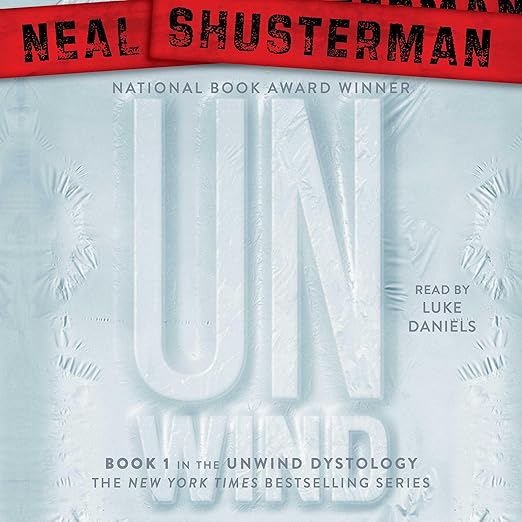
I teach a seminar on speculative fiction and social anxiety, and I return to Unwind in it every year not because it is the most elegant dystopia I know but because it is the most honest about where its premise comes from. The Bill of Life, which allows parents to retroactively terminate their children between thirteen and eighteen through a process of bodily dismemberment called unwinding, is grotesque. It is also a direct and unsparing extension of real political debates about when life begins and who has authority over a body. Shusterman does not argue a side. He builds a world where both sides have made a terrible peace with each other, and then he shows you what that peace costs.
I listened to this on a commute, which in retrospect was the wrong choice. The novel is absorbing in ways that made me miss my stop.
What Neal Shusterman Delivers
The premise does something genuinely difficult: it makes the horror comprehensible. Unwinding is not a secret atrocity hidden from society. It is legal, bureaucratically regulated, and in the case of Lev, treated as a religious tithe by his parents who have spent seventeen years preparing him for it. The social infrastructure around unwinding is as disturbing as the procedure itself because it has the texture of normalcy. Connor is being unwound as a disciplinary measure. Risa is being unwound because the state orphanage is cutting costs. Lev is being unwound out of devotion. Three different justifications, each carrying its own logic, and each one requiring something from society to function.
Shusterman is one of the better YA writers when it comes to trusting his readers with genuine moral complexity. He does not tell you who is right. He shows you how each of these systems of belief operates on the people inside them, and he does it across three protagonists whose perspectives are different enough that the accumulated picture is genuinely multivalent. One reviewer calls it creative genius, and while I would not go that far, the premise is at minimum among the most conceptually committed in the genre.
What Neal Shusterman Gets Right
The multi-POV structure is a significant technical challenge for an audiobook narrator. Connor, Risa, and Lev are not simply different in their situations. They are different in how they process their situations: Connor is reactive and impulsive, Risa is deliberate and strategic, Lev is initially accepting and then, slowly, not. Daniels maintains these distinctions across the full runtime, and the differentiation matters because the novel's emotional argument depends on you understanding each character as a separate consciousness rather than a single protagonist with shifting perspectives. The 10-hour runtime is tight for what the novel accomplishes.
Where Neal Shusterman Loses Some Ground
The early chapters are slower than the premise might suggest. One reviewer specifically notes that the first half did not pull her in, and that experience is consistent with how Shusterman builds his world: carefully, through accumulation of institutional detail, before the plot accelerates. The novel earns its intensity through its setup, but the setup requires patience. Listeners who want immediate action will need to trust that the payoff justifies the early pacing.
It is worth noting that Simon and Schuster Audio's 2020 production is clean and professionally rendered throughout. Luke Daniels has narrated a wide range of science fiction and fantasy, and his facility with ensemble casts means the transitions between Connor, Risa, and Lev never require the listener to actively track whose chapter they are in. The differentiation is built into the performance.
Who Should Pick Up Unwind
This is best for listeners who can handle a dystopian premise that is disturbing rather than thrilling, and who want their YA to engage with real political questions rather than fantasy-adjacent ones. The Shusterman comparison point for fans of Neal Shusterman is relevant: if you have not read Shusterman before, this is one of the best entry points. Skip it if horror registers, even speculative ones, are not for you, or if you need a morally simpler protagonist. Connor in particular is a difficult hero for the first quarter of the novel.