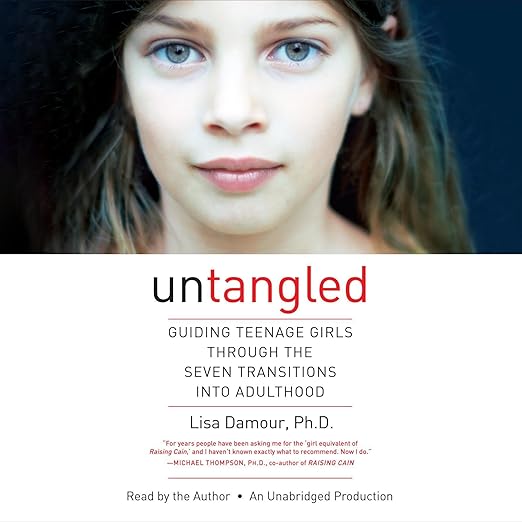
When did your sweet, chatty ten-year-old turn into a door-slamming stranger overnight? That question is exactly what Dr. Lisa Damour spends this audiobook answering, and she does it with an authority that goes beyond the usual parenting-book credentials. Damour worked as an expert collaborator on Pixar's Inside Out 2, and Untangled arrived with a Washington Post endorsement calling it 'the most down-to-earth, readable parenting book I've come across in a long time.' The book organizes adolescent girlhood into seven distinct developmental transitions, from parting with childhood through learning to care for herself, and treats what looks like chaos from a parent's chair as a predictable, even logical, sequence once you know what you are watching unfold.
Seven Transitions, Framed by the Questions Parents Ask
Untangled works as well as it does because Damour resists the two failure modes that sink most books in this category: clinical detachment and alarmist hand-wringing. She writes, and narrates, from decades of clinical experience as a psychologist, but the seven transitions she identifies, parting with childhood, contending with adult authority, entering the romantic world, caring for herself, among others, are described through plain, specific scenarios rather than abstract stages. The synopsis includes a list of the exact questions parents actually ask her: what to do about phone privacy, test anxiety, a friend who self-harms, eating disorder warning signs. That specificity is the book's real spine, more than the seven-stage framework layered on top of it.
The book won a Books for a Better Life Award and landed on the New York Times bestseller list, credentials that matter less here than the fact that Damour is also the author of Under Pressure and The Emotional Lives of Teenagers, meaning Untangled sits inside a broader, consistent body of work rather than a one-off cash-in on a trending topic. Reviewer V. Claire Milam calls it 'one of the clearest and most compassionate books' on adolescent girls' emotional lives, and the praise across all three attached reviews converges on the same point: this is a book parents keep coming back to as specific problems arise, not one they read once and shelve.
Built as a Reference, Returned to in Sections
Structurally, Untangled operates less like a single argument moving start to finish and more like a reference a parent returns to for whichever specific flashpoint is happening right now, rather than a theory absorbed once and filed away. That design choice explains why reviewers describe rereading or relistening to specific sections rather than treating the book as a single cover-to-cover experience, closer in spirit to a manual you consult as situations arise than a narrative you finish once.
Damour's academic background sits alongside a genuine gift for plain language, a combination not every credentialed expert manages equally well in a listen-only format.
Lisa Damour's Calm, Self-Narrated Reassurance
Self-narration by a clinical psychologist discussing her own clinical framework is a genuine asset rather than a nice-to-have. Damour's tone throughout the source material reads as calm and unhurried, the register of someone who has delivered this reassurance to anxious parents in her office hundreds of times, and hearing the author's own voice deliver that reassurance directly carries more weight than a hired narrator reading the same words could manage. Eight hours and thirty-seven minutes of runtime holds real substance, not a padded self-help hour stretched thin, and Damour's pacing across that length suggests someone comfortable holding a listener's attention without leaning on dramatic delivery to do it.
Reviewer EMM describes buying the book because her formerly 'lighthearted and playful' thirteen-year-old had turned 'snarky and moody,' the exact transformation the whole book exists to explain, and reviewer kstevens notes feeling 'better prepared' despite her daughter being only eleven, which speaks to the book's real usefulness before a crisis hits rather than only during one. That preventive angle is worth naming directly: Untangled functions best as a field guide read ahead of the trouble it describes, not a rescue manual reached for only once eye-rolling has already escalated into something scarier.
Parenting audiobooks built around scenario-based advice, rather than checklists or worksheets, tend to translate cleanly to audio, and Untangled fits that pattern: Damour's prose moves through real dialogue-like examples and reasoning rather than fill-in-the-blank exercises or reference tables a listener would need to see on a page. That structural fit is worth naming since not every parenting guide translates equally well to a listen-only format, and this one was clearly written in a voice built for being heard as much as read silently.
Specifically Written for Parents of Daughters
This audiobook is written specifically for parents of daughters, and the synopsis is upfront about that scope: the seven transitions and the sample questions are all framed around girls' experience of adolescence specifically, not a gender-neutral teen parenting guide. Parents of sons looking for equivalent guidance will need to look elsewhere in Damour's catalog or to a different author entirely, since Untangled does not attempt to generalize its framework across genders even in passing references.
A structural note worth flagging: only five total ratings sit on this specific audio edition despite the book's outsized reputation in print, meaning this listing has not accumulated much audio-specific feedback yet, even though the underlying book has been a bestseller for years. That gap is common for backlist nonfiction titles that built their reputation before or outside audio, and it means a prospective listener is relying more on the strength of Damour's print reputation and the Washington Post's endorsement than on a deep well of audio-specific reviewer consensus.
Parents of Daughters Nine Through Eighteen, and Beyond
This is the right pick for parents of daughters roughly nine through eighteen who want language for behavior that otherwise feels unpredictable, plus parents who appreciate a psychologist's voice explaining her own reasoning rather than a ghostwritten summary of research. Anyone already anxious about a specific flashpoint, phone monitoring, dating, disordered eating warning signs, self-harm in a friend group, will find Damour addresses these head-on rather than skating past the hard questions toward safer generalities.
Grandparents, teachers, coaches, and other adults who spend regular time with adolescent girls, not just parents specifically, will also find real use here, since Damour's seven transitions describe developmental patterns visible well beyond the parent-child relationship alone. Anyone in a mentoring or caregiving role who wants to understand why a formerly easy kid suddenly seems unreadable will find the same framework applies even without a direct parenting relationship.
Skip it if you are looking for a book about teenage boys, or if you want heavily research-citation-driven analysis over Damour's more conversational, scenario-based approach. Parents already deep into family therapy for a specific crisis may also find the book's general framework arrives a step behind where they already are, since Untangled is built more for recognizing patterns early than for navigating an acute situation already in progress.