At a Glance
- Performance: Ferdelle Capistrano delivers the Hansen family's creeping dread with restraint, which serves Ania Ahlborn's slow-burn style well, though some listeners may want a harder edge in the more overtly horrifying passages.
- What it covers: Maternal grief and misplaced nurturing, the uncanny child, reality fracturing at the domestic edges
- Feel: Bone-chilling and atmospheric
- Our call: A sophisticated horror audiobook that earns its scares through sustained psychological pressure rather than shock effects, and confirms Ania Ahlborn's standing as one of the most genuinely unsettling writers currently working in the genre.
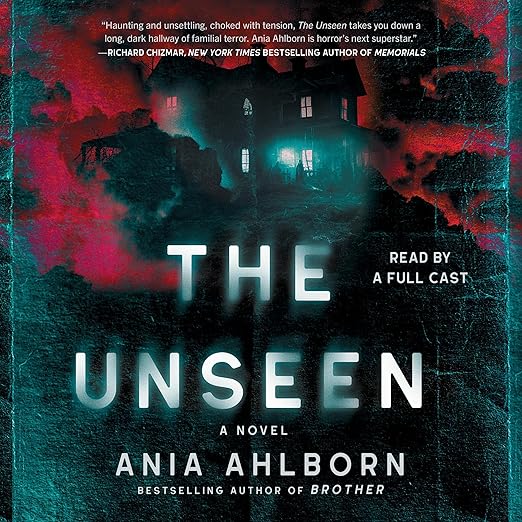
Ania Ahlborn has built her reputation on horror that does not feel borrowed. Her novel Brother has become a touchstone for readers who want psychological dread without the familiar architectures of haunted houses and serial genre beats, and her audiobook Unseen, narrated by Ferdelle Capistrano, pushes that approach further into territory that challenges the reader's sense of what kind of story they are inside. The setup is deceptively domestic: Isla Hansen, reeling from a devastating personal loss, discovers a mysteriously orphaned child near the family's secluded Colorado property. The child is strange in ways that are difficult to articulate. The family notices. Isla does not, or cannot. The tension that builds from this premise is not the tension of surface-level supernatural dread but something slower and more psychologically specific about how grief can distort perception and need.
Capistrano's narration anchors the audiobook in Isla's experience with care. The performance works through register rather than drama, finding the flatness of someone whose grief has numbed them to signals they should be receiving clearly. When the novel shifts perspective to other family members who are watching Isla with increasing alarm, Capistrano adjusts the tone in ways that make those viewpoint transitions legible without jarring the listener out of the story's accumulated atmosphere. The thirteen-hour runtime gives Ahlborn space to develop those perspectives fully rather than rushing from one set piece to the next.
The Child as a Projection Surface for Grief
Reviewer Angela, who describes the previous Ahlborn novel as a disappointment before calling Unseen a return to form, puts it in bone-chilling, graphically well-written territory with multi-perspective storytelling that she found impossible to put down. That assessment aligns with the craft ambitions visible in the synopsis and confirmed by the 4.0 rating from nearly three hundred listeners. Ahlborn's strength has always been her willingness to let horror arrive through accumulation rather than event, and Unseen deploys that patience at full strength across the Hansen household's disintegrating certainties.
The novel is described as pushing the boundaries of horror into a new realm, which is marketing language that can mean very little in practice. What distinguishes this from the typical uncanny-child horror story is the specificity with which Ahlborn renders Isla's psychology. The child does not function simply as a threat; it functions as a projection surface for Isla's grief, a creature that appears where it is needed because need creates it. Whether the horror is ultimately supernatural, psychological, or both is a question the novel deliberately holds open. Ahlborn has produced books in this vein before, and the fan base around her work, specifically the readers who praised Brother as a modern classic, will recognize this ambiguity as a signature rather than a flaw.
Capistrano Can Maintain a Sense of Wrongness
The audio format serves Ahlborn's pacing well. Horror that builds through tone and atmosphere rather than event depends on sustained delivery, and an attentive narrator can maintain a sense of wrongness across long passages where nothing overtly frightening happens. Capistrano's performance keeps that undercurrent running through the quieter chapters without pushing into melodrama. The Colorado setting, with its specific quality of light and terrain, is rendered through sound description in a way that makes the landscape feel isolating in the productive way wilderness settings can in horror fiction.
The multi-perspective structure is another element that audio handles particularly well when a narrator differentiates clearly between viewpoints. Ahlborn gives different family members distinct relationships to the strange child, and those distinctions are meaningful: the husband Luke's skepticism, the five children's wariness, and Isla's absolute conviction that the child is a gift all read differently depending on how far into the story the listener is. Capistrano navigates those relationships without over-explaining the emotional stakes, trusting the writing to carry the weight it was designed to carry. The result is an audiobook where the horror lands cumulatively rather than in isolated moments, which requires both strong writing and a narrator capable of sustaining the temperature across thirteen hours. Capistrano does both.
The Way Love Can Become Distortion
The ending has generated the most divided response among listeners. Reviewer Cindy DiMaggio describes an abrupt conclusion that left many questions unanswered and calls it the weakest element of an otherwise engaging story. This is a fair warning for listeners who require closure at the end of their horror fiction. Ahlborn has always been more interested in the texture of dread than in tidy resolution, and Unseen apparently maintains that preference to a degree that will frustrate some and satisfy others. Listeners who have previously responded well to ambiguous endings in literary horror, who feel that explained horror is diminished horror, will likely find the conclusion consistent with the novel's overall approach.
The thematic material, a mother so consumed by grief that she cannot see what her family sees clearly, is emotionally demanding in a way that extends beyond generic horror discomfort. Ahlborn is writing about loss and the way love can become distortion, and that dimension gives the novel a weight that survives beyond the atmospheric creepiness. Listeners who have experienced complicated grief may find this title particularly resonant in ways that sit outside the usual horror register.
Within the Domestic Horror Tradition of Jackson
This audiobook is for readers who take horror seriously as a literary mode and who are patient with slow-build structure. Fans of Ania Ahlborn's previous work, particularly Brother and her earlier psychological horror fiction, will find Unseen consistent with her best output and worth the thirteen-hour investment. Listeners who prefer event-driven horror, rapid pacing, or concrete supernatural explanations will likely find the ambiguity and restraint frustrating. Anyone who needs full narrative resolution at the end should read the reviewer warnings about the conclusion before committing. Horror readers who enjoy writers like Seanan McGuire, who has praised Ahlborn's work directly, or who respond to the domestic horror tradition of Shirley Jackson, will find this audiobook well within the territory they already know they love.