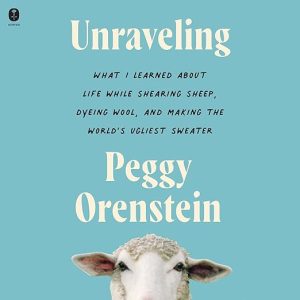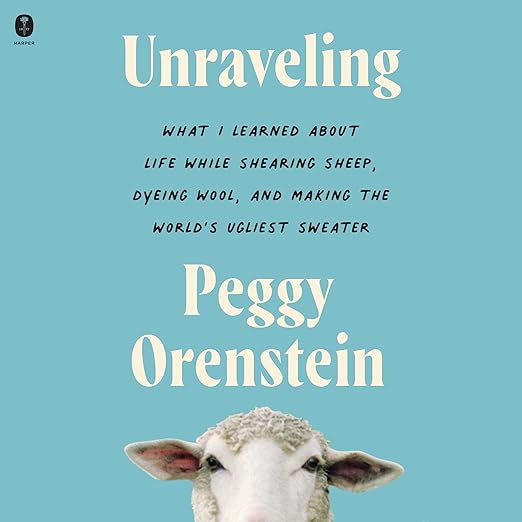
Sheep shearing requires a specific kind of physical confidence - your whole body pressed against the animal, your hands working fast enough that the sheep never has the chance to decide this is a bad idea. Peggy Orenstein describes learning to shear at a farm somewhere in the American countryside during the pandemic, and the way she tells it, she was terrible at first in exactly the ways a lifelong knitter and career writer would be terrible: technically competent at following instructions, physically unconvincing in execution. That scene, early in this memoir and audiobook, sets the register for everything that follows. Orenstein is working with materials - literal and metaphorical - that she does not fully control, and the not-fully-controlling is the point.
The project she set for herself was to make a garment from the very beginning: shear the wool, spin it, dye it, then knit it into a sweater. She had been a lifelong knitter, but the earlier steps were new territory, and the COVID pandemic gave her both the time and the need for something absorbing enough to keep her present while everything else was uncertain. The backdrop of that uncertainty - the deaths of a parent, a daughter preparing to leave for college, the particular kind of aging that is not decline but is also not what you imagined - is what the memoir is actually about. The sweater is the frame; the grief and adaptation are the content.
Orenstein narrates her own audiobook, and that decision is essentially non-negotiable for material this personal. The prose is hers, the voice is hers, and the relationship between the two is the primary reason to listen rather than read. She reads with the tone of someone telling you something true about herself that she has not entirely finished processing - not confessional in the overwrought sense, but immediate in a way that signals genuine investment in what she is saying. One reviewer describes her as a breezy, funny writer who is easy to forget is also an important thinker, and that description maps onto the listening experience accurately. The humor does not announce itself; it arrives as a byproduct of the precision.
The memoir ranges wider than its initial premise suggests. The project of tracing a garment from sheep to finished object turns out to require engaging with climate anxiety, the economics of artisan fiber production, the history of dyeing (Orenstein's section on where color names come from is particularly absorbing), the politics of textile labor, and the question of what sustainability actually means when applied to something as intimate as what you wear. One reviewer calls the book a memoir, a how-to for fiber crafts, a commentary on climate change, and a philosophical inquiry simultaneously, and that is not a stretch. Orenstein is not padding; she genuinely finds all of those threads in the project she undertook.
Listening While Your Hands Stay Busy Spinning
The audio format suits the material in a specific way. Knitting is a tactile practice with a strong oral tradition - patterns are passed by voice, communities gather around shared work, the craft has always been accompanied by conversation. Listening to Orenstein describe the shearing, spinning, and dyeing while you are doing something with your own hands - this is an audiobook that many listeners will put on while engaged in exactly the kind of craft she is describing - feels appropriate to the material in a way that reading her words while stationary would not. A supplemental enhancement PDF accompanies the audiobook for readers who want the visual components.
The pandemic memoir genre has produced a lot of material that uses the COVID period as backdrop without really engaging with what the isolation required of people. Unraveling does something different with that backdrop. Orenstein is not using the pandemic as a readymade explanation for her behavior; she is examining what the particular pressures of that period surfaced in her, and what the particular project of making-from-scratch gave her access to that she could not reach through writing alone. The distinction between doing something because you are stuck at home and doing something because you needed to do it regardless is one the memoir earns rather than assumes.
Grief and Mordanting Techniques, Braided Together
The memoir does not have a plot in the conventional sense. There is a project - the sweater - and there is a timeline - the year of making - but the satisfactions here are accumulative rather than sequential. Readers who need narrative forward momentum to stay engaged may find the essayistic structure requires adjustment. Orenstein is more interested in what each stage of the process reveals than in building toward a climax, and the ending, when the sweater is finished, is deliberately understated. What the project was for, what it changed and did not change, is not resolved so much as acknowledged.
The sections on grief are not segregated from the practical material; they arise within it. Orenstein does not shift registers to do emotional processing and then shift back to discuss mordanting techniques. The emotional content and the craft content are braided, which is structurally appropriate to the subject - the reason she took on the project in the first place was the need to process things that could not be processed through the usual tools of her writing life - and it gives the memoir a coherence that thematically segregated books often lack.
Fans of Orenstein's Earlier Work Will Recognize Her
Listeners who knit, spin, weave, or otherwise work with fiber will find the craft content here genuinely informative and the author's novice perspective a useful guide to the learning curve. Readers drawn to pandemic-era memoirs that engage seriously with domestic practice as a site of meaning-making will find Orenstein's account one of the more substantial entries in that category. Those who know Orenstein's previous work - on girls, on body image, on breast cancer - will recognize the voice and the method. Anyone who requires plot momentum from nonfiction audio will need to make peace with the essayistic structure first. At just under six hours, the runtime is well-matched to the material's scope.
Before You Listen
Does Peggy Orenstein narrate her own audiobook, and does it work for this kind of material?
Yes, Orenstein narrates Unraveling herself, and it is the right choice. The memoir is deeply personal - covering grief over her mother's death, her daughter leaving for college, and the process of aging - and her own voice carries an immediacy that a professional narrator could not replicate. She reads as someone still inside the experience rather than looking back at it.
Is Unraveling a how-to audiobook for fiber crafts or primarily a memoir?
It is primarily a memoir, but one that takes its craft content seriously. Orenstein describes shearing, spinning, and dyeing wool with enough detail that listeners engaged in fiber arts will find it genuinely informative. The craft content and the emotional content are braided throughout rather than separated into distinct sections. A supplemental enhancement PDF accompanies the audiobook for visual reference.
How does this audiobook compare to Orenstein's earlier work on girls and gender?
Unraveling is more personal and essayistic than books like Cinderella Ate My Daughter or Girls and Sex, which are primarily reportorial. The same sharp intelligence and willingness to follow an argument wherever it leads is present, but here the subject is Orenstein herself rather than a cultural phenomenon she is observing from the outside. Fans of her earlier work will recognize the voice immediately.