
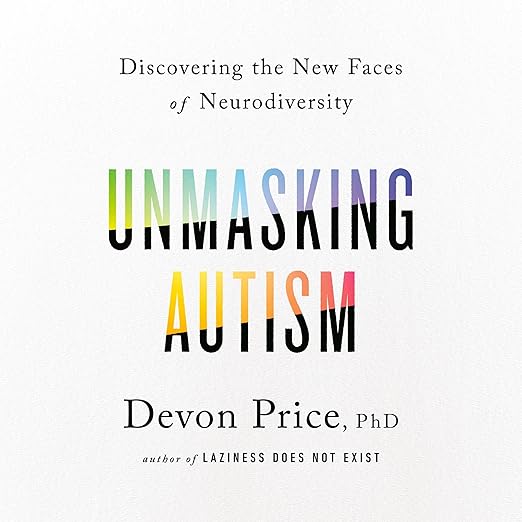
Masking is the word this audiobook is built around, and the description defines it before doing anything else: hiding identifiably Autistic traits in order to fit in, suppressing harmless stims, presenting as unassuming and mild-mannered, forcing yourself into situations that cause severe anxiety so that nobody calls you odd. Devon Price wrote that definition and Devon Price reads it aloud, and the match between author credit and narrator credit here is not a small production detail. It is the argument.
Devon Price Writes from Inside the Mask
Price is doing two things at once and the copy admits to both: a work of social science, with history and research and personal profiles, and a set of prescriptions pointed at the reader's own life. Books attempting both usually fail at one. What holds this one together is that the research and the prescriptions come from the same position, because Price writes as somebody who has masked rather than as somebody studying people who do.
Autistic stays capitalized throughout the description, and that choice announces the book's politics before a single argument arrives. One June 2024 response gets at what the argument does to a reader by recounting its own diagnostic appointment, including being asked whether it preferred the museum or the theater and stalling because the question was too vague to answer honestly. Which museum. What sort of theater. That story demonstrates the subject better than any definition could, and the entry goes on to call the book its new autism-spectrum bible.
Specialists come off badly in that account, and the project explains why. The description says the conversation about autism has been dominated by people on the outside looking in, and a diagnostic encounter is where domination turns procedural: questions written by one group about another and scored by a third. Price does not respond by attacking the instruments. The response is to hand the vocabulary back to the people being measured by them.
Profiles do work here that the argument alone could not. The description promises history, social science research, prescriptions and personal profiles together, and the profiles are what stop a political argument from hardening into a manifesto. A general claim about masking is arguable. A particular person suppressing a particular gesture in a particular office is not, and stacking enough of those makes the general claim feel earned rather than asserted. The recording leaves room for a great many of them.
Exercises for Celebrating and Reframing Autistic Traits
Late diagnosis is where this lands hardest. One July 2024 response reports buying a second copy for its own therapist, on the grounds that the book captures the essence of an experience it had never managed to explain, and notes without complaint the passages that belonged more to Price than to the reader. That is precise praise. It describes a book specific enough to be one person's actual life and general enough to be recognized inside somebody else's.
Exercises are the practical spine, and the description names four of them: celebrating special interests, cultivating Autistic relationships, reframing Autistic stereotypes, rediscovering your values. Each is an instruction rather than an insight, which is unusual in a book this argumentative. The unmasking framework could easily have stayed theoretical. Instead it asks the reader to do things, and the doing is where the risk sits, because unmasking carries social consequences no book can control on your behalf.
Downloadable material ships with the recording, a PDF of exercises, tables, lists and a graph lifted from the book, and here that matters more than it usually does. A book that asks you to complete written work is a book you have to stop and interact with, and audio is the worst available format for that. Anybody intending to actually work through the material will need the file open alongside, which means the recording by itself is not the whole product.
Wrongly Tagged under Children's Health
Tagging on this listing is wrong in a way that could genuinely mislead somebody. The catalog tag reads Children's Health. This is a book by and for adults, largely concerning people who reached adulthood without a diagnosis, and the description states outright that most masked Autistic individuals struggle for decades before discovering who they truly are. A parent buying it as a guide to a young child will find something else entirely, and something a good deal more political than that tag implies.
Outsiders get less than the description promises them. One December 2024 response came to the book after a close friend was diagnosed and reports that it changed how the reader understands autism and neurodiversity, which is a real outcome. It is also the minority use. The prescriptions are written to the Autistic reader in the second person, so a friend or a parent following along is receiving somebody else's instructions and translating as they go.
Prizant is quoted in the description's opening lines, calling this a remarkable work that will stand at the forefront of the neurodiversity movement, and that framing sets up an expectation the book only partly meets. A movement text argues outward, at institutions. This one argues inward, at the reader's own habits of self-concealment. Both are valuable work. Anybody arriving for policy will be handed personal practice instead, and the blurb gives them no warning.
Neurotypical Readers Are Addressed as Bystanders
Therapists, and people who love somebody Autistic, are secondary audiences the book still serves, and one April 2025 response filed from Japan describes precisely that use, reporting a better understanding of people it has known since childhood and a wish to be more compassionate about the misunderstandings. Ten hours inside somebody else's inner life is a large ask, and that entry suggests the time converts into something usable.
Neurotypical readers should expect to be addressed as bystanders rather than as the audience, since that is the design and objecting to it would be missing the point. Anyone wanting clinical detachment, a diagnostic checklist, or a manual for raising an Autistic child has come to the wrong book. Diagnosis arriving late is the situation this was written for, and for the person standing in it, nearly ten hours in the author's own voice is about as direct a form of company as a book can manage.
Before You Listen
Does Devon Price narrate the Unmasking Autism audiobook?
Yes. The narrator credit and the author credit carry the same name, doctoral suffix included. Since the description says Price shares his own experience of masking alongside the research and the profiles, an author-read recording removes a layer between the argument and the person making it.
Is this book about children or about adults?
Adults, despite the Children's Health tag sitting on the listing. The description centers people who passed as neurotypical for decades before working out who they were, and the exercises address an adult reader working on their own life rather than a caregiver managing somebody else's.
What comes with the audiobook besides the recording?
A downloadable PDF holding exercises, tables, lists and a graph taken from the book. Given that a whole section asks the reader to complete written work, that file is closer to essential than optional for anybody who intends to use the book rather than only hear it.







