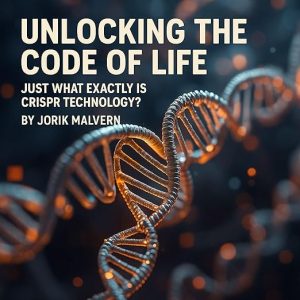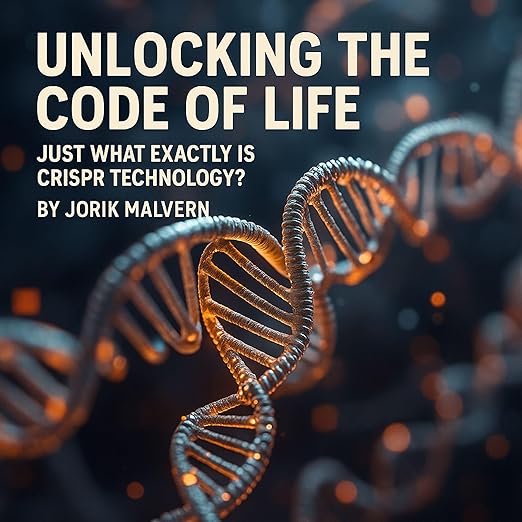
CRISPR arrived in the scientific imagination like a concept from speculative fiction that turned out to be real: a molecular tool capable of finding a specific sequence in billions of base pairs and making a precise cut. Jorik Malvern's Unlocking the Code of Life, narrated by BWC, takes that arrival seriously. The audiobook builds from the fundamentals of genetics through to the current state of gene editing technology and the ethical landscape that technology has created. At three hours and twenty-one minutes, this is a short audiobook for a large subject, but within its scope it is remarkably complete, and the 59 ratings at a 5.0 average suggest an audience that found exactly what they came looking for.
The audiobook belongs to Malvern's Simple Science series, which signals its approach: rigorous popular science rather than either elementary primers or academic texts. Unlocking the Code of Life achieves that positioning by making the Cas9 enzyme, base editing, and prime editing genuinely comprehensible to a general listener without stripping out the complexity that makes the subject matter significant. That balance is harder to maintain than it sounds, and Malvern earns it through clear structural choices throughout.
Malvern's structural choice is to trace the genealogy of CRISPR rather than simply describing what it is and what it does. The book begins with early farmers practicing selective breeding without any understanding of what they were manipulating, moves through Gregor Mendel's pea plant experiments, traces the double helix discovery, the Human Genome Project, and finally arrives at CRISPR as the culmination of a continuous scientific trajectory. That framing gives the technology a context it often lacks in shorter-form popular science coverage, where CRISPR appears as if it emerged from nowhere in the 2010s.
The analogy Malvern uses for CRISPR-Cas9, molecular scissors guided by a GPS map, is familiar from other popular science treatments, but he does not rest on that comparison. He pushes further into how the targeting works, why the precision matters, and what the practical difference is between a cut that repairs correctly and one that introduces an unintended change. The distinction between early CRISPR applications and the newer tools of base editing and prime editing is handled with genuine clarity, showing how quickly the technology has advanced beyond its initial form and what that progression means for both its promise and its risks.
The reach of the content is broad. Malvern covers CRISPR applications in medicine, including work on sickle-cell anemia and hereditary disease. He covers agriculture, from drought-tolerant crops to virus-resistant plant strains. He covers ecology, including gene drives designed to spread edited traits through wild populations. And he covers biotechnology's expanding frontier in ways that resist easy summary. That range within a three-and-a-half-hour runtime requires selectivity, and Malvern makes his choices well.
Pandora's Box Framing the Book Earns
The audio format suits this material because CRISPR's story is genuinely narrative in structure. It has discovery moments, competitive races between laboratories, ethical crises, and pivotal decisions made by real scientists under real pressure. Malvern presents that story with storytelling flair, and the BWC narration delivers the descriptive and explanatory passages cleanly enough that the narrative forward motion is maintained. Listeners who approach this as a science story rather than a science lecture will find the format works in their favor.
The ethical sections are where Unlocking the Code of Life distinguishes itself most clearly from a purely explanatory primer. Malvern does not simply note that CRISPR's possibilities raise questions. He engages with the specific debates: heritable versus somatic editing, the difference between correcting disease and enhancing traits, the governance questions around who controls access to these technologies, and the ecological risks of gene drives in wild populations. The Pandora's box framing in the synopsis is not rhetorical shorthand. The book earns it by showing what has already been done, not just what might be possible, and by asking who should be making these decisions.
Synthetic Voice Meets Heritable Editing Questions
The BWC narration is the audiobook's primary limitation. The synthetic delivery handles the descriptive and explanatory passages competently, but the philosophical and ethical sections carry moral weight that a synthesized voice does not convey with the same gravity a human narrator would bring. When Malvern asks whether editing heritable human genetics should be permitted, those questions deserve the texture of human hesitation in their delivery. BWC delivers them clearly but without that texture, and for a book where the ethical stakes are meant to be felt as well as understood, that is a meaningful gap.
The three-and-a-half-hour runtime also means the book has genuine scope limitations. CRISPR's applications in agriculture, medicine, ecology, and the broader humanities of genetic ethics each merit far longer treatment than Malvern can provide within this length. The book works as an orientation, not a comprehensive treatment, and listeners who want a definitive deep dive into any one of these areas will need to follow up with more specialized reading. Jennifer Doudna's A Crack in Creation, written by one of CRISPR's co-developers, provides a longer and more personal account for those ready to go further.
General Readers Get the CRISPR Story Straight
This audiobook is well suited to general readers who have encountered CRISPR in news coverage and want a structured understanding of what it is, where it came from, and what it actually means for medicine, agriculture, and the future of species including our own. It is also a strong entry point for students approaching genetics or bioethics for the first time who want narrative context before engaging with more technical material. Listeners who already have a scientific background in genetics will find the historical narrative valuable even if the science itself is familiar ground, and the ethical sections are worth hearing regardless of prior knowledge level. At three hours and twenty-one minutes, this is an accessible commitment that delivers genuine substance within its scope.
- Read by: BWC narration delivers the scientific explanations clearly, though the synthetic quality creates some distance from the more philosophically charged sections.
- At its heart: CRISPR as scientific breakthrough, genetic editing ethics, the gap between biological possibility and moral permission
- Vibe: Engaged and intellectually curious, building to genuine moral complexity
- Short version: An impressive primer on CRISPR's history and implications that earns its exceptional rating by treating both the science and the ethics with real seriousness.
Before You Listen
Does this audiobook assume prior knowledge of genetics or molecular biology to follow the CRISPR explanation?
No. Malvern builds from first principles, starting with selective breeding and Mendel's experiments before reaching CRISPR. General listeners without scientific background should be able to follow the entire arc. The Simple Science series this belongs to is explicitly designed for informed general readers rather than specialists.
Does the Unlocking the Code of Life audiobook cover the ethical debates around CRISPR or just the science?
Both, with genuine depth on the ethics. Malvern engages with specific debates around heritable editing, enhancement versus disease correction, ecological risks of gene drives, and governance questions about who controls these technologies. The ethical sections are treated as seriously as the scientific ones throughout.
Is three and a half hours enough to genuinely understand CRISPR technology from this audiobook?
Enough to understand the science clearly and engage with the ethical implications meaningfully, yes. Enough to have comprehensive coverage of any individual application area, no. Malvern's audiobook works as a serious orientation that prepares listeners to engage with more specialized reading on any dimension of CRISPR they want to pursue further.